
Okay, I need you to sit down for this one.
Scientists have discovered that some of the most resilient ancient rock art in the world was painted with... human blood.
And before you start conjuring images of ancient sacrifice rituals, let me tell you the whole story—because it's actually way more interesting (and a lot less horror-movie) than you'd think.
The Cliff Paintings That Wouldn't Quit
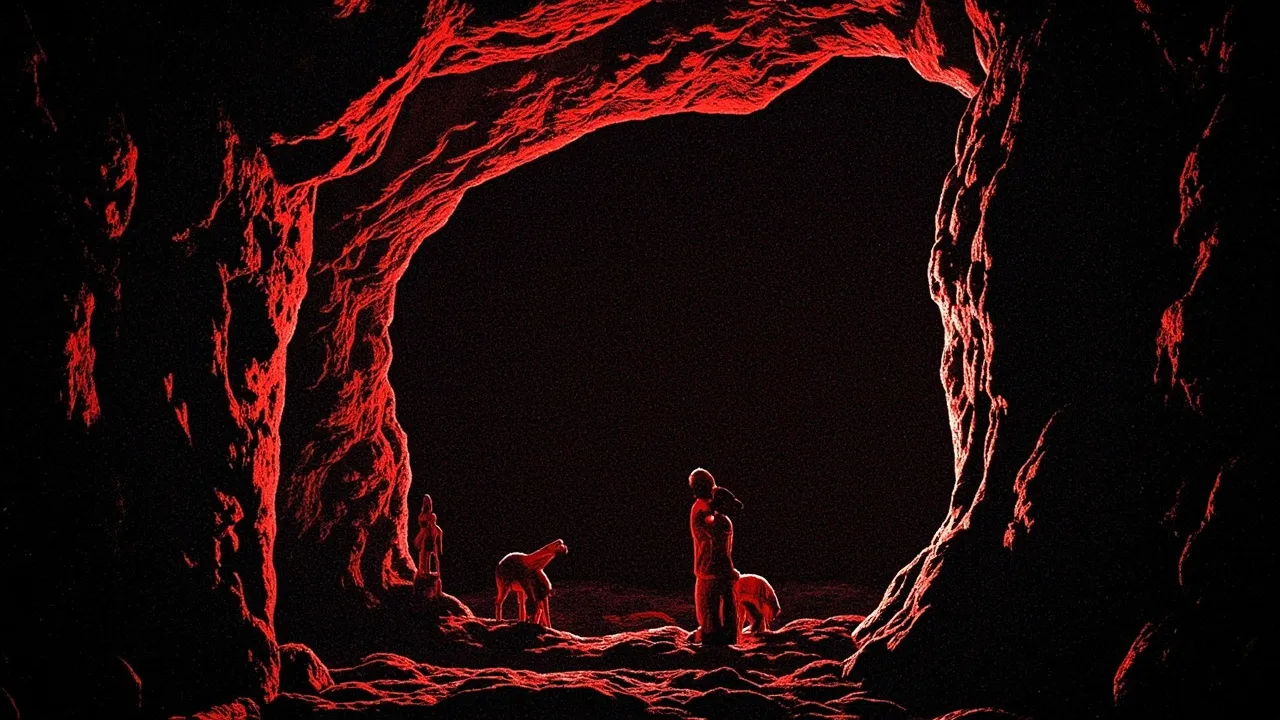
Picture this: you're standing along the Zuojiang River Valley in southern China, looking up at these massive limestone cliffs. And painted across them, in brilliant red that somehow still pops after almost two millennia, are these incredible figures depicting what appear to be sacred rituals. We're talking about the Huashan Rock Art Cultural Landscape—some of the best-preserved prehistoric art on the planet.
Here's the wild part: this region is a tropical monsoon zone. We're talking scorching heat, extreme humidity, and torrential rainy seasons that would absolutely destroy most pigments over time. Yet these paintings? Pristine. Not faded. Not peeling. The pigment is actually bonded so tightly to the rock that when pieces break away, it's the stone that goes, not the paint.
How, you ask? Researchers have been wondering the same thing for years.
The "Macabre" Discovery
Enter Meng Wu, a chemist at Shandong University, who decided to get to the bottom of this mystery. She collected some fragments that had fallen from the cliffs and ran them through some serious chemical analysis—multiple types of spectroscopy and proteomics (which looks at proteins at a molecular level).
What she found made her do a double-take.
The red pigment was made from iron-rich clay containing nano-hematite (basically, fancy red dirt). But the binder—the stuff that holds pigment together and attaches it to surfaces—was made from lime... and blood.
Specifically, human blood.
Now, I know what you're thinking. Bloodletting? Human sacrifice? Some kind of dark, forbidden ritual?
Here's where it gets fascinating. Wu doesn't think so.
The Beautiful Hypothesis
The Luoyue people who created these paintings were ancient hunter-gatherers living in a matriarchal, matrilineal society—meaning they traced their family lines through the maternal side. And if you look closely at the murals, you'll see scenes of pregnant women and childbirth.
Wu's theory? The blood probably came from menstruation or childbirth.
Think about that for a second. These ancient people may have been using something profoundly biological—something intimately connected to life, fertility, and womanhood—as the binding agent for their sacred art. Rather than being macabre, it's almost poetic.
The researchers also found traces of bovine blood (from hunted animals), so it wasn't exclusively human. But the proteins that stood out most—prolactin-inducible protein and lactoferrin—are present at much higher levels in pregnant or recently-pregnant females.
How It Actually Worked
Let me break down the science (because it's genuinely cool):
The Luoyue would have created their paint by mixing slaked lime (calcium hydroxide) with calcium phosphate and blood, then painting this mixture onto the limestone cliffs. The red pigment went on top. As the base mixture reacted with carbon dioxide in the air, it formed calcium carbonate—but the blood proteins essentially biomineralized this into an incredibly dense crystal structure. This created a super-strong bond between the pigment and the stone.
The blood proteins essentially acted like tiny biological workers, building a microscopic fortress around each particle of red pigment and fusing it permanently to the rock.
And get this: you don't need much blood to make this work. A relatively small amount could cover large stretches of cliff face.
What This Changes About Ancient Art
Here's what really got me about this study: Wu says these findings suggest that creating long-lasting prehistoric rock art was "a technically intensive project rather than a labor-intensive one."
In other words, these weren't just people smearing dirt on walls. They were engineers—figuring out complex chemical processes to make their art survive the ages. They understood material science, even if they didn't have our vocabulary for it.
And the fact that they may have chosen blood as their binding agent? That tells us something profound about how they thought about art, fertility, and the sacred. This wasn't random. It was deliberate, meaningful, and deeply connected to their understanding of life itself.
The Bottom Line
So the next time you see a picture of these ancient Chinese cave paintings—still vivid, still striking after thousands of years—remember that you're looking at something made with blood, sweat, and a whole lot of ancient ingenuity.
But probably not the kind of blood you'd expect.