
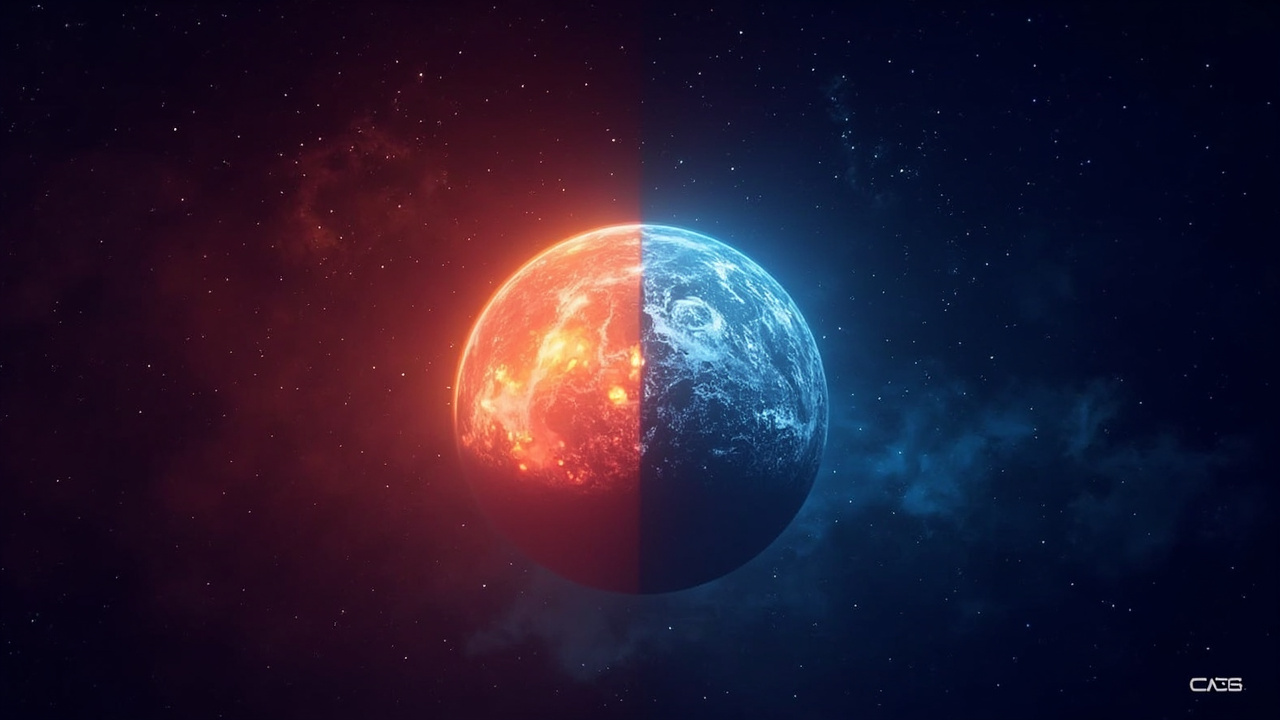
A World Where the Sun Never Moves? Yeah, That's Real.
Alright, let me share something that sounds like it belongs in a sci-fi novel, except it's completely factual.
Say hello to LHS 3844b — a planet hanging around 48 light-years from us. And "weird" doesn't even begin to cover it.
One hemisphere bakes in eternal, unforgiving daylight. We're talking heat intense enough to vaporize anything you consider a body — roughly 2,000°F. Meanwhile, the opposite side drowns in complete blackness. I'm not talking about a long winter night here. This is approaching absolute zero, where molecular motion basically stops. As cold as physical matter can possibly get.
The really bonkers part? This isn't temporary. There's no rotation bringing relief. No sunset to break up the monotony. The same scorching day, the same frozen night, locked in place for eternity.
So... What Causes This?
Scientists call it "tidal locking," and honestly, it sounds like something a vengeful god would design as punishment. Here's what's actually happening:
The planet rotates at the exact same speed it revolves around its star. Picture spinning a basketball on your fingertip — one side stays up, one side stays down. Same idea. One hemisphere permanently faces the star; the other turns away forever.
Here's what gets me: this might be more typical than planets with normal day-night cycles like Earth. When a planet orbits close to its star — which happens all the time — tidal locking becomes essentially guaranteed. Physics doing its thing.
The Pessimistic View (And Why It's Changing)
My first reaction to learning about these planets? "Hard pass on real estate there." You've got frying or freezing with nothing in between. No hospitable middle ground for life as we understand it.
For years, scientists basically agreed. These worlds seemed like barren wastelands. Way too harsh. Way too extreme.
Then a fresh study in Nature Communications flipped that narrative, and honestly? It gives me hope.
Building an Alien Planet in a Laboratory
This is the part I love. Researchers led by Daisuke Noto from the University of Pennsylvania didn't just run computer models. They got hands-on.
Fair warning: they didn't literally construct a planet. Would've been impressive, but budget constraints exist.
What they did build was a small container filled with glycerol — thick, syrupy liquid — mixed with tiny particles that shift color based on temperature. Picture a lava lamp, but engineered for science instead of 70s aesthetics.
They installed heaters and coolers to create temperature differences across the tank, simulating the extreme gap between a tidally locked planet's day and night sides.
The goal, according to Noto, was to observe heat circulation through a planet's interior over extended periods.
What They Discovered Was Genuinely Elegant
Here's where it gets fascinating. The results showed a remarkably orderly pattern.
Hot fluid rose beneath the day side, traveled across the surface, cooled as it reached the night side, sank down, then flowed back underneath. One continuous cycle — like a planetary assembly line, endlessly moving. Steady. Consistent. Almost calming to observe.
"It's not turbulent like Earth's mantle," Noto pointed out. "It's slow and stable. Predictable. Maybe even a little dull — and that's actually a good thing."
Dull sounds negative, but it's a win here. Earth's mantle is chaotic. Unpredictable. Plenty of random hotspots and shifting plates. Great for geological drama, but maybe not ideal for keeping conditions stable enough for life.
This alien setup? It just functions. Smoothly. Efficiently.
That Sweet Spot Exists
Here's the most exciting implication: this circulation pattern could generate temperate regions — especially in mid-latitudes — where conditions might actually be livable. Not vacation destinations, necessarily. But survivable? Possibly.
The team measured heat transport rates similar to Earth's mantle, suggesting these planets could sustain localized geothermal pockets. Imagine standing near a warm vent in frozen tundra. The planet overall might be hostile, but specific zones could be surprisingly comfortable.
What This Means for Finding Extraterrestrial Life
This genuinely excites me.
Our current hunt focuses on Earth 2.0 — a planet mirroring ours with comparable temperatures, atmospheres, and general habitability. Makes sense. We're searching for familiar conditions because familiar conditions definitely support life.
But this research hints we're overlooking something bigger. Life elsewhere might not require Earth-like environments at all. It could flourish in places we'd immediately dismiss as too extreme. Adapt to temperature swings that would annihilate anything we know. Find a way.
Scientists call these "temperate niches" — small zones of balance within otherwise extreme environments. And if these niches exist on tidally locked worlds, suddenly the universe looks a lot more crowded with potential homes for alien life.
The Wrap-Up
So next time someone insists alien life needs beaches, blue skies, and regular sunrises — mention LHS 3844b. Tell them about a world with no dawn, no dusk, and temperatures that sound ripped from a nightmare.
Then mention that, based on this research, life might survey those conditions and think, "Actually, I can work with this."
Because that's kind of beautiful, isn't it? Life carving out existence even on a world where one half burns perpetually and the other freezes colder than space. That gives you something to feel hopeful about.
Now, if you'll excuse me, I'm going to go appreciate that Earth rotates at just the right speed to gift us actual sunrises and sunsets. We really do live in a pretty nice corner of the universe.