
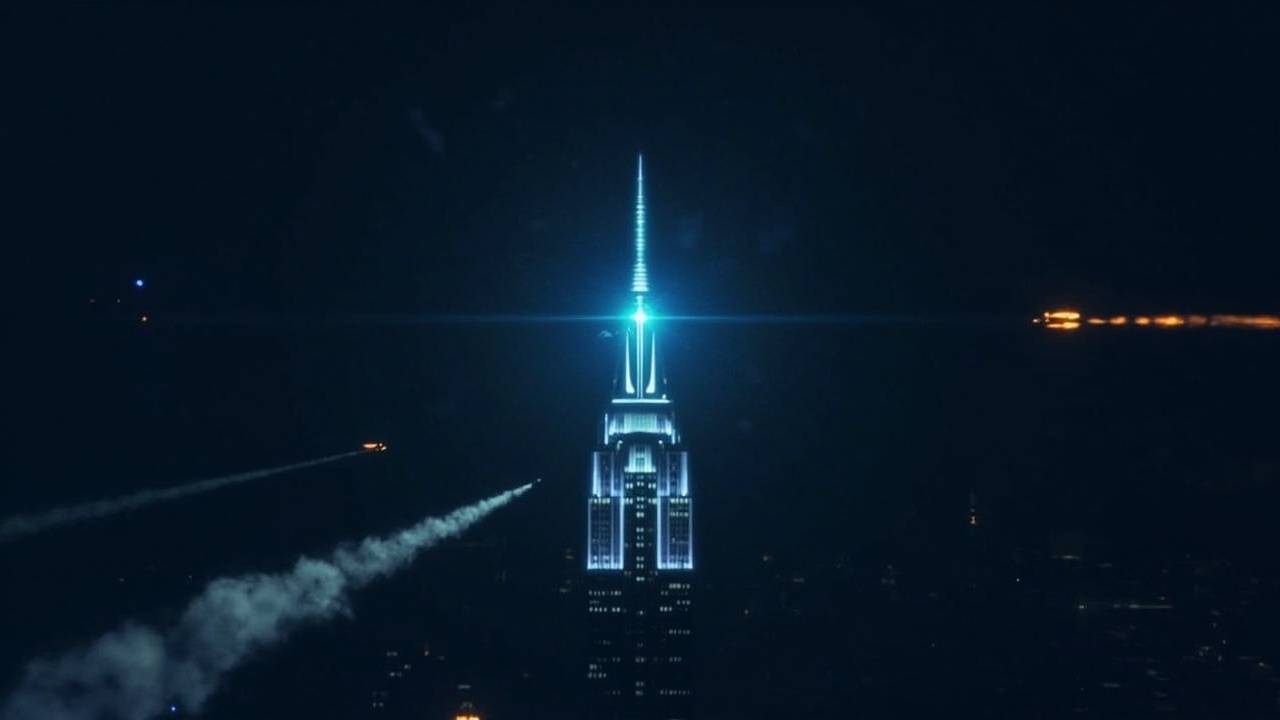
The Day a War Machine Met a Skyscraper
Every time I come across this story, I have to double-check that it's real. A military bomber — the kind you'd expect to find overseas fighting in the war — slammed into one of New York's most iconic structures.
And yet it happened. Just like that.
On the morning of July 28, 1945, a U.S. Army B-25 Mitchell bomber struck the Empire State Building. Here's how it went down.
Meet the Pilot
The man behind the controls was 27-year-old Lieutenant Colonel William Franklin Smith Jr. This wasn't some rookie — Smith had graduated from West Point and earned two Distinguished Flying Crosses. He'd flown over 100 combat missions. When you picture someone qualified to pilot a twin-engine bomber, Smith fits the description perfectly.
His assignment that day? Fly from Bedford Army Air Field in Massachusetts to Newark Airport, pick up his commanding officer, and head back to South Dakota. A simple transport run. Nothing dramatic.
War was winding down, but military schedules didn't care about convenience.
A Decision That Cost Everything
Smith was supposed to touch down at Newark by 10 a.m. Weather had other plans. Fog rolled in, visibility tanked, and delays piled up. Rather than admit he'd arrive behind schedule (turns out military pride works the same as everyone else's), Smith made a fateful choice: he'd navigate under visual flight rules.
Translation? He planned to fly below the cloud cover and use landmarks to guide himself.
Over Manhattan.
In thick fog.
He took off at 8:55 a.m. Rain came with him. By the time he approached New York, conditions had deteriorated badly. La Guardia's tower suggested he land there instead. Smith declined. The fog was so dense that controllers warned him they couldn't even spot the top of the Empire State Building.
That should have been his cue. It wasn't.
At 9:49 a.m., Smith flew into the building's north face between the 79th and 80th floors.
What Happened Next
The bomber punched an 18-foot-wide, 20-foot-deep hole through the structure. One engine tore completely through the building, arced across the street, and ignited a fire in a rooftop penthouse. Chunks of wreckage scattered across nearby rooftops.
The damage was staggering. The casualties could have been worse — much worse.
Saturday Morning Luck
The crash happened on a Saturday. July. Before most offices opened.
As it stood, 14 people died: 11 building occupants (office workers, maintenance staff, an elevator operator) and all three crew members. Horrible? Absolutely. But run the numbers on a weekday morning in the financial district, and those figures would look completely different.
The universe, it seems, gave New York a small mercy that day.
The Elevator That Defied Gravity
Among the casualties was elevator operator Betty Lou Oliver — or so you might think.
Here's what actually happened: one of the falling engines severed 16 elevator cables. Betty Lou's car dropped. Seventy-five floors. Over 1,000 feet of freefall.
She lived.
How? A collapsed pile of severed cables at the shaft's bottom absorbed some impact. The elevator's emergency brakes kicked in just enough to matter. Rescuers pulled her from the wreckage.
Betty Lou Oliver still holds the world record for surviving the longest elevator fall in history.
The Building That Stood
Here's what still gets me: the Empire State Building absorbed a direct hit from a 19,000-pound bomber and didn't collapse.
Steel-frame skyscrapers don't typically shrug off midair collisions. They shouldn't. But this Art Deco giant took the blow, held its shape, and stayed open for business.
Repairs ran about $1 million in 1945 dollars — roughly $15 million today. Expensive, yes. Catastrophic? No.
The building remained the world's tallest until 1971. Nearly eighty years later, it still dominates the Manhattan skyline, still draws millions of visitors, still stands as a monument to stubborn engineering.
What This Story Tells Us
I've thought about this incident for years, and I keep coming back to one lesson about human judgment.
Smith had every qualification. Hundreds of missions, decorations, training. And still, for entirely human reasons — not wanting to seem late, feeling capable enough to push through — he made a call that ended 14 lives.
We all do it. Downplaying risks, stretching rules, convincing ourselves we've got this. Sometimes it works. Sometimes the fog doesn't lift.
The Empire State Building still rises above Fifth Avenue. Most people walking past never know what happened there. But if you ever find yourself standing at its base, looking up at that distinctive spire, remember what it survived.
Some structures refuse to fall. And some stories deserve to be told.