
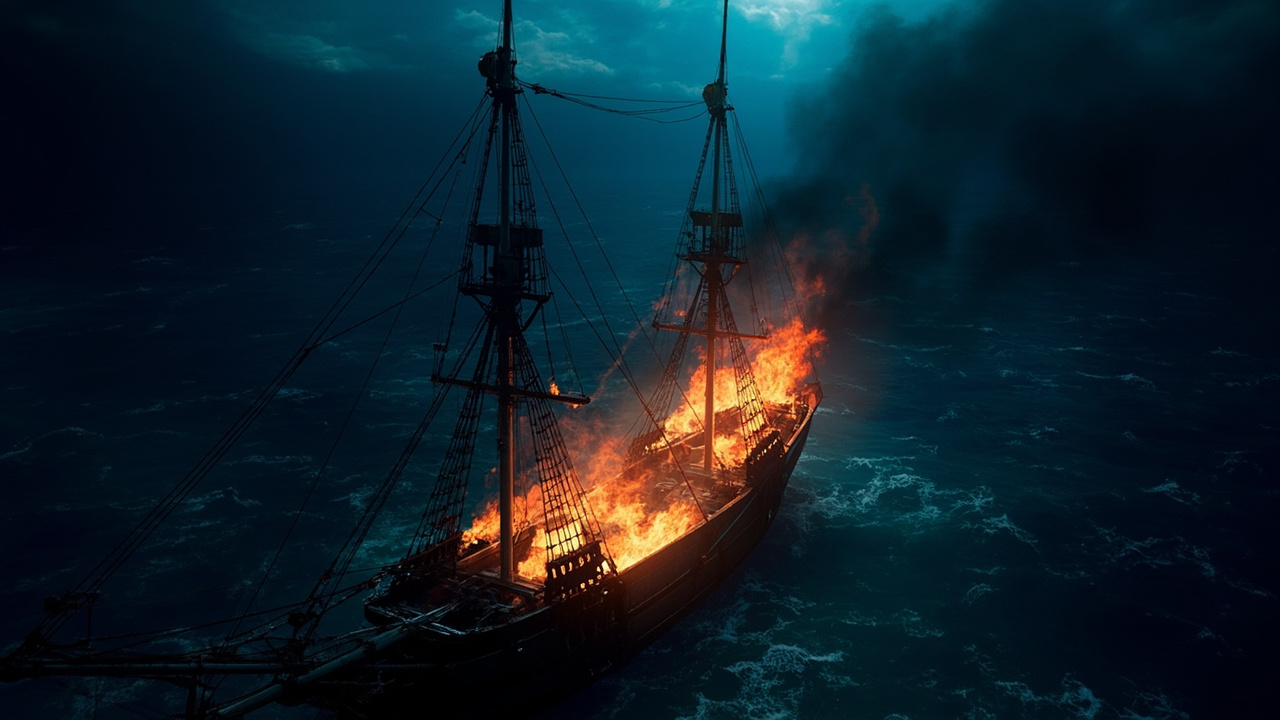
The Pirates Who Destroyed Their Own Ships (And Why It Backfired)
Picture this: you're a wanted criminal with no legal rights, facing execution if caught. Your solution? Torch your own property and hope the evidence burns with it. Sounds extreme, right? But for pirates during the Golden Age of piracy, setting fire to your own ship wasn't just common practice — it was survival strategy.
Here's the thing though: water and fire don't always mix the way you'd expect. Sometimes, burning a ship means sinking it to the bottom of the ocean, where centuries later, archaeologists can still find every single piece of evidence you tried to destroy.
That's exactly what might have happened to Henry Avery.
The Man Who Started Everything
Before Blackbeard terrorized the Caribbean, before Calico Jack Rackham flew his skull-and-crossbones flag, there was Henry Avery — and this guy was on a completely different level.
In 1695, Avery commanded a 46-gun vessel called the Fancy and pulled off one of the most lucrative heists in maritime history. He and his crew looted an Indian ship carrying treasure worth roughly $114 million in today's currency. We're talking gold, silver, diamonds, emeralds, sapphires — the whole collection. After that score, most people would be hiding in a cave somewhere, never showing their face again.
But Avery had something else in mind. Instead of living life on the run, he actually talked King William III into granting him a full royal pardon. Then, get this — he went to work as a spy for the British Crown. From plundering high seas commerce to covert intelligence work? That's one career transition nobody saw coming.
Chasing Ghosts in Bahamian Waters
Now, researchers believe they might have finally found what remains of Avery's infamous ship. A group of underwater archaeologists, led by Sean Kingsley (who has personally explored over 350 shipwrecks and literally authored the definitive book on pirates), spent an entire year searching the waters around Nassau in the Bahamas.
Think about that location for a second. The Bahamas wasn't just any pirate hangout — it was the actual headquarters of piracy during its golden era. Blackbeard used these islands as his base. Calico Jack Rackham plotted his courses from here. Stede Bonnet, the gentleman pirate who somehow abandoned a comfortable life as a wealthy plantation owner to become an outlaw, also operated in these very waters.
Yet as Kingsley pointed out, "nobody knows anything about this magical place." The researchers were given special permission to explore Nassau Harbour — marking the first time anyone had official clearance to dive there. When scientists ask permission to search a location that history basically forgot, you know something important might be hidden beneath the surface.
Something Hiding in Plain Sight
When the team finally descended into the water, they discovered something remarkable: the burned skeleton of a wooden ship. The hull had been deliberately set on fire, then weighted down with rocks used as ballast, sending it straight to the seabed where it remained hidden for over three centuries.
The pirates who did this knew exactly what they were doing. With authorities closing in and no legal standing to protect them, destroying the ship meant destroying proof of their crimes. No vessel, no evidence of piracy. It was a calculated decision — arson as a survival tactic.
But they couldn't have predicted that centuries later, technology and determination would bring everything back to the surface.
More Than Just a Burnt Hull
The discovery went far beyond a destroyed wooden frame. The archaeologists uncovered a snapshot of pirate life, including:
- Two corroded iron cannons still lying where they fell
- A grinding stone that crew members used to sharpen their blades
- Fragments of rigging and bricks from what was once the ship's kitchen
- Wine bottles (because apparently, pirates enjoyed the finer things too)
- Twenty-five lead musket balls carefully stacked together
- Clay smoking pipes decorated with detailed sculptures of lions and unicorns — these weren't cheap mass-produced items, but luxury goods meant for the English pirate elite
That detail about the unicorn pipes really gets me. These weren't rough sailors scraping by. They were sophisticated operators with taste and connections to the upper crust.
Kingsley described the moment he realized what they'd found: "Suddenly, my heart starts pounding... There's wood on the seabed. Maybe this might be the Fancy that we've been looking for this whole time. You forget about time. You forget that you're diving. You're just focused on this moment."
The Bigger Picture
Why would pirates destroy their own ships? Because they had absolutely no legal protection. In the 17th and 18th centuries, captured pirates faced execution without exception. When your options are "get caught and die" or "burn everything and maybe escape," destroying evidence suddenly makes perfect sense.
The Fancy's crew made a choice: burn their own vessel rather than face the gallows. They succeeded in staying hidden for over 300 years.
But here's the irony they never anticipated — their desperate act of destruction actually created a perfectly preserved time capsule. Shipwrecks that were deliberately sunk rarely scatter across the ocean floor. Instead, they settle in one place, protected by layers of sediment, waiting for someone to piece together what happened.
What's Coming Next
This discovery is just the beginning. The research team suspects additional wrecks might be buried deeper in the sediment, holding more artifacts and stories. Each finding adds another layer to our understanding of who these people actually were — not the cartoon villains from movies, but real individuals making difficult choices in dangerous times.
We're learning about pirate culture, their daily lives, their trading networks, their social hierarchies. From Captain Blood to Jack Sparrow, fictional pirates were inspired by real people like Henry Avery. Now we have a chance to separate fact from legend.
Why This Matters
What draws me to archaeology is the reminder that history isn't just names and dates frozen in textbooks. It's made up of actual human beings facing real decisions in specific moments. These pirates weren't one-dimensional villains — they were complex individuals navigating an incredibly risky world, sometimes with surprising sophistication and style.
A burned ship surviving 300 years underwater, patiently waiting for the right person to find it, carries its own kind of poetry. Avery and his crew thought they were erasing their tracks forever. Instead, they were preserving a record that would eventually tell us more about their lives than they ever imagined possible.
If this wreck truly belongs to the Fancy, we've found the ship of the man who sparked the Golden Age of Piracy. The original pirate king. And honestly, I can't wait to see what else surfaces from those Bahamian waters.