
Let me be honest with you — before diving into this topic, I assumed Arctic sea ice was pretty straightforward. Chunks of frozen stuff, wind pushes, ice moves. Basic physics, nothing fancy.
Turns out, I couldn't have been more off base.
The Reality Is Messier
Here's what baffled researchers for longest time: sea ice in the Arctic simply refuses to follow the patterns that wind-based models predicted. Occasionally it zips along faster than expected. Other times it crawls. And the way it spreads across the ocean? Way slower and more gradual than any calculations suggested.
Scientists threw out various theories. Unusual wind currents. Hidden ocean movements. Cracks and fractures in the ice itself. But a fresh piece of research from UC Riverside points to something far more basic — and honestly, when you really think about it, kind of charming.
The answer is collisions. The ice pieces keep bumping into each other.
A Visual Worth a Thousand Words
The study's lead scientist, Bhargav Rallabandi, described it in a way that made me smile: pack a bunch of ice floes together, add some wind, and they crash into one another, passing energy along like a chain reaction. According to Rallabandi, that's literally all it takes to account for what scientists observed.
No need for complex ocean mechanics or exotic forces. Just slabs of floating ice bumping shoulders, similar to children squeezed together at a busy playground.
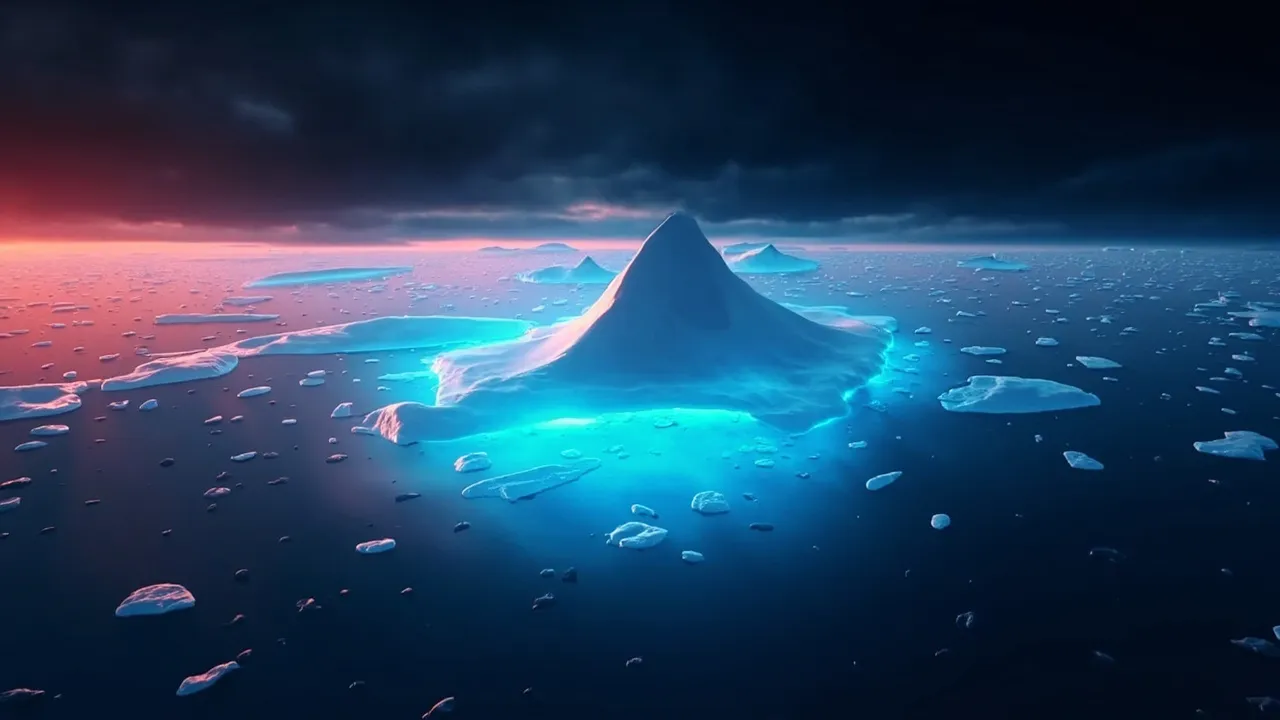
The Arctic isn't a single frozen layer, obviously. It's riddled with thousands of separate floes, some barely a few meters wide, others stretching for kilometers. Wind does push them, causing them to drift and gradually separate. But here's the catch: they're floating in water and often bunch up densely.
When floes get packed into tight quarters, they collide constantly — more frequently than the wind even shifts direction. And each collision saps a tiny bit of energy from the whole system. Think of every bump as a mini brake, keeping the ice from endlessly accelerating whenever wind picks up.
Testing the Theory
To see if this held water, the researchers built a computer simulation treating ice like grains of sand trickling through an hourglass — except these grains bob in seawater and get battered by gusty winds. Their model factored in ocean resistance plus countless repeated collisions between neighboring floes.
They validated their approach against data from the Fram Strait, that striking corridor between Greenland and Svalbard where enormous quantities of Arctic ice flow toward the Atlantic.
The outcome? Their simulation successfully matched three puzzling real-world observations: the speed of ice spreading, the variation in individual floe velocities, and how ice movement changes over hours and days. All achieved simply by incorporating collision dynamics.
Why Should You Care?
This is where things get genuinely fascinating — and a touch concerning.
As global temperatures climb, understanding sea ice movement grows ever more critical. Both the total ice coverage and individual floe sizes determine how often collisions occur. Those collisions then control how quickly ice fields spread and ultimately where they accumulate.
Rallabandi noted this model could help scientists explore whether shifting ice conditions might let floes drift apart more readily and float into warmer waters — melting faster in the process. It's a feedback loop we urgently need to comprehend.
There's also value for climate science itself. Current global climate models simply can't track every single floe across the entire Arctic — there are too many, and they're too tiny. But now researchers have a physics-based approach that captures these interactions without simulating each piece individually. That's a major leap for improving climate forecasts.
The Elegant Truth
What strikes me most about this research isn't necessarily its practical value — it's the lesson that complex real-world behavior often emerges from surprisingly straightforward rules.
The same concepts might explain avalanches tumbling down mountains, debris shifting during landslides, or even those specialized particle-loaded inks used in 3D printing. Anytime numerous objects collide while being pushed by some erratic force, similar patterns could emerge.
Rallabandi summed it up nicely: the model isn't limited to ice. It just requires a chaotic energy source and moving objects that bump into each other.
Wrapping Up
So the next time climate reports mention Arctic sea ice dynamics or modeling efforts, remember this story. Out on that frozen ocean, thousands of ice chunks are constantly colliding like friends at a packed gathering, and through these simple interactions, they're shaping the behavior of the entire system.
Science has a way of doing that. The grand picture often arises from the tiniest, most unremarkable collisions.