
The Golden Eclipse Nobody Predicted
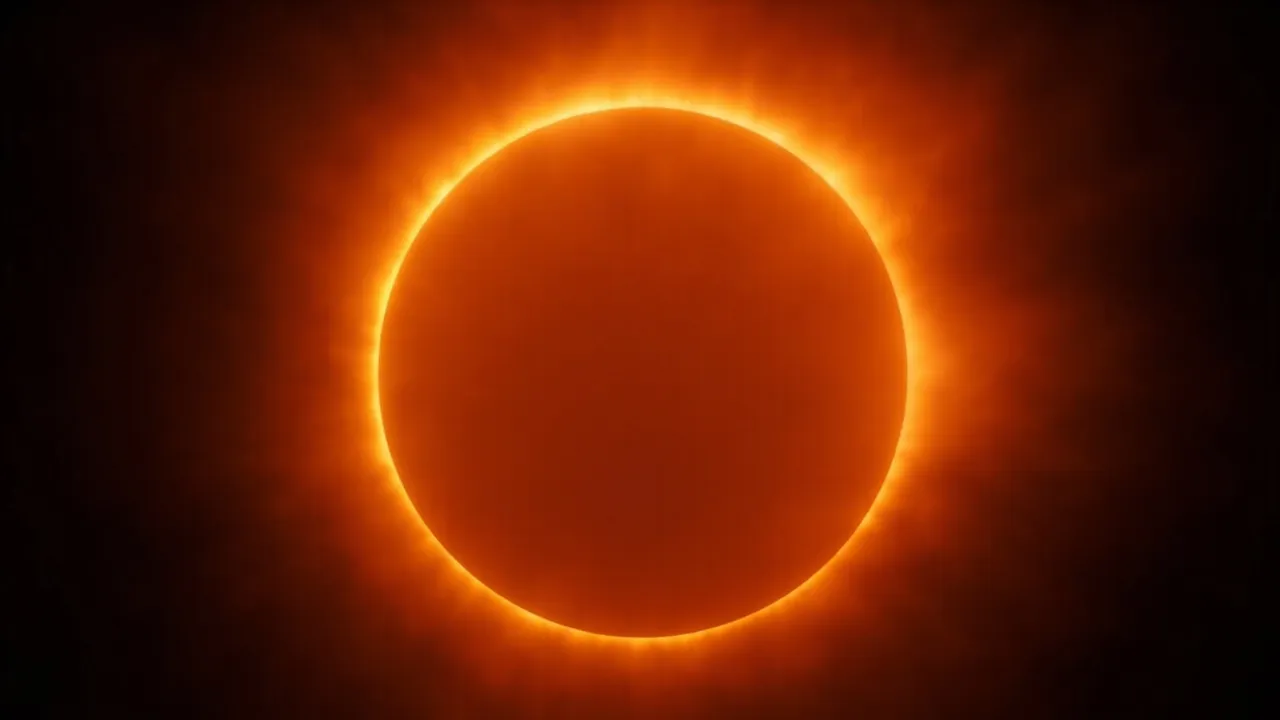
I've seen countless eclipse photographs over the years, but last week's batch made me stop scrolling. The Sun's outer atmosphere—the wispy crown we call the corona—appeared in an unexpected shade: gold. Not the pearly white you'd typically expect, but a rich, almost ethereal golden glow visible across Spain.
What surprised me most? The eclipse itself wasn't responsible. Our own atmosphere was the real artist here.
How White Became Gold
Here's the thing about total solar eclipses: when the Moon completely covers the Sun's blinding surface, the corona takes center stage. Under normal conditions, it appears white or silvery—delicate, elegant, but predictable.
So what changed in Spain?
The timing and location created perfect conditions for atmospheric magic. Over Spain, totality occurred while the Sun sat extremely low on the horizon—essentially a setting Sun eclipse. When light must travel through such a thick layer of Earth's atmosphere to reach observers, interesting optical effects emerge.
The same physics explains why sunsets paint the sky in orange and red. Atmospheric molecules scatter away shorter blue wavelengths, leaving behind the warmer tones. The longer the light's path through air, the stronger this filtering effect becomes.
But there's more to this story.
The Hidden Variable: Wildfire Smoke
This is where last week's event becomes unique. Beyond the already-low Sun, the atmosphere contained an unusual passenger: significant smoke from nearby forest fires.
That particulate matter acted as an additional filter, scattering even more blue light from the equation. Picture it as nature stacking multiple atmospheric treatments on top of each other—the horizon's natural filtering combined with extra smoke particles doing the same job.
The result? Spanish skywatchers witnessed a corona with remarkably deep golden hues. Nature essentially applied its own version of photo filters, and Spain received the golden hour preset cranked all the way up.
The Pink Contrasting Detail
What struck me most wasn't just the gold, but what didn't change.
Jutting from the Sun's left edge, a massive solar prominence stood apart—a looping structure of glowing plasma ejected from the solar surface, shaped by magnetic fields. This particular feature didn't adopt the golden trend. Instead, it remained bright pink.
The reason? Its light originates strongly from hydrogen emissions, which maintained their characteristic color despite all that atmospheric filtering. Against the unusually golden corona, this pink structure resembled a flag planted on a gold banner. The contrast was striking.
The image captured using HDR techniques—combining multiple exposure levels to reveal both extremely bright and faint details simultaneously—shows something genuinely hard to believe. It's the kind of photograph that makes you double-check whether it was actually real.
Why This Matters
Beyond spectacular visuals, moments like this capture why following celestial events stays exciting. You can study eclipses for decades, understand the mechanics completely, and still encounter surprises the atmosphere throws your way.
Science predicts what should occur. Nature decides what actually occurs. Sometimes those surprises turn out to be the most beautiful moments of all.
If you witnessed last week's eclipse firsthand, you experienced something genuinely uncommon—not merely another total solar eclipse, but one wearing its own unique character. The kind of event that makes you appreciate our cosmic positioning: existing at precisely the right distance from the Sun to witness these phenomena at all.
I'm already marking my calendar for the next one. Catch you under the shadow!