
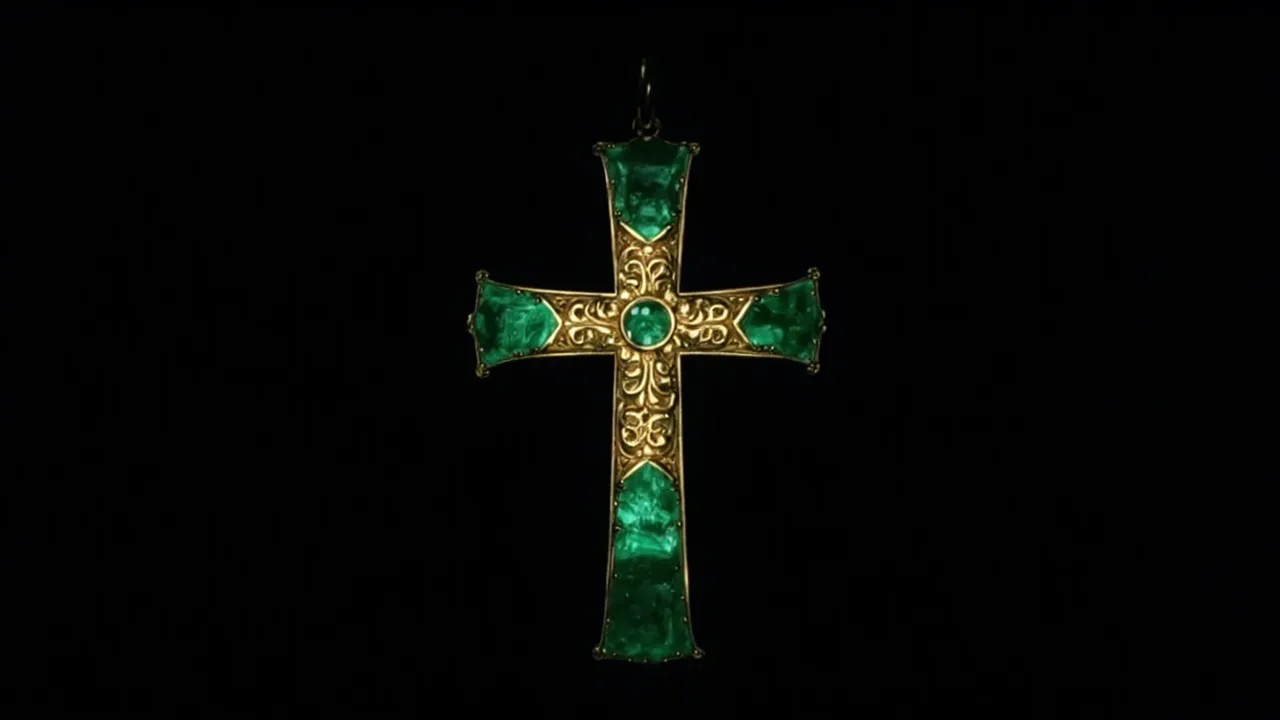
The Emerald Cross That Vanished
Let me tell you about something that still blows my mind every time I think about it.
Imagine this: Bermuda, the 1950s. A guy named Teddy Tucker—ex-British Navy diver—decides to do some exploring along the ocean floor. Just a casual afternoon dive. And what does he find buried there? A three-inch gold cross glittering with seven real emeralds. Not a replica. Not a fantasy. The actual thing.
The kind of treasure that belongs behind glass with a security guard standing next to it.
But here's where it gets interesting.
The Man Behind the Discovery
Tucker wasn't your typical island local killing time. During World War II, he'd trained in underwater demolition for the Royal Navy. After the war ended, he returned to Bermuda—his actual birthplace—and picked up what he called a "mild interest in treasure hunting."
That mild interest turned into something extraordinary. Tucker would go on to locate over a hundred shipwrecks in Bermuda's surrounding waters. One discovery, though, would end up defining his entire life.
Local fishermen had mentioned something odd: marble columns resting on the seafloor near Freemans Bay. Tucker, being the inquisitive sort, went down to take a look. What he found was the wreck of a Spanish galleon called the San Pedro, dating back to 1592.
Over multiple diving trips, he pulled up gold bars, coins, and various artifacts. But on his seventh expedition to the site, everything changed.
That One Moment
His daughter Wendy, who now maintains a website honoring her father's work, shared how Tucker described that instant:
"I lifted this big wooden plank—probably part of the hull—and slid it aside. Underneath, face down, was a cross. Solid gold, shining. I picked it up, flipped it over, and there were the emeralds."
Try to picture yourself in that moment. You're simply moving a rotting piece of wood from a four-century-old wreck, and suddenly—gold and emeralds, gleaming like they were placed there yesterday.
Tucker immediately recognized the gems were genuine. He'd learned that glass imitations would have clouded and dulled over hundreds of years underwater. These sparkled with that signature "green fire" only real emeralds possess.
So what did he do with this museum-quality artifact?
He took it home and stuffed it in his closet.
I swear I'm not making this up. A piece worth millions ended up tucked between old sweaters like a pair of forgotten socks.
When News Gets Out
Tucker attempted to keep quiet about his find. He even returned to the wreck site and rearranged things to make it look less like a significant discovery, hoping to discourage other treasure hunters.
It didn't help.
Word spread. Life magazine ran a story calling it "one of the most valuable pieces of sunken treasure ever found." Suddenly, Tucker couldn't step onto a boat without other hunters tailing him, waiting for him to lead them to the good stuff.
The Smithsonian entered the picture. An expert named Mendel Peterson examined the entire collection—including our cross—and placed a value of $250,000 on it. Adjusted for inflation? Over $3 million today.
Eventually, Tucker sold the entire collection to Bermuda's government. The cross went on display at the Bermuda Aquarium, then relocated to the Bermuda Maritime Museum.
And then things took a strange turn.
The Switch
In 1975, museum officials moved the cross again—preparing for a prestigious visitor. Queen Elizabeth II was scheduled to tour the museum. Officials even invited Tucker to attend and serve as a guide for the queen.
When Tucker saw the cross, something immediately felt wrong.
It looked lifeless. Dull. When he touched it, flecks of paint came off on his fingers.
This wasn't the $3 million artifact. This was a cheap plastic reproduction—fresh enough that the paint hadn't even dried properly.
Someone had swapped the real cross for a fake, right under the noses of museum security.
The Mystery Lives On
The queen never learned about the swap. FBI and Interpol both investigated, but no arrests were ever made. The cross was never found.
Tucker passed away in 2014 at 89 years old. The theft of his most famous discovery haunted him until the end.
Looking back at this story, the heist itself might be more remarkable than the original treasure hunt. This wasn't some reckless smash-and-grab. Whoever pulled it off had to:
- Gain access to supposedly secure museum facilities
- Produce or acquire a convincing replica to replace the original
- Execute the swap without triggering any alarms
- Time everything so perfectly that the deception wasn't uncovered until after the royal visit
That takes serious planning. This wasn't amateur work.
So who was responsible? A rival treasure hunter wanting the real prize? An insider with access to the display cases? Someone who simply dreamed of owning a piece of living history?
We'll likely never know.
And there's something profoundly melancholy about that. That gold cross carries centuries of history within it—the tale of a Spanish galleon, the craftsmanship of workers in the Americas, the secrets of the ocean floor. Its value extends far beyond money. It's genuinely irreplaceable.
Somewhere out there, the cross might sit in a private collection, or it might have been lost again—perhaps discarded by a thief who realized they could never safely sell such a famous piece.
Until someone finds it, all we have is a plastic replica and a "what if" that will never be answered.