
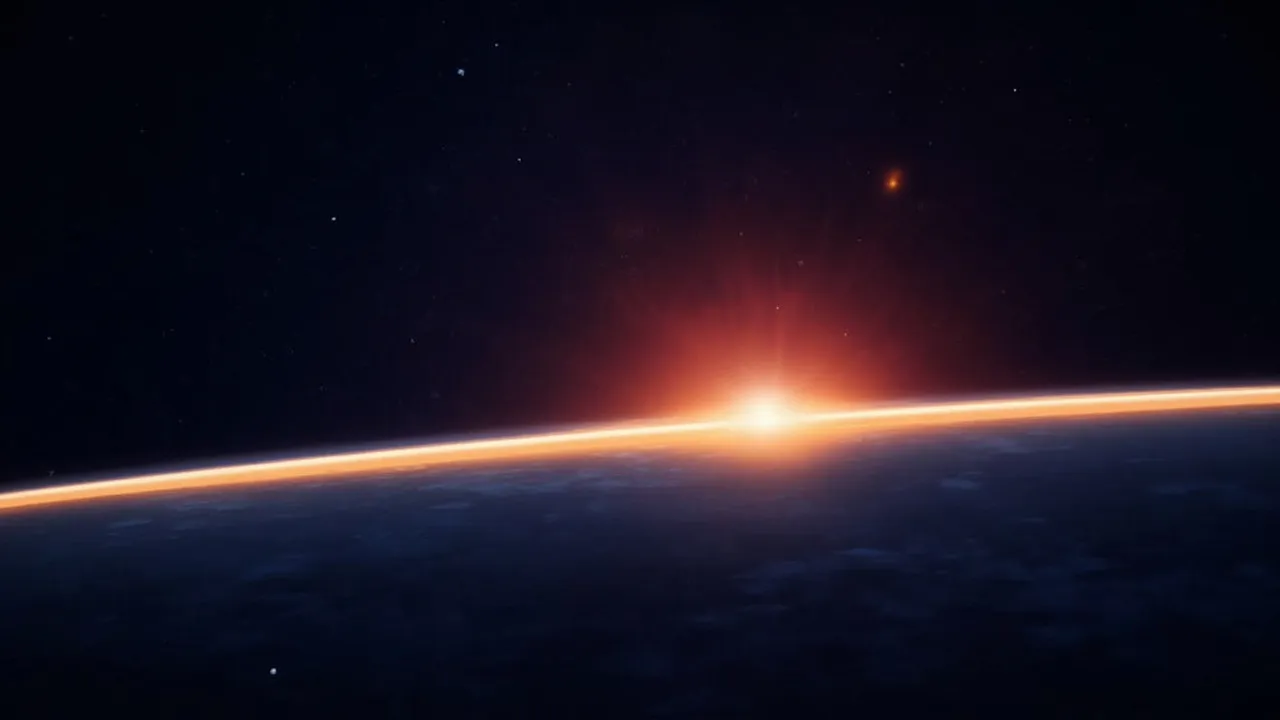
The Day Earth Lost Its Force Field
Imagine floating through space, minding your own business, when suddenly your invisible shield just... vanishes. No warning. No backup. Just you and every dangerous thing the universe has to throw at you.
Sounds like something from a space horror movie, doesn't it?
Turns out, this might have been Earth's reality—multiple times, actually—over the last 14 million years.
Meet Your Planet's Bodyguard
Let me introduce you to something pretty remarkable: the heliosphere.
Every second of every day, our Sun fires out a stream of charged particles called the solar wind. These particles race outward at incredible speeds, creating an enormous protective bubble that wraps around our entire solar system. Scientists call this bubble the heliosphere.
Think of it as Earth living inside a cosmic安全屋—a shielded space where harmful radiation and nasty interstellar stuff can't reach us.
The Sun's been running this security operation for billions of years. Not bad for a ball of burning gas, right?
But here's the plot twist: researchers funded by NASA just discovered that this protective shield might have failed us at some crucial moments.
Our Solar System Isn't Staying Still
Here's something that took me a while to really grasp: nothing in space just sits there.
Our entire solar system is actually on a road trip around the Milky Way's center—and we're talking about a journey spanning 4.6 billion years. During that time, we've passed through all kinds of cosmic neighborhoods.
The research team ran computer simulations tracking our Sun's path, and the results were eye-opening. It turns out our star has plowed through massive, cold clouds of gas and dust at least three times in recent history: roughly 2-3 million years ago, 6-7 million years ago, and 13-14 million years ago.
When this happened, the heliosphere got absolutely crushed—compressed down to smaller than Earth's orbit. During those moments, our planet would've found itself floating outside the Sun's protective zone.
Ouch.
Climate Clues From Space
This is where things get really interesting.
The timing of these "shield failures" lines up suspiciously with some puzzling climate events here on Earth.
Scientists have found traces of interstellar dust in deep-sea sediments, Antarctic ice cores, and even Moon rocks—and these all match those exact time periods. It's like finding evidence at a crime scene.
When researchers modeled what would happen if Earth's atmosphere directly encountered these dense clouds of galactic hydrogen, the simulations showed something striking: increased water vapor in the atmosphere and changes in the upper atmosphere that eventually rippled down to Earth's surface.
Could these moments of cosmic vulnerability have triggered ancient ice ages? The research team thinks it's a real possibility. We've always explained climate changes through Earth's orbit, greenhouse gases, and ice sheets—but maybe we've been overlooking something much bigger.
Why This Changes Everything
This research opens up a whole new way of thinking about Earth's history.
For centuries, we've studied our planet's climate by looking at... well, Earth. Local factors. Atmospheric chemistry. Ocean currents. But this work suggests that some of the biggest climate shifts might've come from completely outside our atmosphere—from the Sun's journey through the galaxy and the cosmic neighborhoods we've wandered through.
The research team is now developing what they call a "digital twin" of the heliosphere—a detailed computer model that could predict how our protective bubble behaves when it encounters dense interstellar clouds. Eventually, this could help scientists identify other star systems with similar protective environments, which is massive for finding habitable planets.
The Bigger Picture
What really sticks with me from this research?
We're not as isolated as we like to think. Earth doesn't exist in a bubble within a bubble. Our planet's entire history has been shaped by forces far bigger than anything happening on our surface—the Sun's behavior, our path through the Milky Way, cosmic environments we've passed through.
Next time you're basking in sunlight, take a second to appreciate that invisible shield keeping us safe from the cosmic chaos out there.
And if you're feeling grateful, send some love to the Sun. It's been doing a pretty critical job for about 4.6 billion years.
That's commitment, if you ask me.
Source: https://www.sciencedaily.com/releases/2026/09/260901070523.htm