
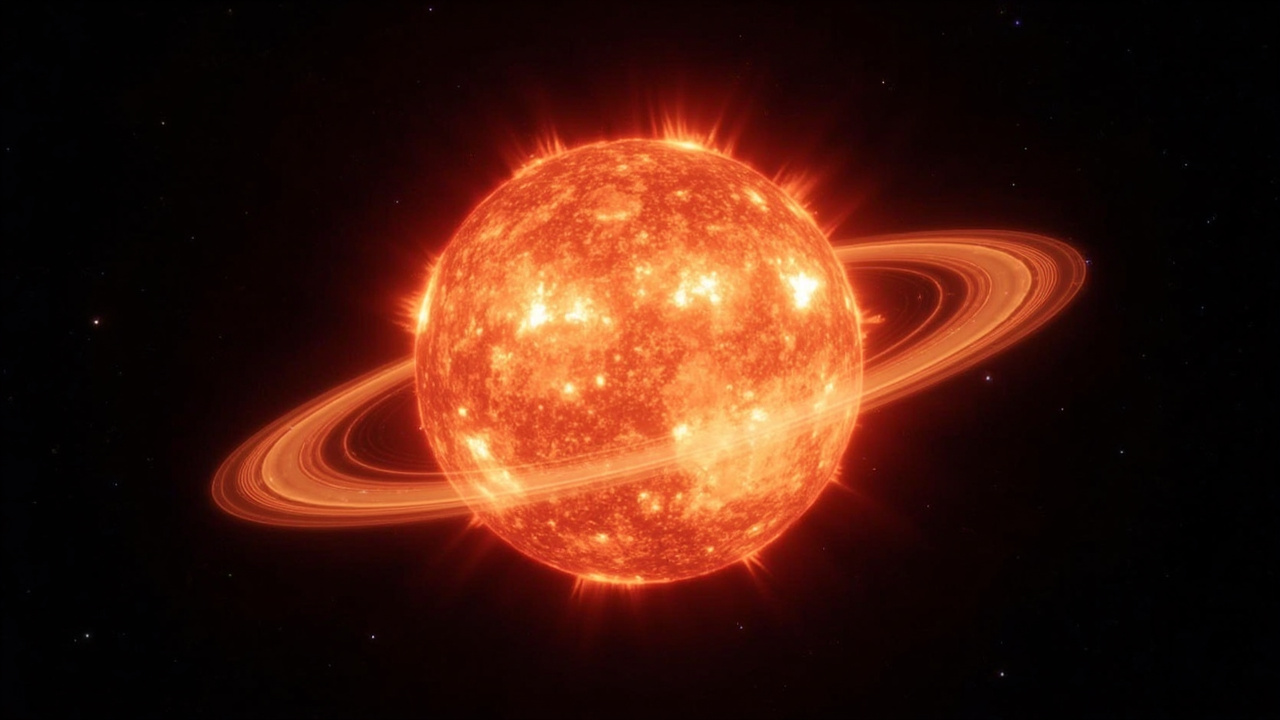
What If an Alien Civilization Built a Solar Farm Around Their Sun?
Okay, I need you to picture this with me: an alien species, maybe billions of years more advanced than us, decides their planet's energy supply just isn't cutting it anymore. So they do what any sensible civilization would do — they build a massive shell around their star to capture every last drop of sunlight.
Sounds like something out of Star Trek, right? But here's the thing: scientists are actually looking for this. And they're getting better at it.
The concept is called a Dyson sphere, named after physicist Freeman Dyson, who first dreamed up the idea back in 1960. But here's the reality check — a solid shell around a star probably wouldn't work. Stars are hot, and the structural forces would be absolutely bonkers. So researchers now imagine something more practical: a "Dyson swarm," basically a cloud of countless orbiting panels and collectors that work together to soak up stellar energy.
Red Dwarfs: The Galaxy's Most Common — and Most Promising — Targets
Here's where it gets really interesting. A new study by Amirnezam Amiri from the University of Arkansas is helping astronomers figure out what these structures would actually look like through our telescopes. And the research points to some surprising candidates.
Red dwarfs are the most common stars in our galaxy. They're small, cool, and burn fuel so slowly that they can potentially survive for trillions of years. From an engineering perspective, they're also more manageable. Building a Dyson swarm around a red dwarf would require far less material than around our Sun.
But here's the real plot twist: white dwarfs might be even better candidates. These are the dense, collapsed remnants of stars like our Sun — basically stellar corpses that have shrunk to about 1% of their original size. Because they're so compact, a Dyson swarm could orbit just a few million kilometers above their surface. That's practically snuggling up to the star. The energy payoff would be enormous, and the structure needed would be surprisingly modest.
The Infrared Magic Trick
Now here's where the science gets really cool (pun absolutely intended).
A Dyson sphere would completely change how a star appears on the Hertzsprung-Russell diagram — that's the cosmic equivalent of a "temperature vs. brightness" chart that astronomers use to classify stars. The structure would absorb most of the star's visible light, but here's the thing: energy can't just vanish. So the same amount of energy gets radiated back out — except as infrared heat instead of visible light.
Think of it like this: imagine you're wearing a black t-shirt on a hot day. It absorbs all the sunlight and then radiates that heat back out. Same idea, but cosmic.
The result? A star that looks way, way colder than it actually is. A typical red dwarf burns at around 3,000 degrees Kelvin. But a Dyson sphere surrounding it could have an effective temperature of only 50 degrees Kelvin — about two orders of magnitude colder. That's not just unusual; it's essentially unprecedented in nature. No known natural object sits in that weird cold zone, which makes any detection there immediately suspicious.
Weird Light Patterns and Dust-free Signals
The study also points out that real Dyson swarms probably wouldn't be perfect solid shells. That brings me to another fascinating clue: the light patterns they'd produce.
Imagine thousands of solar collectors orbiting a star at different speeds and distances. As they transit in front of the star, they'd create brightness variations that would look completely different from anything natural. No pulsating star or orbiting planet produces light curves quite like a swarm of metallic structures would.
Another telltale sign? Dust. Regular stars often have dusty disks that produce distinctive silicate signatures — basically a chemical fingerprint. A Dyson sphere would be made of radiator panels, not cosmic dust, so it would look suspiciously "clean" in the spectrum. No dust, no excuses.
James Webb Is Our Best Shot
Here's some exciting news: the James Webb Space Telescope is perfectly positioned for this hunt. It's basically a giant infrared camera designed to peer into the cosmic dust and find things we couldn't see before.
In May 2024, researchers from Project Hephaistos identified seven promising Dyson sphere candidates, all around red dwarfs, after scanning roughly 5 million stars. One was later ruled out when scientists realized a perfectly aligned black hole was creating the strange signal. That still leaves five objects that deserve serious follow-up investigation.
None have been confirmed as alien megastructures — yet. But Amiri's work gives astronomers concrete observational clues to look for. It's not just hoping and praying; it's actual science-based searching.
Why This Matters
Look, I know what you might be thinking: "Are we really looking for alien sun-hats?" And honestly, I love that we are. Even if we never find a single Dyson sphere, the search itself pushes us to develop better telescopes, better analysis techniques, and a deeper understanding of what technosignatures might actually look like.
Plus, there's something beautifully optimistic about it. We're not just waiting for aliens to contact us — we're actively scanning the cosmos for signs of advanced engineering. We're asking: what would the universe look like if someone else solved the energy problem? And how would we spot their solution from millions of light-years away?
That's pretty amazing, if you ask me.
Source: https://www.sciencedaily.com/releases/2026/07/260710003524.htm