
Okay, I need you to picture this with me.
You're a tiny flatworm, just hanging out in a pond, living your best regenerative life. (Yes, flatworms can literally regrow their entire bodies if you cut them in half — they're basically the Marvel superheroes of the animal kingdom.) But something's different today. You've been surgically fused with part of another flatworm — some kind of mad scientist experiment — and now your body is rejecting the foreign tissue.
What happens next sounds like something out of a sci-fi horror movie.
Your immune cells don't just attack the problem. No, no. They detonate.
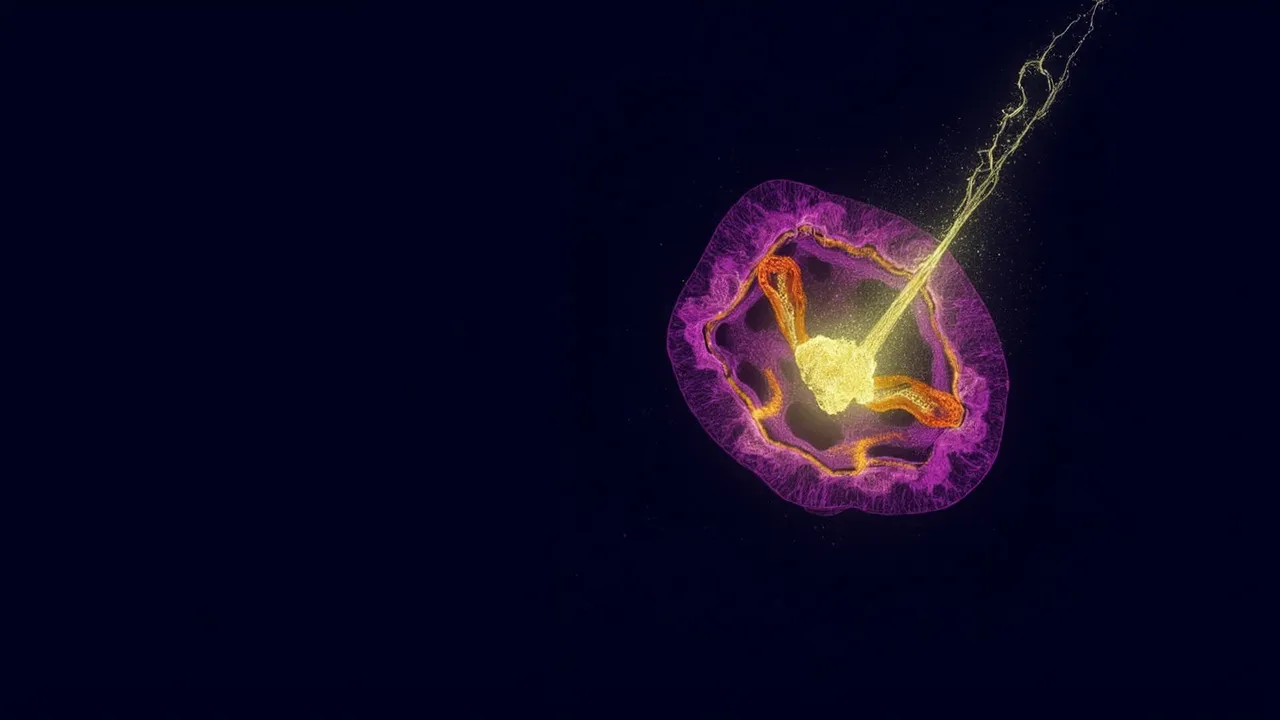
Stanford researchers recently published a study in Cell describing something completely new: cells that blow themselves up to destroy threats around them. They call them "ruptoblasts," and honestly, the name is perfect because these little guys experience what's called "ruptosis" — a rapid, explosive cell death that makes them disappear almost without a trace.
The lead researcher, postdoctoral scholar Chew Chai, first spotted these cells while investigating a question that had puzzled scientists for years: Can flatworms tell the difference between their own body parts and someone else's? (Spoiler: Yes, they absolutely can, and they are NOT happy about foreign tissue.)
When the flatworms rejected the fused tissue from unrelated individuals, something wild happened. The response was dramatic — like "there's a fire and an alarm goes off, and the cells just blow up," as Chai described it. But here's where it gets really interesting.
The hormone activin spiked during this rejection process, triggering a severe inflammatory response. The worms didn't die immediately, but they were goners within days. When Chai injected activin into healthy worms who hadn't been surgically fused with anyone, they experienced the same inflammatory chaos.
Now, here's where the science gets genuinely mind-blowing.
Using some pretty sophisticated microscopy techniques, Chai watched individual cells respond to the activin. A small group of cells suddenly BURST OPEN, releasing substances that killed everything nearby, and then — get this — the cells completely disappeared within five minutes. Vanished. Gone. Like they were never there.
What's wild is the speed. Other cells in our bodies can kind of "explode" when they die, but we're talking hours-long processes with slow leaks. Ruptoblasts operate in seconds to minutes. They're not slowly releasing their contents — they're unloading everything at once, like a biological grenade.
And these little suicide bombers are effective. When researchers tested ruptoblasts against E. coli bacteria, human kidney cells, and mouse blood cells, the ruptoblasts destroyed all three. But here's the beautiful part: the damage stayed localized. It didn't spread in some kind of chain reaction of destruction. Just a precise, powerful, contained attack.
This is different from our familiar immune cells like T cells or neutrophils, which are blood cells made in bone marrow. Ruptoblasts are glandular cells — they evolved an explosive secretion system specifically for this purpose.
Now, you might be wondering: why don't humans have these? According to the researchers, it's probably because the collateral damage from ruptosis is just too much for us to handle. When cells explode and release their contents, they can cause inflammation and damage to surrounding tissue. Humans can't easily repair that kind of localized destruction.
But flatworms? Those little guys are basically walking stem cell factories. They can regrow almost anything. So they can afford to sacrifice a few cells if it means obliterating a threat.
The researchers believe ruptoblasts probably evolved very early in animal history — they only found similar cells in other basal flatworms. Somewhere along the line, vertebrates like us apparently decided this nuclear option wasn't worth the fallout.
But here's where my imagination gets carried away: Could we somehow harness this? The researchers themselves suggest that the ability to deliver a powerful but contained attack could eventually inform treatments for bacterial infections or even tumors. What if we could engineer something that targets bad cells with this kind of precision destruction?
I don't know about you, but I'm genuinely thrilled that there's a team of scientists out there studying flatworms that explode their own cells. The natural world is so much weirder and cooler than we give it credit for.
Nature has been running experiments in survival for hundreds of millions of years. Sometimes those experiments result in creatures that can regenerate from a single slice. Sometimes they result in cells that destroy themselves to protect the whole.
And honestly? I'm here for all of it.