
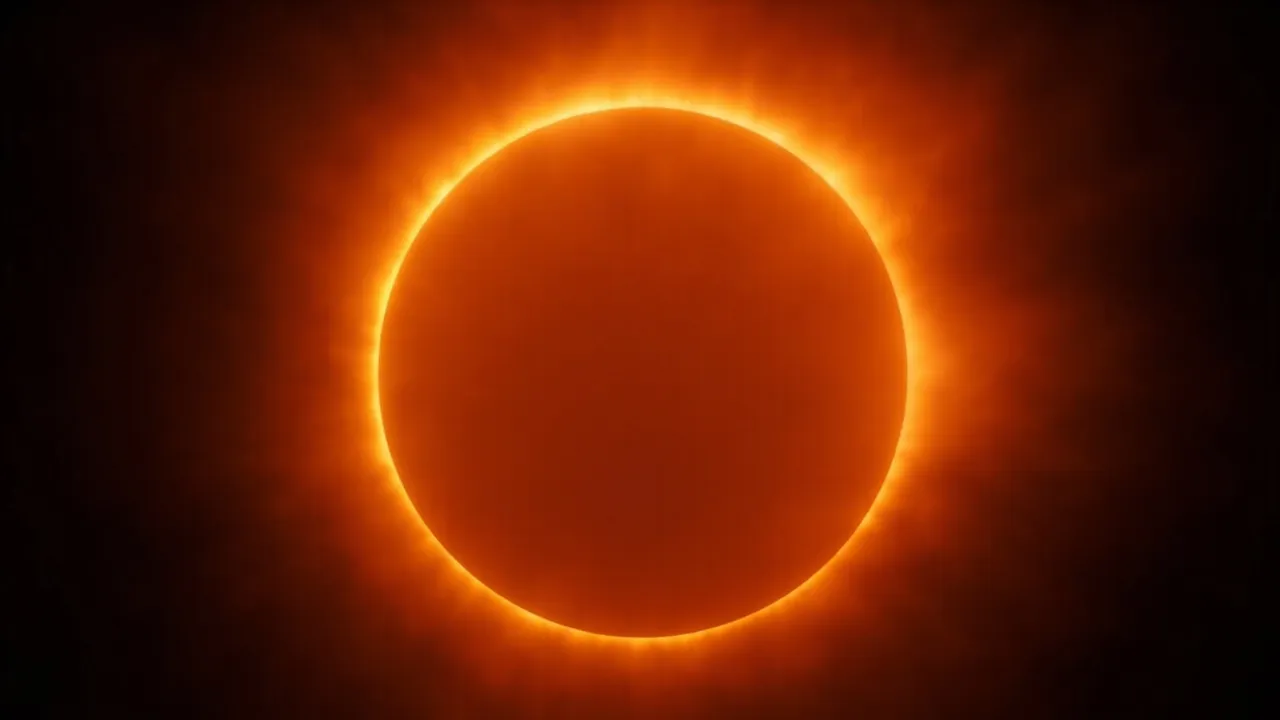
Okay, I'll admit it — I've seen a lot of eclipse photos in my life. But when the images from last week's total solar eclipse started flooding in, something looked different. The Sun's outer atmosphere, that wispy halo we call the corona, wasn't its usual pearly white. Over Spain, it glowed with an almost surreal golden hue.
And here's what makes this story really interesting: the eclipse itself didn't cause the gold. The atmosphere did.
Why Golden, Not White?
Here's the thing about total solar eclipses — when the Moon completely blocks the Sun's bright face, we're treated to that magnificent corona. Normally, it looks white or silvery, like a delicate lace fan floating in space. Beautiful, but familiar.
So why did watchers in Spain see gold instead?
It comes down to timing and geography. In Spain, totality happened while the Sun was sitting very low on the horizon — basically, it was a setting eclipse. And when light has to travel through much more of Earth's atmosphere to reach your eyes, interesting things happen.
You know how sunsets look orange and red? Same principle here. The molecules in our atmosphere scatter away the shorter blue wavelengths of light, leaving the warmer colors behind. The more atmosphere the light passes through, the more dramatic this effect becomes.
But wait — there's a twist.
The Secret Ingredient: Forest Fire Smoke
This is where the story gets really specific to last week's event. Besides the already-low Sun, there was something extra in the air that day: an unusual amount of smoke from nearby forest fires.
That smoke acted like a bonus filter, scattering even MORE of the remaining blue light. Think of it like adding another layer of atmospheric "treatment" on top of what the horizon was already doing. The result? The corona that Spanish observers saw took on those remarkably rich golden tones.
Nature basically ran the eclipse light through a series of Instagram filters, and Spain got the golden hour preset on maximum.
Nature's Little Contrasts
Now here's what really got me about this story. Not everything turned gold that day.
Sticking out from the Sun's left edge was a massive solar prominence — one of those enormous loops of glowing plasma that extend outward from the Sun's surface, shaped by powerful magnetic fields. This particular prominence didn't follow the golden trend. It stayed bright pink.
Why? Because it was emitting light strongly tied to hydrogen, which held onto its color despite all that atmospheric filtering. So against that unusually golden corona, there was this striking pink structure popping out like a flag on a gold background.
The HDR-processed image that captured this moment is genuinely one of those "I can't believe this is real" photos. HDR imaging combines different exposure levels so you can see both the very bright and very faint details simultaneously — kind of like how our eyes can adjust, but more dramatic.
Why This Matters
Beyond just being a pretty picture, moments like this remind me why I love following celestial events. You can study eclipses for decades, know exactly what's going to happen, and still have the atmosphere throw you a curveball.
Science tells us what SHOULD happen. Nature decides what ACTUALLY happens. And sometimes, those moments of surprise are the most beautiful.
If you managed to witness last week's eclipse in person, you saw something genuinely rare — not just another total solar eclipse, but one with its own distinct personality. The kind of event that reminds you how lucky we are to exist at just the right distance from the Sun to see these things at all.
Now I'm already marking my calendar for the next one. See you under the shadow!