
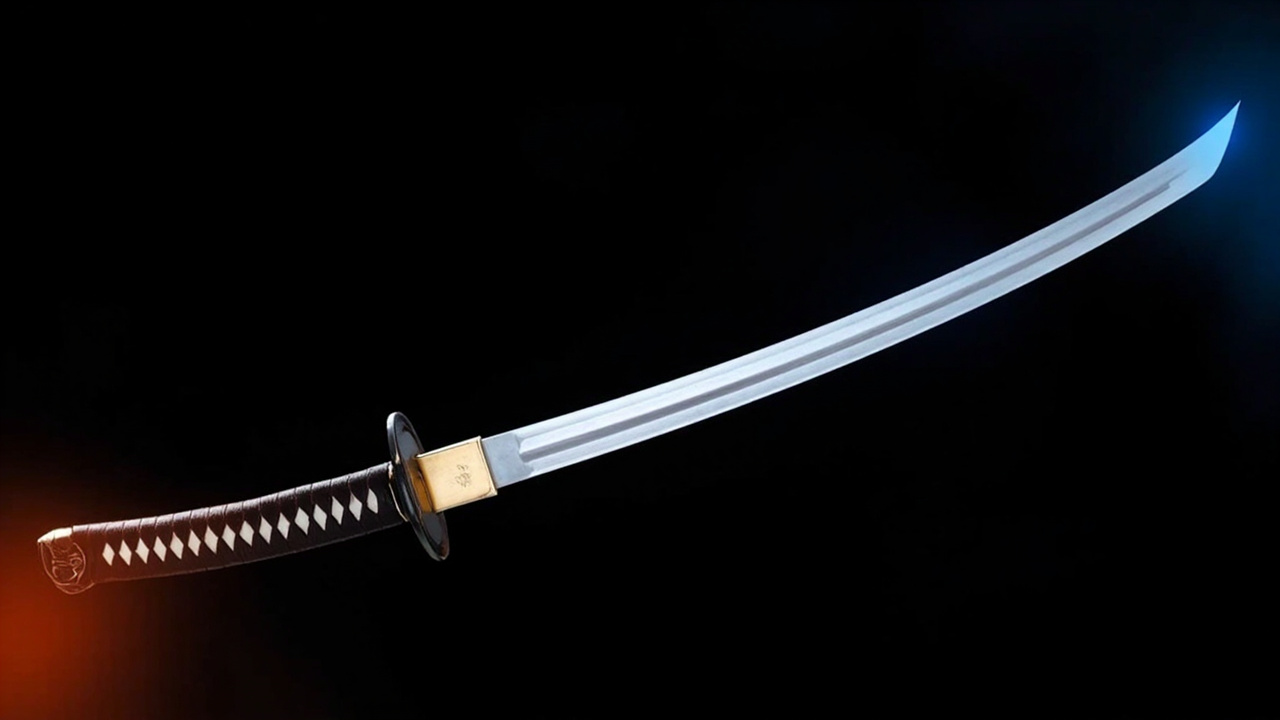
The Swordsmith Who Changed Everything
Let me tell you about a guy named Masamune. No, not the video game character—the original Masamune.
We're talking about Gorō Nyūdō Masamune, a Japanese swordsmith who lived way back in the 13th and 14th centuries. And honestly? "Swordsmith" feels like an understatement for this guy. He's basically the Michelangelo of samurai swords.
Here's the wild part: historians and sword experts alike consider him possibly the greatest sword-maker who ever lived. Not just in Japan—ever. In any country. At any point in human history.
What made him so special? Well, this guy mastered something called "nie"—basically, he figured out how to create these gorgeous, visible crystals in the steel that gave his blades a unique shimmering quality. It's achieved through this incredibly delicate process called differential hardening, where you coat different parts of the sword in clay before quenching it in water. The edge cools super fast (making it razor-sharp), while the spine cools slower (keeping it flexible instead of snapping like brittle glass).
The result? Swords that were both deadly effective and heartbreakingly beautiful. And they didn't just look pretty—they could genuinely change the course of battles.
A Sword With Its Own Life Story
Now, Masamune created many incredible blades during his lifetime, but one stands out above all others: the Hōnjo Masamune.
The name alone tells you this sword had quite the journey. "Hōnjo" refers to Hōnjo Shigenaga, a famous general who apparently got his helmet literally sliced in half by this very blade during the fourth Battle of Kawanakajima—but survived and claimed the sword as his prize. (Imagine being the guy who lived through having his helmet cleaved in two and walked away thinking, "You know what? I want whatever just hit me.")
After Shigenaga sold it in 1595, the sword eventually ended up in the hands of the Tokugawa clan—specifically, Tokugawa Ieyasu, who basically founded the entire Tokugawa Shogunate and united Japan after centuries of civil war. From that point on, it became a hereditary symbol of power, passed down through generations like a family heirloom on steroids.
By 1939, Japan officially declared it a national treasure. This wasn't just some old family keepsake—it was recognized as a piece of living history, irreplaceable and priceless.
And then World War II happened.
The Disappearance
Here's where things get really strange.
When Japan surrendered in August 1945, the terms of their capitulation required them to hand over all weapons—including samurai swords. In December of that year, Tokugawa Iemasa (a direct descendant of Ieyasu) delivered the Hōnjo Masamune to the Mejiro police station in Tokyo.
His intention was noble, actually. He wanted to set an example of cooperation with the Allied Occupation, showing that Japan was committed to peaceful compliance. A real "I'm taking one for the team" kind of moment.
But here's the kicker: after he surrendered it, the sword was never seen again.
Not in some warehouse. Not in a museum. Not anywhere.
When investigators looked into what happened, they got an answer that's somehow more confusing than silence. The Mejiro police claimed a man named "Sgt. Coldy Bimore" had collected the swords for the Foreign Liquidations Commission. But here's the thing—no one by that name was ever assigned to handle Japanese weapon collections.
suspicious music plays
So where did it go? Was it melted down? Thrown into the ocean? Stolen? Hidden in someone's attic? The truth is, nobody knows. And this isn't some minor historical footnote we're talking about—it's literally one of the most valuable and significant objects in Japanese cultural history.
Why This Story Still Haunts People
Look, I know what you might be thinking: "It's just a sword. People lose things."
But it's really not just a sword. Think about what this thing represents.
We're talking about nearly 700 years of continuous history, passing through the hands of legendary warriors, shoguns, and samurai. This blade witnessed the unification of Japan. It survived wars, earthquakes, political upheavals—centuries of human chaos. And then it just... vanishes in the bureaucratic mess of World War II's aftermath?
There's something almost tragic about that, isn't there? All those centuries of careful preservation, only for it to disappear during one of history's messiest moments.
On the bright side, though—there's genuine reason to hope.
The Discovery That Changed Everything
In 2013, something amazing happened. A private collector brought a sword to the Kyoto National Museum, and experts confirmed it was the Shimazu Masamune—one of Masamune's other legendary creations that had also been lost to history.
If one of Masamune's swords could resurface after being missing for generations, who's to say the Honjo Masamune couldn't do the same?
Maybe it's sitting in some forgotten box in an attic right now, waiting to be rediscovered. Maybe it was smuggled out of the country and is hanging in a private collection somewhere. Maybe there's even a chance it survived the destruction and is hidden away in a government vault, forgotten about.
We simply don't know. And honestly? That mystery is part of what makes this story so compelling.
What Do We Do With Stories Like This?
I find myself thinking about the Honjo Masamune often. There's something beautiful about the fact that people are still looking for it. That there are historians, collectors, and enthusiasts who haven't given up hope.
Maybe the real treasure isn't the sword itself—it's what it represents. The craftsmanship of a master who lived 700 years ago. The hands that wielded it across centuries of Japanese history. The hope that even in our modern world of GPS tracking and digital records, some mysteries refuse to be solved.
The Honjo Masamune might still be out there, waiting for its story to continue.
And honestly? I hope we get to find out what happens next.