
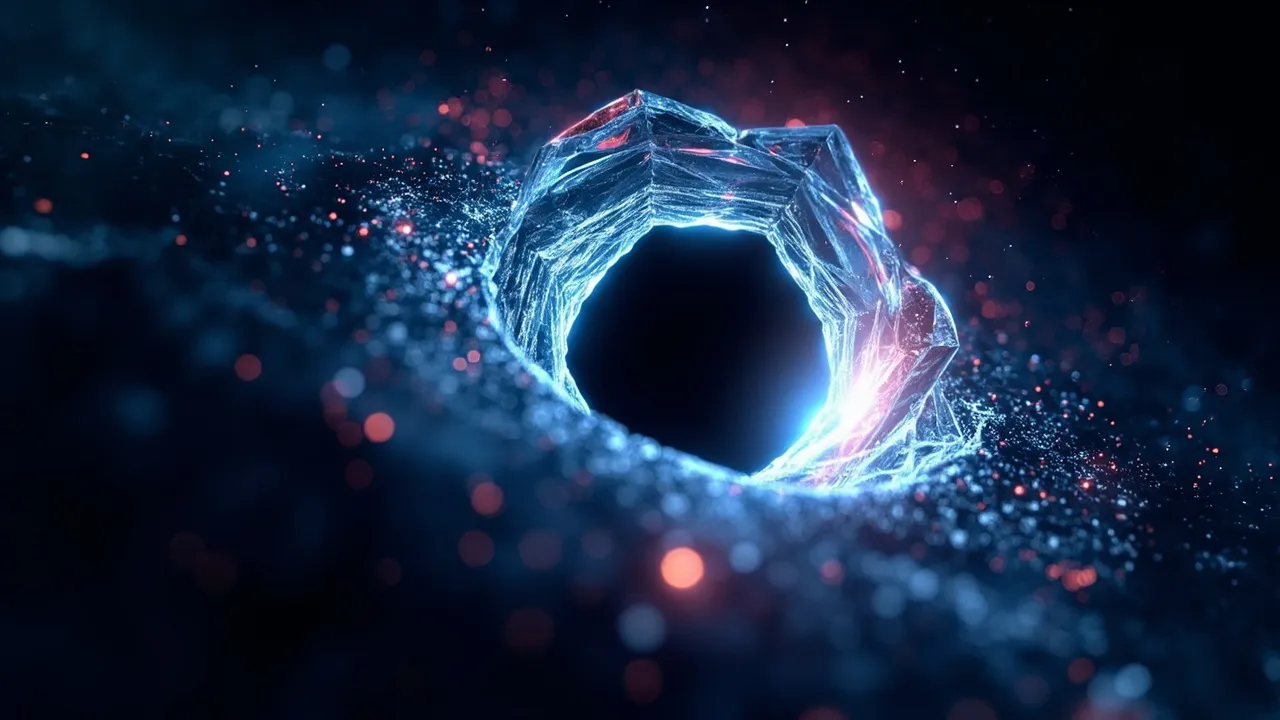
Okay, I need you to picture something wild with me.
You're probably familiar with black holes — those cosmic monsters that nothing, not even light, can escape from. Usually, we think of them as ginormous objects sitting at the centers of galaxies or formed when massive stars collapse in spectacular supernova explosions.
But here's where things get really interesting: physics doesn't actually require a black hole to be massive. There's no minimum size limit. And now, researchers from Goethe University Frankfurt and TU Wien have figured out something remarkable about how truly tiny black holes might form — and the answer involves what they're calling a "spacetime crystal."
Wait, Spacetime Can... Freeze?
Let me break this down. You know how water at zero degrees Celsius can suddenly freeze? One moment you've got liquid water, then — boom — the molecules spontaneously arrange themselves into a regular pattern, and you've got ice.
According to these researchers, spacetime itself might be capable of something remarkably similar.
"Take liquid water at zero degrees Celsius," explains Professor Daniel Grumiller from TU Wien. "A very small change is enough to make the water freeze. The water molecules then spontaneously arrange themselves into a regular pattern and form an ice crystal."
The same kind of thing can apparently happen with spacetime. Under extremely specific, critical conditions — think conditions that might have existed just moments after the Big Bang when everything was impossibly dense and chaotic — spacetime can organize itself into a repeating, crystal-like pattern. A spacetime crystal.
And here's the absolutely wild part: this crystal is unstable. It's sitting there on a knife's edge, and a tiny nudge in either direction determines its fate.
The Cosmic Fork in the Road
Picture this: you've got your spacetime crystal, perfectly balanced. If nothing disturbs it, it might simply dissolve back into normal spacetime, leaving behind ordinary particles drifting around. But add just a tiny, tiny bit of energy — we're talking almost imperceptible amounts — and the entire structure collapses in on itself.
Into a black hole.
"This spacetime crystal is a very peculiar and fascinating object," says Grumiller. "It is a kind of intermediate state, an unstable point that can evolve in two different directions."
I don't know about you, but I find something almost beautiful about this. The universe, at its most fundamental level, operates on these knife-edge balances where the smallest input can trigger completely divergent outcomes. A nudge in one direction gives you peaceful emptiness. A nudge in the other gives you a singularity from which nothing escapes.
The Math That Took Decades to Crack
Now, here's where the story gets almost as interesting as the physics. Scientists knew this was theoretically possible for decades. Computer simulations showed it could happen as early as 1993. But there was a problem: actually writing down the mathematical equations that described this process proved incredibly difficult.
Think about it — you're trying to mathematically describe how spacetime itself reorganizes, how gravity behaves in these extreme conditions, and how a black hole emerges from nothing. The equations involved are brutal.
But these researchers found a clever workaround. And honestly, what they did feels almost like mathematical sleight of hand.
The Magic of Infinite Dimensions
"Our universe has four dimensions — three dimensions of space and one dimension of time," explains Christian Ecker from Goethe University Frankfurt. "But in principle, nothing prevents us from writing down physical equations for a larger number of dimensions — five dimensions, forty-two dimensions, or even infinitely many."
Here's the counterintuitive bit: instead of making the problem harder, going to infinite dimensions actually made it easier. The complex calculations that were nearly impossible in four dimensions suddenly became tractable with infinitely many dimensions.
The team could then work backwards, step by step, to see if those solutions translated back to our familiar four-dimensional universe.
It worked.
"Our technique turns out to be remarkably stable," says Florian Ecker from TU Wien. "Depending on the desired precision, we can systematically improve our formulas using additional approximation methods."
This gives physicists an entirely new analytical tool for studying black hole phenomena that were previously beyond mathematical reach.
Why Should You Care?
I know what you might be thinking: "This is fascinating, but what does it actually mean for me?"
Well, first of all, it's a reminder that the universe is far stranger and more wonderful than we typically imagine. Spacetime itself — the stage on which everything in the cosmos plays out — can potentially organize itself into patterns and undergo phase transitions, just like matter can freeze into crystals or evaporate into gas.
But there's also a more practical dimension to this research. Primordial black holes — tiny black holes that might have formed in the early universe — remain a fascinating possibility that scientists are actively searching for. Understanding exactly how they might form helps us know where and how to look for them.
And honestly? Sometimes pure knowledge is its own reward. The fact that human beings can peer this deeply into the fabric of reality and derive equations that describe phenomena like spacetime crystals is, I think, genuinely awe-inspiring.
The Bottom Line
The next time you see an ice cube form in your freezer or watch frost crystallize on a cold morning window, take a moment to appreciate the parallel. The same mathematical principles that govern how water molecules organize themselves also describe, in principle, how the fabric of spacetime itself could arrange into a crystalline pattern — and how that pattern could, under the right circumstances, collapse into one of the most extreme objects in the universe.
Physics is wild. And we keep finding new ways to understand just how wild it really is.