
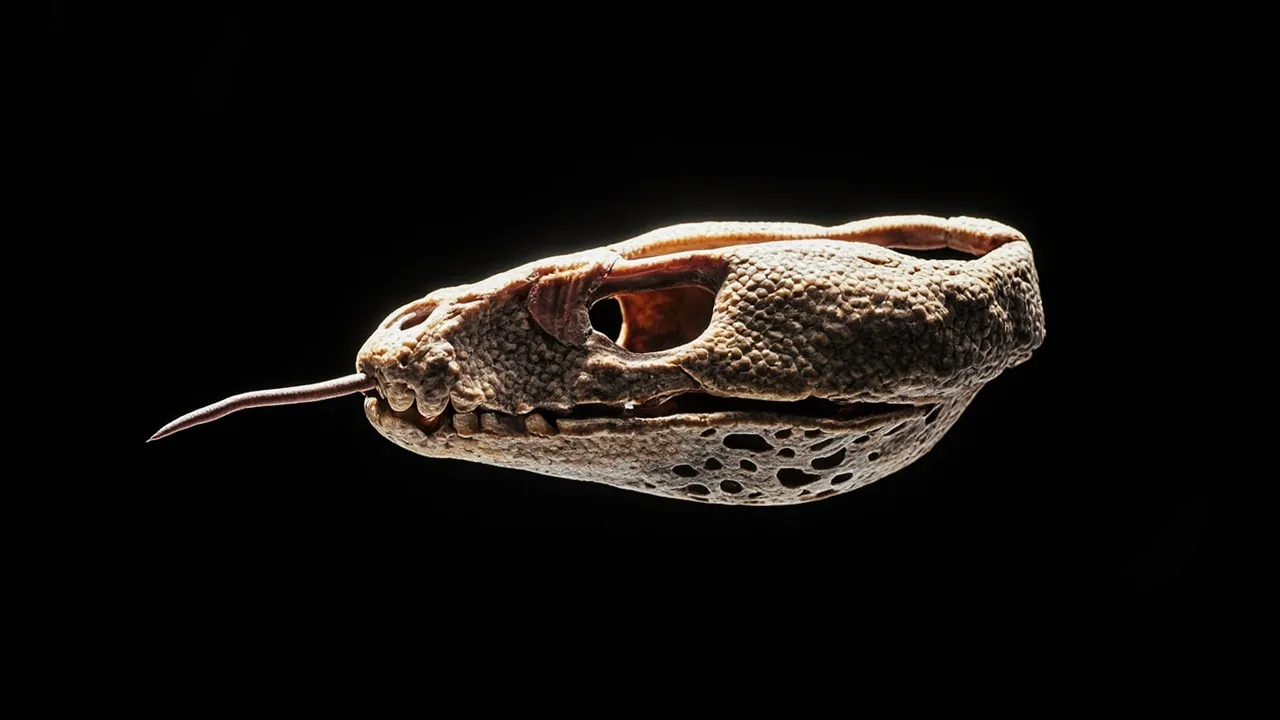
Okay, I have to admit—when I first heard about this study, I expected another "scientists found a cool fossil" story. But what researchers uncovered from this 80-million-year-old snake skull? This is genuinely one of those discoveries that makes you rethink everything.
The Plot Twist No One Expected
For the longest time, scientists have been locked in what I'll call the "snake origin debate." You basically had two teams: the underground crowd who thought snakes evolved their long, limbless bodies while living in burrows, and the ocean lovers who were convinced our slithery friends first emerged from marine environments. Simple enough, right?
Well, surprise! Neither team was completely right.
A research team led by Tiago Simões from Princeton University just published findings in Nature that completely blow this debate wide open. They discovered a new snake species in southeastern Brazil—named Tametara mirim—and it's one of the most complete fossil snake skeletons ever found. Like, we're talking about a specimen that preserved details of the skull, vertebrae, AND brain structure. That's basically the lottery for paleontologists.
What Can a Brain Tell Us?
Here's where it gets really interesting. The team used computed tomography (basically super-powered CT scans) and 3D rendering to create a digital reconstruction of the ancient snake's brain case. And what they found was... unexpected.
When they compared Tametara to another famous fossil snake called Dinilysia (found in Argentina), the differences were striking. These two ancient snakes had completely different brain shapes—and those shapes told very different stories about their lifestyles.
"The two had strikingly different brain shapes, both from each other and from most other snakes studied," explained Nicolas Di-Poï from the University of Helsinki, who worked on the brain reconstruction. Tametara showed clear adaptations for burrowing life, while Dinilysia appeared built for surface-dwelling.
Evolution Wasn't a Straight Line—It Was Chaotic
Here's the really wild part. When you add in evidence from marine sediments, the picture that emerges isn't a neat evolutionary line. Instead, it's more like early snakes were constantly experimenting, constantly moving between underground tunnels, open ground, and ocean waters.
Rather than gradually "perfecting" one body plan, different snake lineages were trying out different ecological strategies at the same time. It's almost like evolution was running multiple experiments simultaneously, and various snake body types were all competing to see what would work best.
Simone Macrì, who also worked on the brain reconstruction, put it beautifully: "The brain tells a much richer story than the skeleton alone."
And honestly, that quote could apply to so many areas of science, couldn't it? Sometimes the biggest revelations come not from what we see on the surface, but from what's going on inside.
Why This Matters Beyond Snakes
I love this story because it's a reminder that evolution isn't a straight line from "primitive" to "advanced." It's messy, it's experimental, and honestly? It's kind of beautiful in its chaos.
Early snakes weren't failures who hadn't figured out the "right" way to be a snake yet. They were explorers, trying out different solutions to the challenge of survival. Some burrowed, some swam, some slithered across the surface—and eventually, all those different experiments led to the 4,000+ snake species we have today.
The next time you see a snake—whether it's in your backyard or on a nature documentary—try to imagine its ancient ancestors crawling through Cretaceous landscapes, experimenting with all sorts of body plans and lifestyles. The snake you see today is the result of millions of years of evolutionary trial and error.
And honestly? That's pretty amazing.
Source: ScienceDaily