
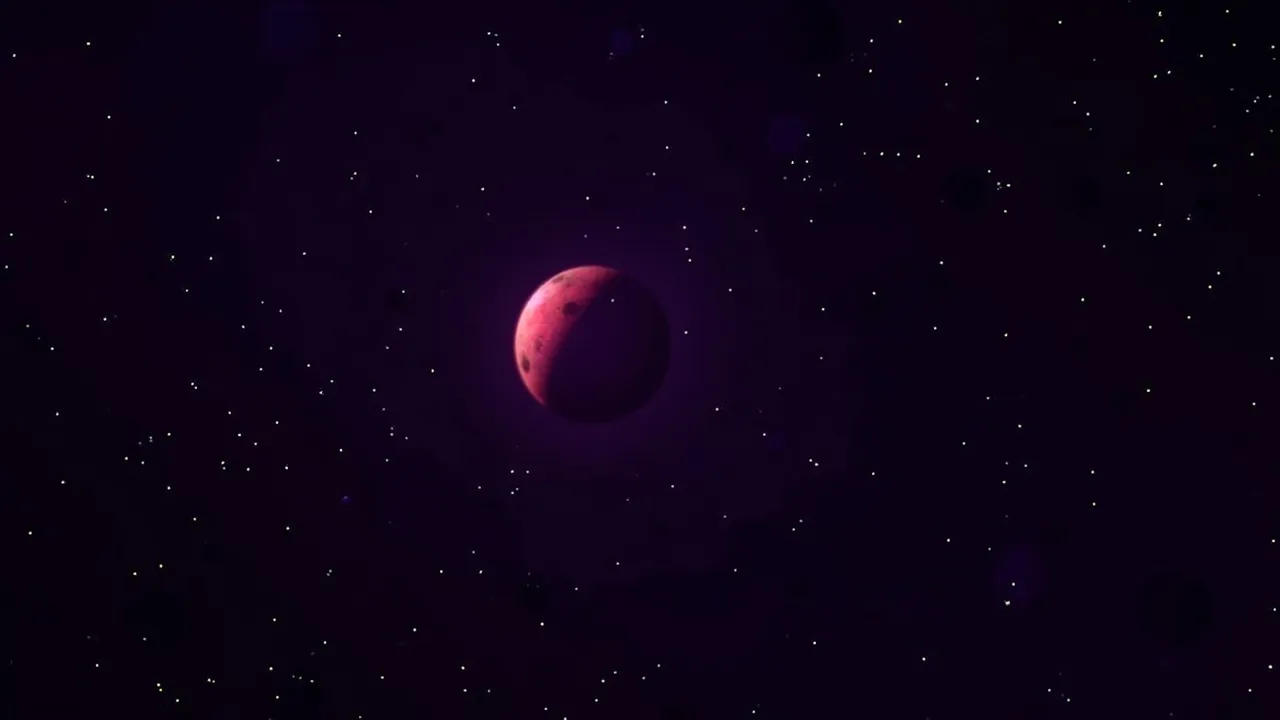
The Little Moon That Hid Its Scars
You know that feeling when you're staring at Mars through a telescope and suddenly remember it has moons? Neither of them gets much attention. Phobos gets all the glory, circling close and fast. But Deimos? Deimos just drifts there, quiet and overlooked.
Here's what blows my mind, though: we've known about these moons for over 150 years, and we still don't fully understand where they came from. I recently stumbled onto some research that's starting to change that, and honestly, it's kind of fascinating.
Two Weird Things About Deimos
Deimos looks like someone tried to sculpt a potato in zero gravity. It's lumpy, stretched out, and vaguely potato-shaped if you're being generous. But two things about it have always nagged at scientists.
First, there's this enormous gouge near its south pole. Imagine biting into an apple and leaving a massive chunk missing—that's basically what Deimos looks like. Scientists call it a large depression, and nobody could figure out how it got there.
Second, and this is the strange part: Deimos is suspiciously smooth. Its surface is buried under a thick blanket of dust and rubble. No other moon in our solar system looks quite like it. Meanwhile, Phobos nearby is pockmarked with craters like a teenager's face after a bad acne phase. Why is Deimos so different?
For years, these two puzzles seemed completely unrelated. Turns out, they might not be.
One Collision, Two Headaches
A fresh study published in Nature Astronomy has an answer that's almost elegant in its simplicity: one asteroid, one impact, both mysteries solved.
Researchers at the University of Bern ran an absolute ton of computer simulations—I'm talking hundreds of them—to test what could have happened to Deimos over billions of years. Their conclusion? An asteroid roughly 320 meters wide (about the length of three football fields) probably slammed into Deimos at a 45-degree angle. That single blow would have carved out the giant southern depression.
But here's the really clever part. When that space rock hit, it violently ejected material outward. All that debris eventually drifted back down and settled across Deimos like cosmic snow. In some areas, this accumulated layer could be over 200 meters deep. That's basically the moon hiding its old wounds under a thick, dusty blanket.
Dr. Sabina Raducan, who led the study, mentioned that each simulation took about a week to run. "We carried out about a hundred simulations," she explained. That adds up to a lot of coffee-fueled nights and humming servers.
The Data That Made This Possible
What makes this study actually stand out is where the data came from: ESA's Hera spacecraft.
In March 2025, Hera used Mars as a gravitational slingshot to build speed for its journey to Dimorphos (that's the asteroid NASA hit with the DART mission). But during that maneuver, it swung past Deimos and snapped some actual close-up images.
Think about it this way. Before, we had blurry, pixelated photos of Deimos—like trying to recognize a friend from a mile away. Hera handed scientists a pair of binoculars for the first time. We finally got a decent look at the thing.
The Secret Weapon: 20 Years in the Making
To actually model what happened, the team used specialized software called the "Bern Smoothed Particle Hydrodynamics" code. This isn't some quick simulation they threw together. The University of Bern has been developing this tool for about two decades.
The concept is fascinating if you're into that sort of thing. You break everything down into millions of tiny particles, each with its own properties, then watch what happens when a giant rock crashes into a moon. How do the particles move? Where do they end up? What happens to the surface?
This same software was used to predict what would happen when NASA deliberately crashed a spacecraft into Dimorphos. And the predictions were impressively accurate. So when this team says their models are reliable, they have good reason to be confident.
Why Should Any of This Matter to You?
Fair question. Beyond the obvious "space is cool" appeal (and it genuinely is), here are two concrete reasons this research matters.
Understanding how our solar system formed. The early solar system was chaotic—asteroids flying everywhere, colliding constantly. Studying Deimos helps us piece together what that wild period looked like. Every moon tells a story about the neighborhood it grew up in.
Protecting Earth. JAXA is planning a mission called MMX (Martian Moons eXploration) that will visit both Deimos and Phobos. The findings from this study could help decide where the spacecraft looks and what it investigates. Plus, Hera's main mission is studying what happens when you deliberately crash into an asteroid—and that's directly relevant to planetary defense. If we ever need to push a dangerous rock away from Earth, we'll want to know exactly how these impacts work.
The Big Takeaway
There's something deeply satisfying about scientific detective work like this. Two completely different mysteries—a giant bite mark and an unnaturally smooth surface—turning out to have the same explanation. It reminds me of finding out someone's weird-shaped scar and their fear of heights both came from the same childhood accident.
The universe keeps doing this. Throwing us puzzles that seem disconnected, until suddenly they click into a single story.
So next time you're outside and Mars is visible, take a second look. That little dot next to it? Deimos has been keeping secrets for billions of years.
We're finally starting to listen.