
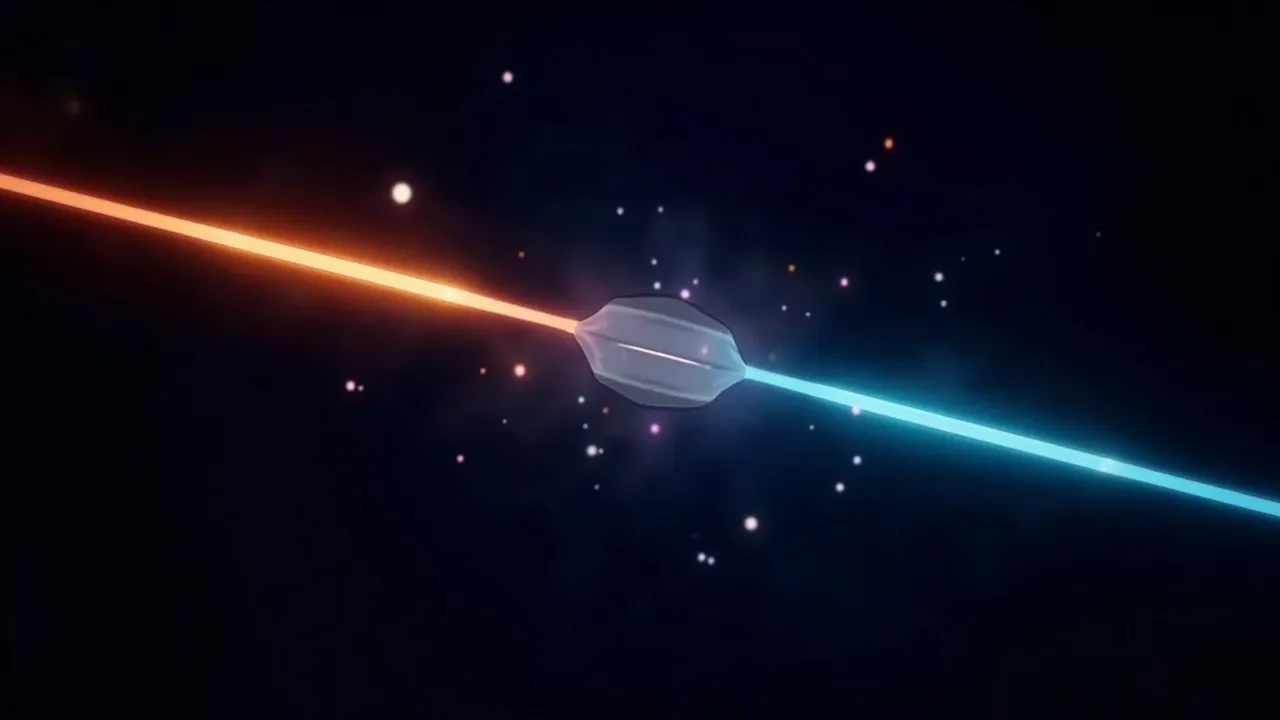
The Weirdest Experiment You Haven't Heard Of
Okay, I need to tell you about something that happened in a physics lab recently, and honestly? My brain still hasn't recovered.
Three physicists at the University of Oslo were having what sounds like a very nerdy dinner conversation: What actually happens if you try to cut a photon in half?
Simple question, right? Photons are just particles of light. You should be able to slice one up and get... well, two smaller chunks of light. Maybe.
But here's the thing—photons are "elementary particles," meaning they're not made of anything smaller. You can't just chop them like you might chop a bigger atom or molecule. They don't have an inside to expose.
Still, the researchers wondered: what if you tried to "truncate" a photon? Like using a shutter to snip off part of an optical pulse?
Here's Where It Gets Weird
When you cut away part of a photon, something completely counterintuitive happens.
Instead of ending up with two damaged halves of light, you actually create more photons.
I know. I had to read that sentence three times too.
The team's paper (published in Physical Review Letters, if you want to get fancy about it) puts it this way: by cutting away part of a photon, you "effectively create a bunch of new photons." Even if you close the shutter slowly.
The metaphor that comes to my mind is the mythological hydra—you cut off one head, and two more grow back. Except in this case, the hydra is made of light and the rules don't make any sense.
Why Photons Are Stranger Than You Thought
So why does this happen?
Here's the key insight: photons aren't symmetrical little packets of light. One side of a photon has what researchers call an "infinite tail." Imagine a wave that just... trails off forever in one direction. That's your photon.
Because of this asymmetry, where you make your cut actually matters a lot. A photon isn't a neat, uniform blob waiting to be split.
To figure out exactly what was going on, the Oslo team built what scientists call a "toy model"—a deliberately simplified version of the real situation so they could focus on the essentials. They imagined a single photon traveling in one dimension with a single polarization, heading straight toward a mirror-like shutter that would clip it mid-flight.
And what emerged from this clean little experiment?
One piece was pure vacuum—nothing. No photon at all. The other piece was a complete, whole single photon. They were completely separate, clean states, with no memory of ever being part of something larger.
Neither piece looked "cut." Both looked whole. But somehow the photon had... redistributed itself?
Why Hasn't Anyone Asked This Before?
The researchers themselves note that this is a question that seems obvious in hindsight, yet apparently nobody had bothered to ask it before. And I think I understand why.
When you're a working physicist, you're probably focused on practical problems—experiments that might lead to quantum computing breakthroughs, or new ways to transmit information, or understanding the fundamental structure of the universe. Sitting around wondering "but what if we just... cut a photon in half?" feels almost too simple.
And maybe that's the lesson here. Sometimes the questions that seem too basic to ask are actually hiding the most fascinating weirdness in physics.
What Does This Even Mean?
Now, I should be clear: this was a theoretical exercise using idealized models. Real-world setups would be messier. But the fundamental insight—that truncating a photon doesn't reduce its number but potentially increases it—seems to be real.
The researchers suggest that these kinds of truncated photon states might be easier to study using classical physics than quantum approaches. But for the rest of us just marveling at the strangeness, I think the takeaway is simpler:
The universe is way weirder than we give it credit for.
We like to think we understand light. We've known about photons for over a century. We use them for everything from communication to medical treatments. And yet, apparently, we still don't fully understand what happens when you try to snip one.
Physics isn't finished surprising us. And honestly? I can't wait to see what questions we haven't thought to ask yet.
Have you ever wondered about something so basic that you assumed someone else must have already answered it? Maybe the most interesting discoveries are hiding in questions we've been too embarrassed to ask.