
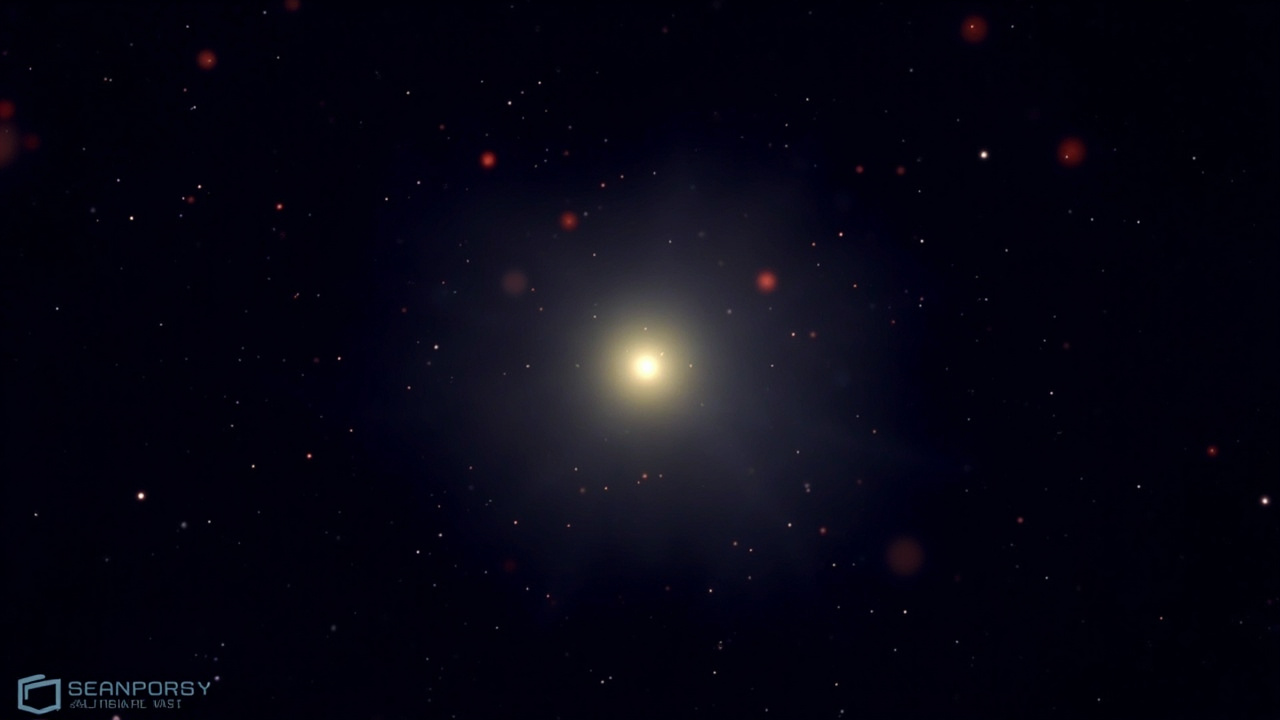
The Star That Wouldn't Stop Confusing Astronomers
Here's a fun fact: there's a star you can literally see from your backyard on a clear night that has been driving scientists absolutely bonkers for the past 50 years. It's called gamma-Cas, and it sits right at the center of the famous W-shaped Cassiopeia constellation. Pretty famous, right? Yet despite being one of the brightest stars visible to the naked eye, it's been hiding a secret that took half a century to uncover.
The weird part? Scientists kept detecting intense X-rays coming from this star—the kind of radiation that shouldn't be there according to everything they thought they knew about how stars work. It's like finding out your neighbor's house is secretly producing nuclear energy. Except in space. And somehow even cooler.
A Star With a Long Reputation for Being Difficult
The oddness around gamma-Cas actually goes back way further than the X-ray mystery. Way back in 1866, an Italian astronomer named Angelo Secchi was studying this star and noticed something completely unexpected in its light patterns. The star was showing bright lines where it should have been dark—basically breaking all the rules.
This quirk was so unusual that it actually created an entire new category of stars called "Be stars." The "B" stands for hot and blue-white, while the "e" stands for "emission lines"—that weird bright fingerprint in the light. Turns out, these stars are spinning like crazy fast, and all that spinning actually ejects material into space, creating a disc of glowing stuff around them. Kind of like the spinning motion a figure skater uses to kick up snow.
But here's where it got really weird: in the 1970s, astronomers detected X-rays coming from gamma-Cas. And not just a little bit—we're talking about X-rays that shouldn't exist, coming from plasma heated to about 150 million degrees. For comparison, the Sun's core is only 27 million degrees. This star was basically running around like it had a hidden furnace inside it.
The Mystery Gets Deeper
For decades, scientists had two competing theories. Maybe, they thought, the intense magnetic field around the star's spinning disc was creating these X-rays. Or maybe—and this is where it gets interesting—there was something hiding in the shadows nearby, something invisible, pulling material from the star and heating it up as it fell inward.
Picture it like this: imagine a vampire slowly sucking the life force out of a sleeping giant. Except the "vampire" is a compact stellar corpse called a white dwarf, and the "life force" is hot plasma that creates X-rays when it gets compressed. Grim? Maybe. Fascinating? Absolutely.
Scientists found about two dozen similar systems over the years, confirming that gamma-Cas wasn't alone in this bizarre behavior. But they still couldn't prove which theory was right.
The Game-Changer: Better Technology Finally Wins the Day
Enter XRISM (X-Ray Imaging and Spectroscopy Mission), a cutting-edge space telescope with an incredibly precise spectrometer called Resolve. Think of it like upgrading from binoculars to a high-powered microscope for studying space.
When astronomers pointed XRISM at gamma-Cas, they got their smoking gun. The hot plasma creating all those X-rays moved in perfect sync with the orbit of an invisible companion star. It wasn't magnetism. It was definitely the cosmic vampire scenario—a white dwarf (essentially a dead star crushed to Earth-size but with the mass of our Sun) was pulling material from gamma-Cas and heating it up in the process.
Mystery solved. Finally.
"It's extremely satisfying to have direct evidence to solve this mystery at long last!" said Yaël Nazé from the University of Liège, who led the research. And honestly? You can feel the relief in that statement. Fifty years of "hmm, we're not sure what's going on here" finally gets an answer.
So What Does This Actually Mean?
Here's why this matters beyond just scratching a scientific itch: understanding gamma-Cas helps us understand how binary star systems (two stars orbiting each other) actually form and evolve. Scientists thought these white dwarf + Be star pairs should be pretty common, but they're actually rarer than expected. Now that they know what gamma-Cas really is, they can build better models and understand stellar relationships in general.
Plus, there's something genuinely cool about watching scientists do what they do best: asking questions, making observations, gathering data, and eventually figuring things out. Even if it takes 50 years. Even if it requires international cooperation between Japanese, European, and American teams. Even if it means building space telescopes just to see something invisible.
That's how science actually works, and honestly? It's pretty inspiring.