
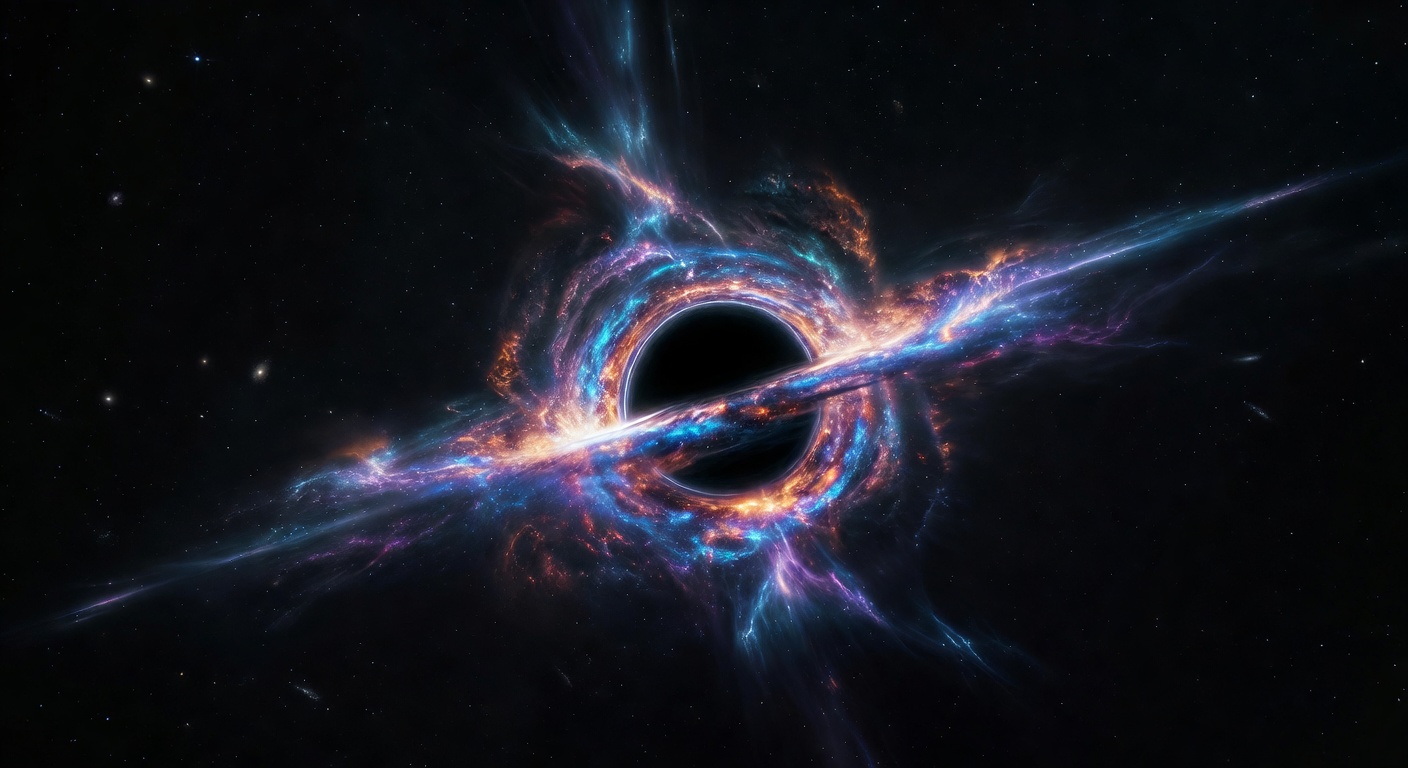
When Black Holes Take Century-Long Naps
Here's something wild: the universe is full of supermassive black holes just... hanging out. They're chilling at the centers of galaxies, not causing much trouble. But every now and then, one of them decides it's time to party.
That's what happened with the galaxy J1007+3540, and astronomers got front-row seats to the show.
Scientists recently observed this galaxy's central black hole firing up after roughly 100 million years of silence. To put that in perspective, that's like someone sleeping through the entire existence of modern humans and then suddenly yelling loud enough to be heard across a baseball field made of galaxies.
A Cosmic Volcano Like Nothing Else
The lead researcher, Shobha Kumari, described it perfectly: it's like watching a volcanic eruption, except this volcano is so enormous it could stretch from Earth to the outer reaches of our solar system... and then keep going. Way farther.
The jets of magnetized plasma shooting out from the black hole are pushing and shoving against the incredibly hot gas surrounding the galaxy. Imagine trying to blow a bubble underwater while someone keeps squeezing it from the outside—that's basically what's happening here, except on a scale our brains can barely comprehend.
Reading the Black Hole's Resume
Here's the really clever part: scientists could actually see evidence that this black hole has done this before. The newer jets from the recent wake-up call were clearly visible, but they could also see the older, faded remnants from earlier eruptions sitting around like cosmic ruins.
It's like finding your journal from five years ago next to something you just wrote today. The "handwriting" is completely different because so much time has passed.
Using super-sensitive radio telescopes in the Netherlands and India, researchers mapped out these layers of activity. The newer jets appeared bright and compact. The older material? Faint, stretched out, and definitely tired-looking.
When Your Environment Pushes Back
Here's where things get even more interesting. J1007+3540 isn't just hanging out in empty space. It's embedded in a massive cluster of galaxies filled with extremely hot gas. All that surrounding pressure is literally bending and warping the black hole's jets.
One of the lobes got squished so much that it now has an "ultra-steep radio spectrum"—which is fancy astrophysicist-speak for "this stuff is really old and exhausted."
There's even a faint tail of plasma stretching outward, being dragged through the cluster like a comet's tail. It's been there for millions of years, a permanent scar left by the black hole's previous tantrums.
Why This Matters More Than You Might Think
When you're studying something like J1007+3540, you're not just geeking out over one weird galaxy. You're learning about how the entire universe works.
These "episodic" black holes—the ones that turn on and off over cosmic timescales—help us understand:
- How often black holes actually flip between sleep and awake modes (spoiler: it's complicated)
- How ancient plasma behaves when it meets modern jets (they don't always play nice)
- How the environment around a galaxy can literally reshape it (it's way more powerful than we used to think)
Instead of galaxies growing smoothly and steadily, it looks like they're more like a tug-of-war between the immense power of black hole eruptions and the crushing pressure of the surrounding universe.
What's Next?
The research team isn't done. They're planning to use even higher-resolution instruments to zoom in on the center of J1007+3540 and watch how the newly-reactivated jets continue pushing their way through this hostile environment.
Every observation brings us closer to understanding one of the biggest questions in astronomy: what exactly triggers these cosmic wake-up calls, and how do they shape the galaxies they're supposed to be sleeping inside?
For now, we just get to enjoy the show—a black hole's ultimate power move playing out across nearly a million light-years of space.