
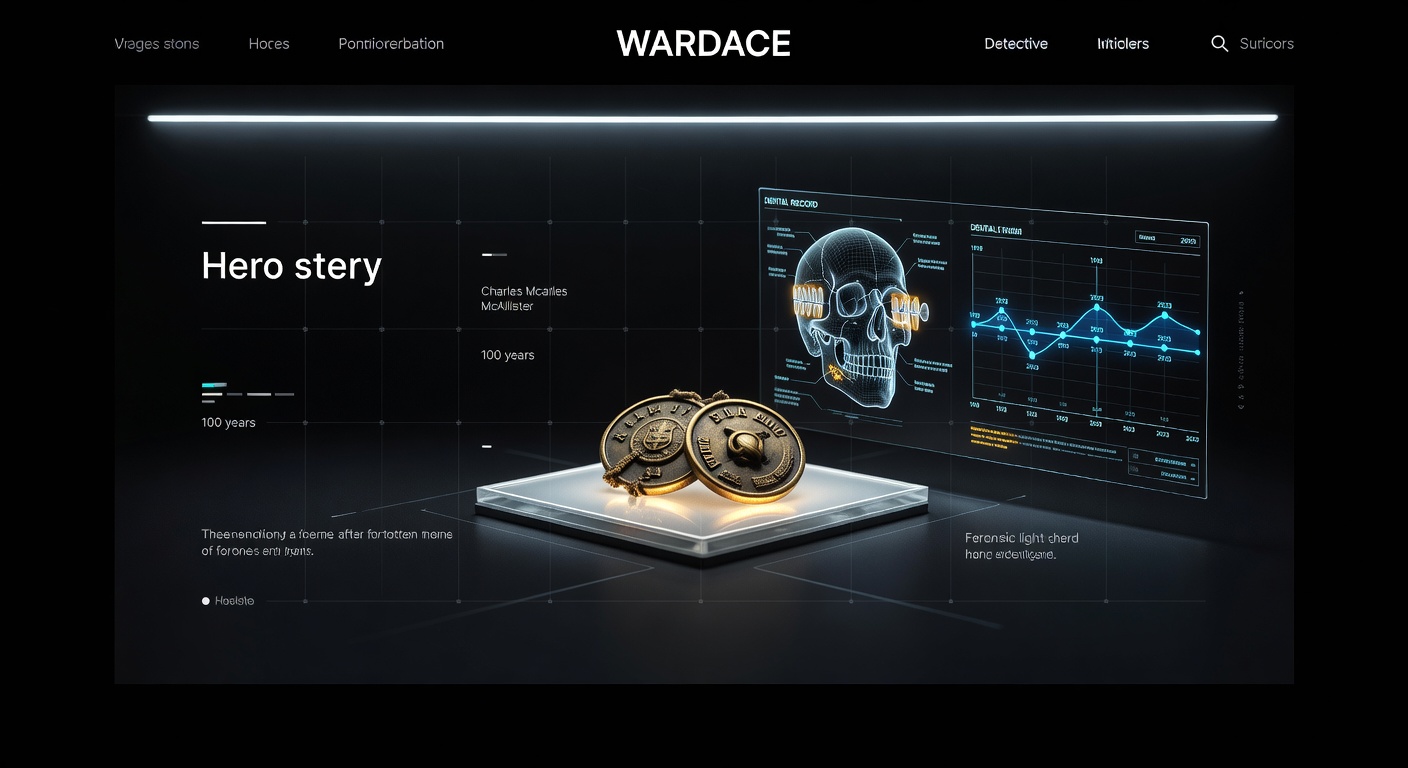
A Century of Waiting: How Two Forgotten Buttons Finally Brought a WWI Hero Home
There's something deeply unsettling about not knowing. In the aftermath of World War I, thousands of American families faced exactly that nightmare—loved ones who went to war and simply... didn't come back. No body, no closure, just endless wondering. For Charles McAllister's family, that uncertainty stretched on for 106 years.
The Battle That Swallowed Soldiers
July 1918. The Franco-American counter-offensive at Aisne-Marne was supposed to be a turning point in the Great War. Instead, it became a meat grinder. Over 1,000 American soldiers vanished in the chaos—some buried in unmarked graves, their identities lost to history.
Charles McAllister was one of them.
Eighty-Five Years Later, A Chance Discovery
Fast forward to 2004. French archaeologists were doing construction work near the old battlefield when they uncovered something unexpected: human remains. Not just one set, but two American soldiers, still in uniform, still clutching the artifacts of their final moments.
One soldier had a wallet with his name embossed on it—Francis Lupo. Easy identification, closure granted. But the other? Just skeletal remains and some uniform buttons. Nobody had any idea who he was. The military gave up. He became a case number: CIL 2004-101-I-02.
And there he sat. Forgotten.
The Detective Who Couldn't Let It Go
Enter Jay Silverstein, a forensic archaeologist who was working at the military's central identification lab when these remains arrived. Fourteen years later, as the 100-year anniversary of the soldier's death approached, something sparked in Silverstein's mind. What if?
He decided to reopen the case. On his own time. Using materials nobody had properly connected before.
Here's the thing about being a real detective (whether you're solving murders or identifying soldiers from a century ago): you work with what you have. And what Silverstein had was... two buttons.
Two Buttons. That's It.
One button said "WA." The other had a "2" and a "D" split between two crossed rifles.
To most people, those are just buttons. To Silverstein, they were a Rosetta Stone.
The "WA" meant Washington State. The crossed rifles with "2" and "D"? That's military shorthand for the 2nd Regiment, Company D of the Washington State National Guard. This was someone's entire military identity stitched onto fabric.
Silverstein also noticed the soldier had been buried with a medal from the 1916 campaign against Mexico. That narrowed things down significantly. He cross-referenced military maps, campaign records, and historical data to identify which regiments were actually in that location on that specific date.
The field narrowed from 1,000 missing soldiers to hundreds. Then to dozens. Then to just four men from Company D who matched the timeline.
The Final Puzzle Pieces
With four names, Silverstein pulled their military records. He compared heights. He examined dental patterns. One by one, he eliminated three of them.
That left Charles McAllister.
But even Silverstein, the thorough detective that he is, knew he needed to be absolutely certain. He reached out to Beverly Dillon, a descendant of McAllister's family. Beverly had something precious: the last letter her great uncle had written before shipping out to France.
And she had something even more useful: her DNA.
Mitochondrial DNA analysis confirmed it. The probability wasn't 99%. It was impossible for these remains to belong to anyone else. After 106 years, Charles McAllister finally had a name.
What This Actually Means
Here's what gets me about this story: it's not just about solving a historical mystery, though that's cool. It's about a forensic expert who cared enough to spend his personal time on a case everyone else had written off.
It's about how two ordinary buttons became evidence. How someone's military unit insignia could survive a century buried in French soil and still tell the story of who wore it.
And it's about a family finally getting to say goodbye to someone they'd been mourning—incompletely—for their entire lives.
Charles McAllister is finally going home to Seattle. He'll have the military funeral he deserved in 1918. His great-niece Beverly will be there. A century late, but it's happening.
In a world of unsolved mysteries and cold cases, sometimes persistence, curiosity, and two forgotten buttons are enough to write a different ending.
Sources: https://www.popularmechanics.com/science/a70963122/wwi-missing-soldier-forensic-discovery