
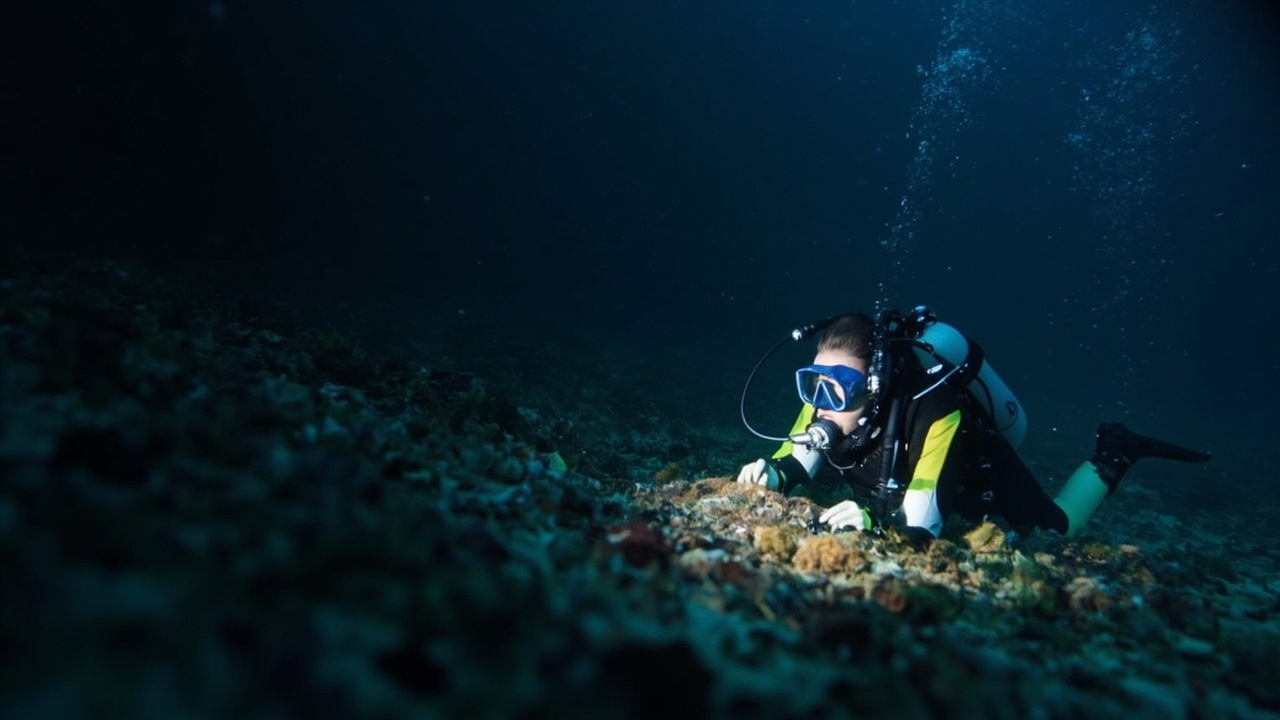
You're floating in the crystal-clear water off Sardinia, minding your own business, when something glints at you from the sandy bottom beneath the seagrass. You reach down, pick it up, and realize it's... a coin? An ancient one?
That's exactly what happened to a diver back in May 2023 near Arzachena on the Italian island of Sardinia. And honestly? What he found might honestly be the coolest thing I could ever imagine happening underwater.
The Discovery That Started Small
The diver noticed something metallic poking out of the seagrass near a sandy clearing. Nothing huge at first — just one object. But once investigators got involved, they realized they'd barely scratched the surface.
We're talking about at least 30,000 coins — and possibly as many as 50,000. Let that number sink in for a second. That's not a handful of coins sitting in a display case. That's a literal treasure scattered across the seafloor.
The Italian culture ministry's initial estimates put the total at over 30,000 coins, with later reporting suggesting figures closer to 40,000 or even 50,000 when all is said and done. These weren't gold, unfortunately (though that would have been nice). We're dealing with bronze and copper folles — the coins the Romans used, then later the Byzantine Empire continued using. Think of them as the everyday currency of their time, the coins people would have used to buy bread, wine, and amphorae of olive oil.
Roman Coins That Survived 1,700 Years
Here's what's absolutely wild to me: these coins were in incredible condition. The ministry described the state of preservation as "excellent and rare." For coins that have been sitting on the seafloor since the 300s CE, that's remarkable. I mean, we've had phones in the ocean for a few months and they barely work, but bronze coins? Still looking good after nearly two millennia.
The studied samples date the hoard between 324 and 345 CE, which puts us squarely in the late Roman period. This was a time when the Roman Empire was in its final phases but still very much functioning. These coins would have been in circulation when people were buying and selling across the Mediterranean, likely loaded onto ships heading somewhere with valuable cargo.
Wait — Is There a Shipwreck?
Here's where it gets really interesting. And this is the part that makes my archaeologist heart go pitter-patter.
The coins were found scattered across two large areas of dispersion, not just one neat pile. Divers also documented fragments of narrow-necked amphorae — those classic two-handled storage vessels you see in every historical drama about ancient shipping. That pattern, according to the ministry, could fit a shipwreck scenario.
Picture this: a merchant ship, probably somewhere between 324 and 345 CE, loaded with coins to pay for goods at its destination. Something goes wrong — maybe a storm, maybe hitting rocks — and down she goes. The amphorae break open, the coins scatter across the seafloor, and slowly, piece by piece, they get covered by seagrass and sediment over the centuries.
That's one possibility, anyway. Maybe it wasn't a shipwreck at all. Maybe the coins were deliberately cached underwater as a hidden treasure by someone who never came back for them. Or maybe we're looking at something else entirely that archaeologists will figure out in the next few years.
The honest truth? We don't know yet. And honestly? That uncertainty is part of what makes this so exciting. The investigation is ongoing, and a final archaeological interpretation is still pending.
You Can't Just Keep What You Find
Now, here's a plot twist that might surprise you. So the diver does everything right — he contacts the authorities immediately, and teams from Italy's art-protection police, the ministry's underwater archaeology office, firefighters, and border police all show up to help with the recovery. Good citizen behavior, right?
But then it got legal. In a January 2026 ruling, the Administrative Court of Sardinia actually rejected the diver's claim for a statutory reward. The reasoning? The court decided this wasn't a truly "fortuitous" discovery — meaning the diver had used a metal detector to search the area, and evidence suggested the spot was already known to be potentially archaeologically significant.
So yeah, sometimes doing the right thing isn't always the profitable thing. The diver followed the law by reporting it, but he didn't get the finder's reward that Italian law sometimes provides for accidental discoveries. Just a friendly reminder: if you ever find something ancient while diving, definitely report it, but know that the legal picture can get complicated fast.
Where Will These Coins Live?
The natural question: after all this effort, where do these coins actually end up?
From what was reported at a December 2023 public presentation in Sassari, part of the cleaned and cataloged material was expected to go to Arzachena's civic museum. But here's the thing — as of mid-2026, they're still not on public display. Archaeological preservation and cataloging takes time. Finding, cleaning, dating, and documenting 30,000 to 50,000 coins? That's going to keep experts busy for quite a while.
Which is honestly a bummer in some ways. We're all here imagining these coins, but we can't actually go see them yet. Patience, apparently, is a virtue that extends to archaeology just as much as everywhere else.
What This All Means
Luigi La Rocca, the director general of archaeology for the region, put it beautifully: the find "highlights the richness and importance of the archaeological heritage that our seabed, traversed by men and goods since the earliest times, still guards and preserves."
He's right. We're constantly捡-ing up stories about lost treasures, hidden shipwrecks, and forgotten civilizations from the land, but the ocean? We forget that the Mediterranean was essentially the ancient world's highway. Ships were moving people, goods, and yes — coins — across those waters for centuries. And most of that history is still down there, waiting for someone like that diver to stumble upon it.
So the next time you see a postcard of Sardinia's beautiful beaches, remember what's hiding just offshore. Ancient coins. Maybe amphorae fragments. Possibly an entire shipwreck we haven't found yet.
All it took was one diver with a curious eye and some luck.
What do you think? Would you rather find 50,000 Roman coins or actually discover the shipwreck they came from? I'm honestly not sure which would be cooler. Drop me a comment — I love hearing your thoughts on stuff like this.
Source: Popular Mechanics