
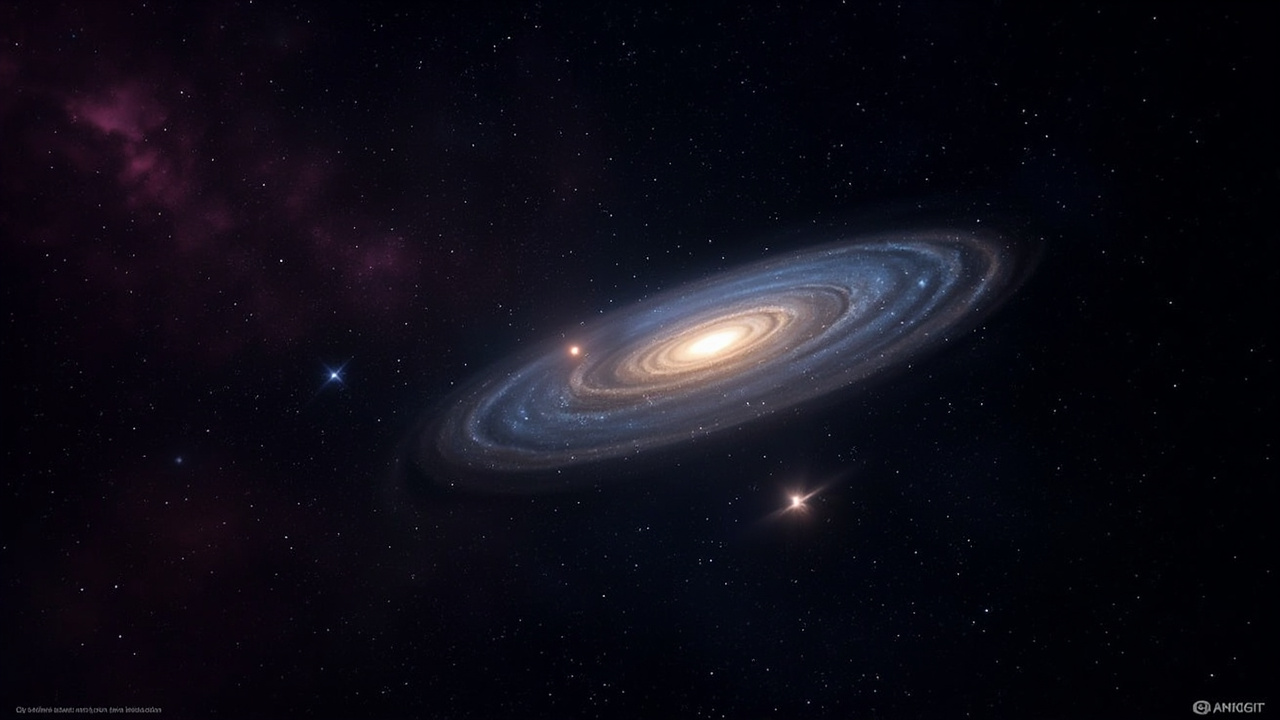
Have you ever felt like your life was on a path you couldn't control? Like forces bigger than you were gently (or not so gently) nudging you in a direction you didn't choose?
Well, buddy, you and I aren't alone.
Meet M88: The galaxy going places it never asked to go
The Hubble Space Telescope recently captured a stunning image of something called Messier 88 (or M88, if you're into the whole brevity thing). This is a spiral galaxy — you know, the kind with those pretty curved arms spiraling out like cosmic cinnamon rolls — sitting about 63 million light-years from Earth. That's roughly 63 million light-years of "if you could see this, what you're seeing already happened before your great-great-great-grandparents were born."
M88 is absolutely gorgeous in the new image. At its heart sits a supermassive black hole roughly 100 million times heavier than our Sun, actively snacking on gas and dust. Surrounding this cosmic munching machine? A warm, reddish glow of older stars, with bright pink and blue star clusters tracing its spiral arms through space.
It's genuinely beautiful. It looks like a frozen moment in time, doesn't it?
But here's the thing: this galaxy is moving, and it can't stop.
The Virgo Cluster: When a thousand galaxies become neighbors
M88 belongs to something called the Virgo Cluster. Think of it as the universe's most exclusive neighborhood committee — except instead of arguing about lawn care, these galaxies are bound together by gravity and constantly orbiting each other like some impossibly slow cosmic dance.
The Virgo Cluster contains over 1,000 galaxies. And M88? It's currently about two million light-years from the cluster's center, which sounds like a lot until you realize it has to keep traveling inward.
Why? Gravity. That's really it. The combined mass of all those galaxies pulls everything toward the middle. M88 is on a path with a destination, and it doesn't get a vote in the matter.
The encounter that will change everything (in 200-300 million years)
Here's where things get dramatic. Scientists predict that in about 200-300 million years, M88 will make its closest approach to something called Messier 87 (M87). M87 is the big kid on the block — a giant elliptical galaxy that dominates the Virgo Cluster like the kid who showed up to the neighborhood skate party with a professional halfpipe.
The problem isn't just gravity, though. It's something called ram pressure stripping.
Imagine you're driving a car (the galaxy) through a thick fog (the hot gas filling galaxy clusters). The resistance you feel pushing against your windshield? Multiply that by about a bajillion, and you've got ram pressure stripping. As M88 gets closer to M87, it will plow through the hot gas surrounding the cluster, and that pressure can literally blow away huge portions of the galaxy's own gas.
Not metaphorically. Literally rip gas right off the galaxies.
And this is already happening. Scientists have noticed that M88's gas disk looks compressed and shortened along its leading edge — like snow piling up in front of a plow. The gas and dust are bunching up where the galaxy is "facing" its direction of travel. It's a preview of what's coming.
The real tragedy: What happens to star formation?
Here's where I get a little melancholy about this whole cosmic saga.
You know what galaxies need to make new stars? Cold gas. It's the raw material, the ingredients, the flour and sugar of stellar creation. Without it, a galaxy can't make new stars. It can only fade, slowly using up what little it has left.
And here's the devastating part: M88 already has significantly less cold gas than it should for a galaxy its size, especially in its outer regions. The journey through the Virgo Cluster is actively stripping it away.
Scientists studying M88 as part of a Hubble observing program have found evidence that this galaxy's star formation future is looking bleaker. Every million years it spends navigating this cosmic neighborhood, it's losing more fuel. Every pass near M87 will be another haircut it can't refuse.
Eventually, M88 might transform from a vibrant spiral galaxy full of active star formation into something quieter. Something gentler. Maybe even something that doesn't look like what it started as.
We're watching a transformation happen in slow motion
What's got me genuinely fascinated about this story is that we get to watch it happen. This isn't theoretical physics happening in some equation or simulation — we're literally observing a galaxy in the middle of a life-changing journey. Hubble's Wide Field Camera 3 can resolve individual star clusters and nebulae in M88 despite it being tens of millions of light-years away, and every image we take is another chapter in this unfolding story.
The universe doesn't just happen to galaxies and stars. They evolve. They change. They respond to forces beyond their control, just like us.
M88 won't see M87 for another few hundred million years. The stripping will intensify. It might survive as a galaxy — or it might merge with the giant and become something new entirely. The spiral arms that make it so recognizable now might dissolve. The black hole at its center might grow. Stars might scatter.
But for now? We've got the most gorgeous portrait of a galaxy caught in the middle of its own story, spinning helplessly toward its own transformation.
Sometimes I look at that image and think about how many of us are mid-journey too — headed toward something that will change us, already feeling the pressure of forces we didn't choose.
If M88 could talk, I wonder what it would say.
For now, I guess we'll just keep watching.
Source: https://www.sciencedaily.com/releases/2026/06/260601025329.htm