
When a Tiny Ship Took On a Giant
Imagine you're commanding a Navy destroyer. You're heavily outgunned. The enemy has bigger guns, more ships, and more firepower than you could ever hope to match. Your mission? Buy time for your friends to escape, knowing full well that you probably won't make it out alive.
That's exactly what USS Johnston's captain, Commander Ernest Evans, faced on October 25, 1944.
During the Battle of Leyte Gulf in the Philippines, a small American task force called "Taffy 3" found itself staring down a massive Japanese fleet. We're talking about six escort carriers (basically floating targets) being protected by just three destroyers and four destroyer escorts. And they were up against four battleships, six heavy cruisers, two light cruisers, and eleven destroyers.
Oh, and one of those battleships? The Yamato—literally the biggest, baddest battleship ever built by any nation. Its guns were 18 inches wide. The Johnston's guns? A measly 5 inches. That's like bringing a BB gun to a tank fight.
The Crazy Part? It Actually Worked
Here's where things get genuinely wild. Instead of running away or surrendering, Evans did something that should've gotten him killed immediately: he charged directly at the Japanese fleet. His tiny destroyer, along with the other escorts, basically threw themselves between the massive Japanese force and the American carriers, hoping to buy enough time for the big ships to escape.
They succeeded. The Johnston damaged the Japanese heavy cruiser Kumano badly enough to force it out of action. But the cost was staggering—the destroyer was struck multiple times and sank after just 2.5 hours of battle. Only 141 of 327 crew members survived.
Evans? He was awarded the Congressional Medal of Honor posthumously. Thousands of lives were saved because a man with a smaller gun refused to back down.
77 Years in the Abyss
For decades, nobody knew exactly where the Johnston had ended up. The battle happened over the Philippine Trench, one of the deepest parts of the ocean, so people assumed finding it would be basically impossible.
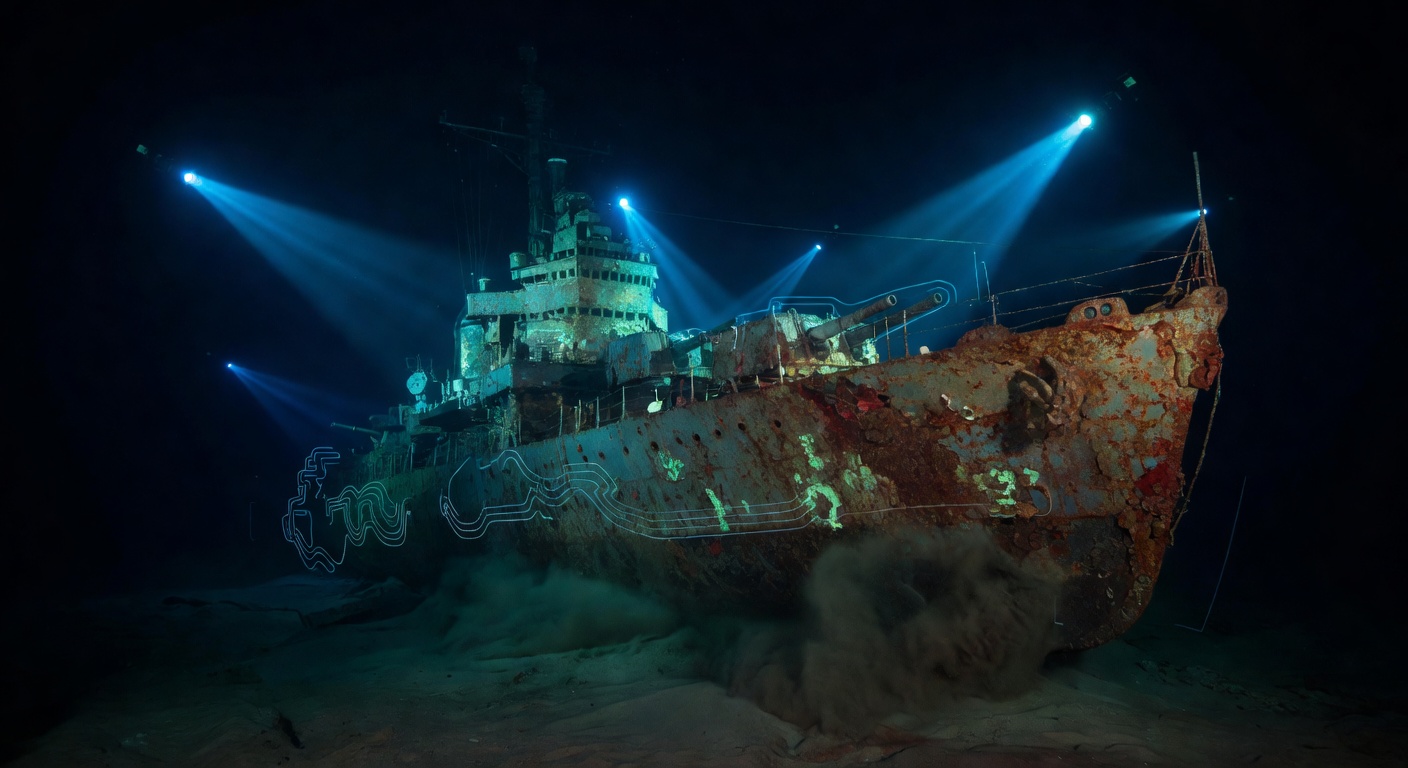
Then in 2019, an underwater exploration team discovered a Fletcher-class destroyer wreck at an absolutely insane depth: 21,180 feet. That's roughly four miles straight down. But here's the problem—they couldn't tell if it was the Johnston or the USS Hoel, another destroyer that went down in the same battle.
Fast forward to 2021. A team from Caladan Oceanic (founded by two former Navy officers) used a special manned submersible called the Limiting Factor to dive down to the wreck. Not once, but twice. Eight-hour dives each time. These were literally the deepest wreck dives ever recorded in human history.
And when they got there? The proof was unmistakable. The hull number 557 was still visible on the bow, clear as day despite nearly eight decades underwater. The team also photographed the bridge, the torpedo tubes, and those 5-inch guns that had fought so bravely against impossible odds.
Leaving a War Hero to Rest
Here's what really gets me about this story: they didn't recover anything. They didn't pick it apart for artifacts or salvage. They left the Johnston exactly where it was.
That's because the USS Johnston isn't just a shipwreck—it's a grave site. The U.S. Sunken Military Craft Act, passed in 2004, legally protects all American naval wrecks from looters and treasure hunters. The wreck is where it belongs: a memorial to the 186 sailors who never came home, resting in peace in the deep.
There's something beautiful about that. In a world obsessed with "discovering" and "recovering," sometimes the most respectful thing you can do is just leave something alone. Let it be a monument.
The USS Johnston's story reminds us that bravery isn't about having the biggest gun or the best odds. It's about doing the right thing anyway. And nearly eight decades later, we finally got to say: "We found you. We remember what you did."