
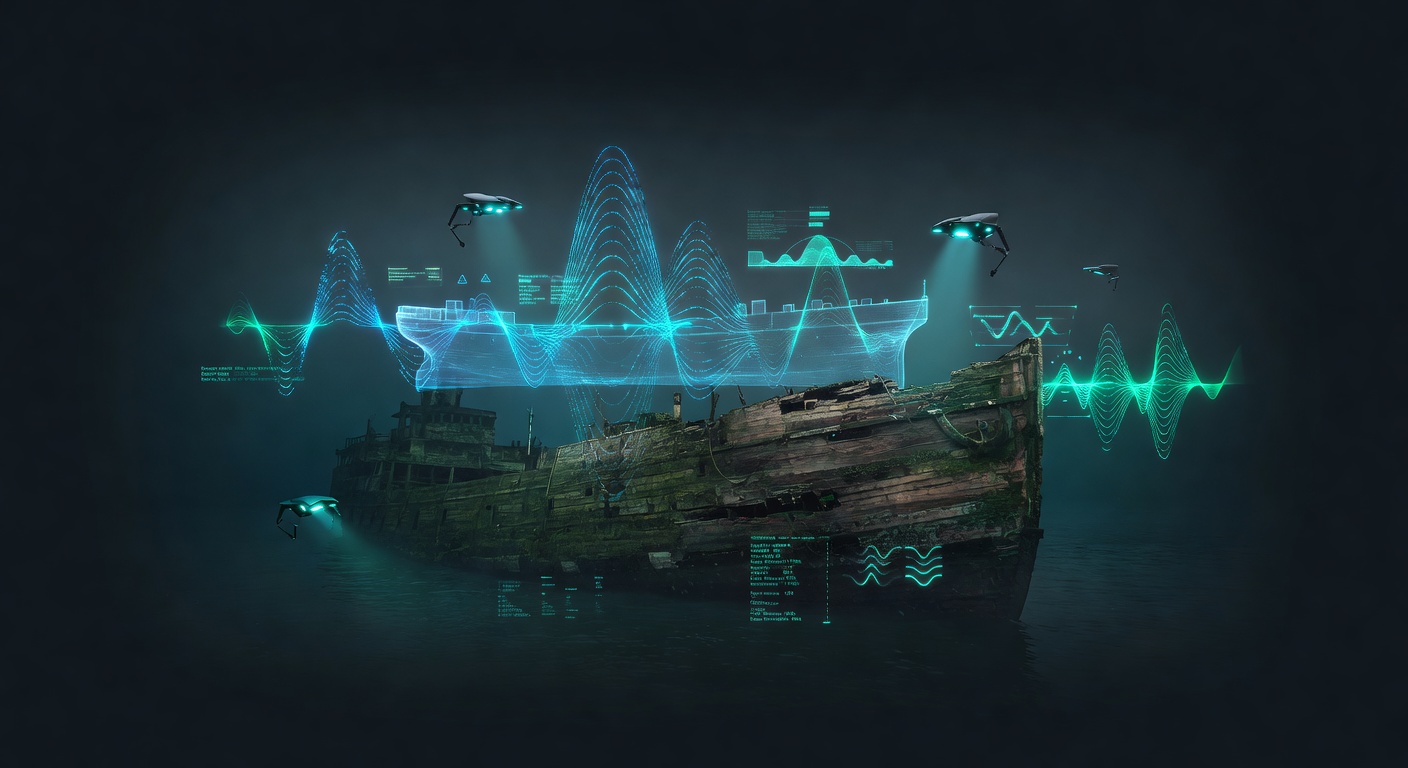
A Ghost Ship's Homecoming: How Modern Tech Found a Wreck Lost in Time
There's something hauntingly romantic about shipwreck stories. A vessel disappears into history, swallowed by water and time, leaving behind only newspaper clippings and unanswered questions. But what if I told you that one of Lake Michigan's most dramatic shipwrecks just came home after more than a century?
The Night Everything Changed
Picture this: July 1886, Lake Michigan, just after midnight. The steamship Milwaukee is cruising along calm waters, headed to pick up a fresh cargo of lumber. The crew is probably relaxed—visibility is good, conditions are perfect. Then, out of nowhere, a thick wall of fog rolls in like someone's thrown a blanket over the entire lake.
This is where things go sideways fast.
The Milwaukee's lookout spots lights from another ship, the C. Hickox, coming straight at them on an identical heading. Navigation rules are clear: both captains should slow down, turn right, and signal with their steam whistle. Straightforward stuff. But here's the kicker—with clear visibility just moments before, neither captain bothered to slow down.
The fog thickens. The Hickox's captain tries to turn, but his steam whistle's chain snaps. No signal. The Milwaukee's captain doesn't budge. For just a moment, the fog clears enough for both crews to realize what's about to happen, but it's too late. The Hickox slams directly into the Milwaukee's side.
Two hours later, despite desperate attempts to rig ropes and keep the stricken ship afloat, the Milwaukee slipped beneath the surface in 360 feet of water—40 miles from Holland, Michigan. It would vanish from human knowledge entirely.
Fast Forward to 2024
Here's where it gets cool. The Michigan Shipwreck Research Association decided to look for the Milwaukee. Using historical newspaper accounts and an understanding of water currents, they fired up their sonar equipment and basically said, "We're going to find you in two days."
And they did.
I mean, come on—that's impressive. Two days of searching in a massive lake, and boom, sonar paints a picture of wreckage on the bottom. A few weeks later, they sent down a remotely operated vehicle (ROV) to get a better look, and what they found absolutely blew my mind.
The Milwaukee was sitting upright on the lake bottom, in perfect condition, facing the exact same direction it was when it went down 137 years ago. The forward mast was still standing. The ship's structure was remarkably intact—like it had been carefully placed there and preserved in time.
The Ships Tell Their Own Story
What's fascinating about the Milwaukee isn't just that it survived in pristine condition (thanks to the cold, oxygen-poor lake environment—nature's perfect time capsule), but the story the ship itself could tell about how it ended up on Lake Michigan at all.
The Milwaukee was originally built in 1868 as a sleek steamship designed to fit through the Welland Canal locks, which meant it could move freely between Lake Ontario and Lake Erie. It was a workhorse for the Northern Transportation Company, one of the earliest steamship operators on the Great Lakes.
But then the 1873 Wall Street panic happened—remember that? Economic depression. Railroads started expanding westward. The shipping companies got hammered. The Milwaukee was passed around like a hot potato, eventually getting bought and modified multiple times. By the 1880s, it was owned by a guy named Lyman Gates Mason from Muskegon, who basically gutted the ship to maximize lumber capacity.
These modifications made it tough for researchers to identify the wreck with certainty—photos from before the changes didn't match perfectly with what was sitting on the lake bottom. But once the ROV got down there and researchers studied the footage, they could see exactly what Mason had done: made the pilothouse and aft cabin smaller to cram in more lumber.
Why This Matters More Than You'd Think
Finding the Milwaukee isn't just about satisfying our curiosity about old ships (though, let's be honest, that's pretty satisfying). This discovery marks the 19th shipwreck the Michigan Shipwreck Research Association has found off the coast of West Michigan. They're basically becoming the detectives of lake history, using modern technology to solve 19th-century mysteries.
What I love about this story is how it connects the dots between different eras. You've got 1880s captains making split-second decisions in fog that seals a ship's fate. You've got early industrial tragedy and human error. Then, 137 years later, sonar technology brings that story back to the surface in perfect clarity. It's like watching history do a slow-motion rewind.
And those captains who were negligent that night? Both had their licenses suspended. At least there was some accountability, even if it couldn't bring back the Milwaukee.
The Lake's Perfect Preservation
One detail that absolutely fascinates me: the Milwaukee survived intact because Lake Michigan is essentially a deep freezer. The cold water and lack of oxygen down at 360 feet mean that the wooden ship didn't rot or deteriorate the way it would have in shallower, warmer water. Wooden shipwrecks in the Great Lakes are often preserved almost perfectly—it's like finding a ship in amber.
This is why the Great Lakes are basically a museum of maritime history. And it's why researchers keep searching. Every wreck found is another chapter of American history literally rising from the depths.
The Fog Never Lies
Here's what gets me about the Milwaukee's story: the fog that caused the accident is the same fog that's been obscuring the ship's location for 137 years. It took modern technology—sonar imaging, remotely operated vehicles, and database research—to punch through that metaphorical fog and bring the truth back up.
The captains who were too confident in the calm waters that preceded the fog made a fatal mistake. Sometimes the old saying is true: pride comes before a fall. In this case, it was pride—or maybe just human nature—that sent the Milwaukee to the bottom of the lake in the middle of the night.
But at least now, we know what happened. At least now, the Milwaukee can finally be known and understood again. And that, to me, is worth celebrating.
Source: https://www.popularmechanics.com/science/a70936614/ship-found-intact-in-lake-michigan