
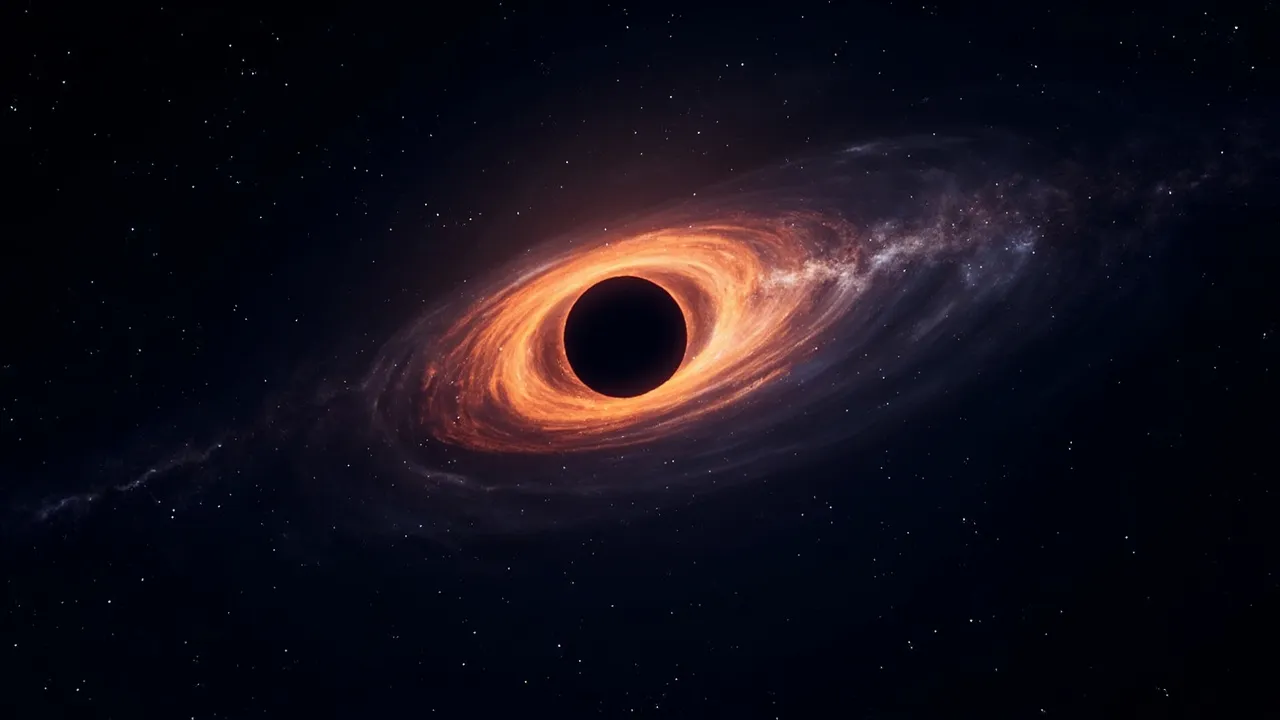
When Black Holes Go Rogue
Okay, let me tell you about something that's been blowing my mind all week.
Imagine you're a supermassive black hole — one of those absolute unit cosmic objects with millions or billions of times the mass of our Sun. You've spent billions of years just vibing at the center of your galaxy, being the dramatic gravitational anchor that holds everything together. That's your spot. That's where the cool black holes hang out.
But this black hole? It got evicted. Or maybe it just... wandered off. Scientists aren't entirely sure.
NASA's Neil Gehrels Swift Observatory recently spotted one of these cosmic heavyweights a whopping 30,000 light-years from its galaxy's center. For reference, that's about a third of the distance from Earth to the other side of our own Milky Way. In cosmic terms, this thing is basically living in the suburbs while its galaxy's actual black hole is downtown.
And it was hungry.
A Stellar Crime Scene
Here's what happened: a star made the fatal mistake of drifting too close to this wandering black hole. The black hole's intense gravity — and I mean intense — stretched and tore that star apart in what's called a tidal disruption event.
When this happens, the star doesn't go quietly. It creates one of the most spectacular light shows in the universe. In this case, the resulting flare burned with the brilliance of about ten billion suns at its peak. Scientists watching from Earth saw something shine brighter than the entire galaxy surrounding it.
For months.
The whole thing started back in November 2025, when the Zwicky Transient Facility — a sky survey telescope in California — picked up this unusual flash. But here's what makes it special: their AI algorithm flagged it because it looked like a tidal disruption event, except... it wasn't in the right place. These events are supposed to happen near galactic centers, where all the massive black holes hang out.
This one was way off the map.
Why This Discovery Is Actually Huge
Let me break down why astronomers are so excited about this.
For basically as long as we've been studying supermassive black holes, we've assumed they all live in galactic cores. It made sense — these enormous objects formed alongside their galaxies, and gravity brought them together at the center where they could be all dramatic and gravitationally dominant.
But this discovery? It's validating a whole new way of finding black holes that were basically invisible to us before.
"We were looking for these star-shredding events as a way to find otherwise invisible supermassive black holes wandering away from the galactic cores where they usually reside," said Robert Stein, a researcher at the University of Maryland and NASA's Goddard Space Flight Center.
Think about that. There could be supermassive black holes just... floating around out there, outside their home galaxies, and we'd have no idea they existed unless we caught them in the act of destroying a star. It's like discovering that some apartment buildings have residents who don't actually live in any building at all.
So How Did It End Up There?
This is the really juicy question, and honestly, the answer is kind of wild.
The leading theory is that this black hole didn't start in the galaxy where it was found. Instead, it probably came from a smaller galaxy that got absorbed during a merger. You know how the Milky Way is going to eventually merge with Andromeda? When that happens, both galaxies' central black holes will eventually interact, and the dynamics get... complicated.
Researchers think three or more galaxies might have merged, and their black holes got into a gravitational dance that basically kicked the smallest one out to the cosmic equivalent of the countryside.
Another possibility? A dwarf galaxy is currently in the middle of merging with the larger one, and this black hole got caught at the edge of the interaction zone.
Either way, this rogue black hole is essentially a refugee from an ancient galactic merger. It's been wandering alone through space, probably for billions of years, and it finally found a snack.
What This Means For Astronomy
Before 2024, every single confirmed tidal disruption event had been found in a galactic core. That was partly because that's where we were looking, but also because we just assumed that's where the massive black holes were.
This discovery changes everything.
It's validating a new technique: using these violent stellar destruction events as beacons to find black holes that would otherwise be completely invisible. If we can spot them when they're eating, we can start mapping out how many of these cosmic wanderers are actually out there.
And honestly? That kind of shifts how we think about galaxy evolution. If black holes can get kicked out of their homes and wander through the universe, that affects how galaxies form, merge, and grow over time.
The universe is getting more interesting by the day, folks. And we're just barely starting to see how much we don't know.
Source: ScienceDaily