
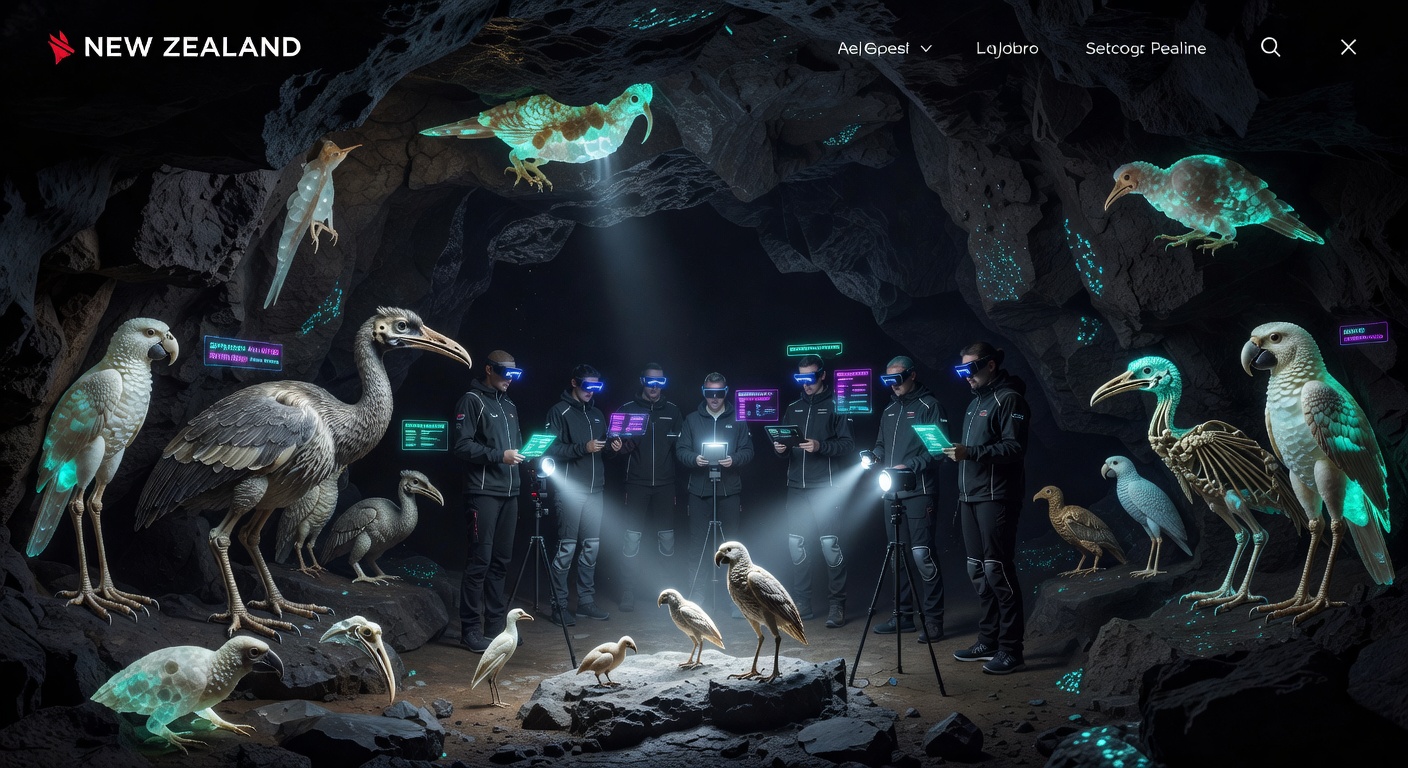
A Slice of Ancient New Zealand We Never Knew Existed
Imagine opening a time capsule that had been sealed for a million years. That's essentially what happened when paleontologists started digging around in a cave near Waitomo on New Zealand's North Island. What they found is genuinely mind-blowing: an entire community of birds and frogs that completely vanished long before the first human arrived in Aotearoa.
This isn't just another fossil discovery. This is proof that New Zealand's famous bird diversity has a much more dramatic backstory than anyone realized.
Nature's Reset Button: Climate and Volcanoes
Here's the wild part—those incredible birds we associate with New Zealand today? They're not the original cast. They're more like the second or third generation, after nature had already wiped the slate clean multiple times.
The fossils tell us that about a million years ago, roughly 33-50% of New Zealand's bird species simply disappeared. And it wasn't because of human hunting or deforestation. It was because the planet was throwing everything at them: massive volcanic eruptions and rapid climate swings that made survival impossible.
Think of it like this: imagine your favorite forest completely transforms every few thousand years. The trees change, the temperature shifts dramatically, ash falls from the sky. Eventually, the creatures perfectly adapted to the old forest can't hack it in the new one. They go extinct, and nature fills the gap with something different.
Meet the Flying Kākāpō That Time Forgot
One discovery especially caught my attention: a previously unknown parrot species called Strigops insulaborealis. This was an ancient cousin of the kākāpō—you know, that adorable, chubby, flightless New Zealand parrot that sounds like it's laughing at you.
Here's where it gets interesting: this ancient version might have been able to fly. The fossils suggest it had weaker legs than today's kākāpō, which means it probably didn't spend all day climbing trees. Researchers are still investigating whether those wings actually worked, but the possibility is genuinely fascinating. Somewhere along the evolutionary path, the kākāpō said "nope, I'm done flying" and became the ground-dwelling party animal we know today.
The cave also held fossils of a takahē ancestor and an extinct pigeon that hung out with Australian bronzewings. It's like a completely different bird party than what we see now.
How Volcanoes Became Nature's Dating Service
So how did scientists figure out this cave was exactly one million years old? Volcanic ash, baby. Two distinct ash layers sandwiched the fossils—one from an eruption 1.55 million years ago, another from around 1 million years ago. That later eruption? Scientists think it dumped meters of ash across the entire North Island. Most washed away, but some got trapped in the cave, essentially sealing the time capsule shut.
It's pretty clever detective work. The volcanoes that were destroying ecosystems also ended up preserving them perfectly for us to study.
The Real Story Nobody Expected
Here's what really gets me about this discovery: for years, scientists blamed humans for everything that went wrong with New Zealand's wildlife. Humans arrived around 750 years ago, hunted the moa to extinction, changed the forests—case closed, humans are the bad guys.
But this find proves that New Zealand's animals were already on a rollercoaster ride long before people showed up. Nature was reinventing the island's wildlife constantly, long before we had any say in it.
The forests kept shifting. Habitats transformed. Species that thrived disappeared, replaced by entirely new lineups. It's not a story of a pristine paradise that humans destroyed. It's a story of an ecosystem that was always changing, always unstable, always forcing its residents to adapt or die.
That doesn't excuse human impact—we absolutely accelerated extinctions and caused real damage. But it does tell us that New Zealand's wildlife is tougher and more adaptable than we thought. These animals survived super-volcanoes and climate chaos. If we protect them properly, maybe they can surprise us again.
The cave near Waitomo just gave us a missing chapter in one of Earth's most unique stories. And honestly? It makes me want to visit New Zealand even more.