
The Volcano That Nearly Ended Everything (7,300 Years Ago)
Imagine an explosion so massive it buries Central Park under 12 kilometers of ash and rock. That actually happened — not in Manhattan, but off the coast of Japan. The Kikai caldera erupted 7,300 years ago with such force it remains the biggest volcanic bang of our entire geological period, the Holocene.
Here's what makes it terrifying: these kinds of supervolcanoes can do it again. And now scientists have confirmed that one is actively recharging.
Why Nobody Really Understands These Things (Until Now)
For decades, researchers have puzzled over a fundamental mystery: How do volcanoes accumulate enough magma to create catastrophic eruptions? It sounds like a straightforward geology question, but it's not. These systems are literally miles below the ocean floor, buried under extreme pressure and temperature. How do you even study something like that?
Kobe University geophysicist Seama Nobukazu put it perfectly: "We must understand how such large quantities of magma can accumulate to understand how giant caldera eruptions occur." Before this research, that was basically a guess wrapped in scientific language.
The Underwater Detective Work
Here's where things get clever. Unlike landlocked volcanoes, Kikai is underwater — and that's actually an advantage. The ocean allowed researchers to set up a massive scientific experiment.
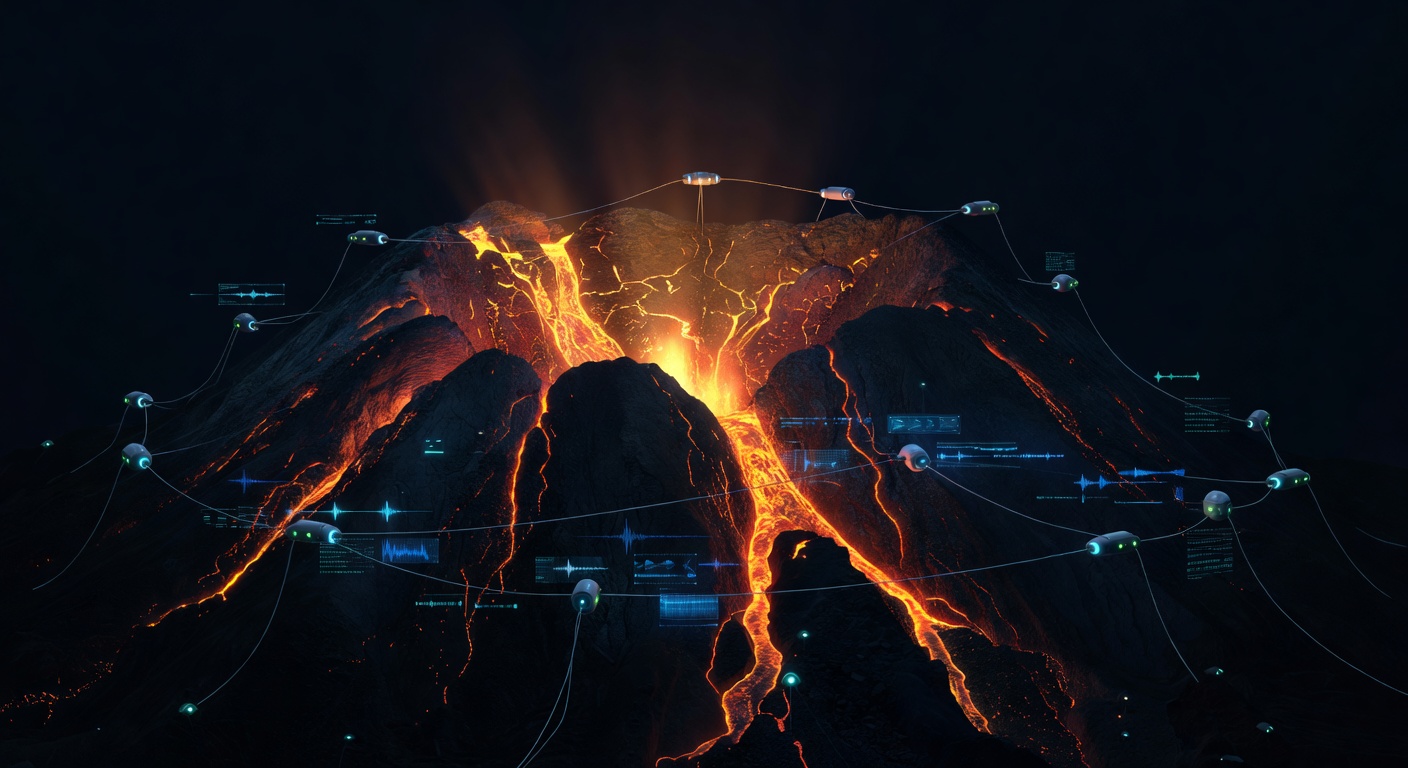
The team used something called an airgun array (exactly what it sounds like: underwater guns that fire controlled blasts) combined with ocean-floor seismometers to listen to how seismic waves bounced through the rock beneath the caldera. By analyzing these echoes, they could essentially take a detailed ultrasound of the magma system lurking underneath.
It's the same principle as a medical ultrasound, except instead of seeing a baby, you're mapping where molten rock is hiding inside the planet. Pretty wild.
The Smoking Gun: Fresh Magma is Flowing In
Here's where the discovery gets genuinely unsettling.
The researchers confirmed that yes, there's a massive magma reservoir directly beneath where that ancient eruption occurred. But here's the kicker: the magma currently sitting in that reservoir isn't leftover from 7,300 years ago. It's new stuff.
Scientists had already noticed a lava dome growing at the center of the caldera over the past 3,900 years. Chemical analysis proved it: the composition is completely different from what erupted millennia ago. This means fresh magma is actively being injected into the system — like topping off a tank that's preparing to explode again.
What This Means for Yellowstone (and Us)
This discovery about Kikai doesn't just matter for Japan. The same magma injection pattern appears beneath other supervolcanoes, including Yellowstone in the United States and Toba in Indonesia. That means researchers might finally understand a crucial pattern: how these sleeping giants recharge and prepare for their next cataclysm.
Seama's team wants to use these same underwater techniques to study other calderas. The long-term goal? Get good enough at monitoring these systems that we can actually predict when the next giant eruption might happen — or at least give us warning signs.
The Bottom Line
We live on a planet that occasionally decides to throw tantrum-level fits. Sometimes those tantrums reshape civilizations. The good news is that scientists are getting smarter about detecting the warning signs. The better news is that these supervolcano cycles happen on timescales of thousands of years, not decades.
Still, knowing that one of Earth's most destructive forces is actively refilling beneath the ocean? That's the kind of information that makes you appreciate just how dynamic and occasionally dangerous our home actually is.
Source: https://www.sciencedaily.com/releases/2026/03/260329222930.htm