
The Moment Everything Changed
Imagine being a paleontologist, doing what you do every single day—carefully brushing away sediment from a half-billion-year-old fossil—when suddenly you realize you're looking at something that shouldn't exist.
That's exactly what happened to Rudy Lerosey-Aubril at Harvard when he was examining a specimen from Utah. He expected to find an antenna, like you'd see on most ancient arthropods from that era. But instead, he found a claw. And not just any claw—this was something that would completely reshape our understanding of spider evolution.
"I had just exposed the oldest chelicera ever found," Lerosey-Aubril said, and honestly, I can only imagine the goosebumps moment.
What's a Chelicera, Anyway?
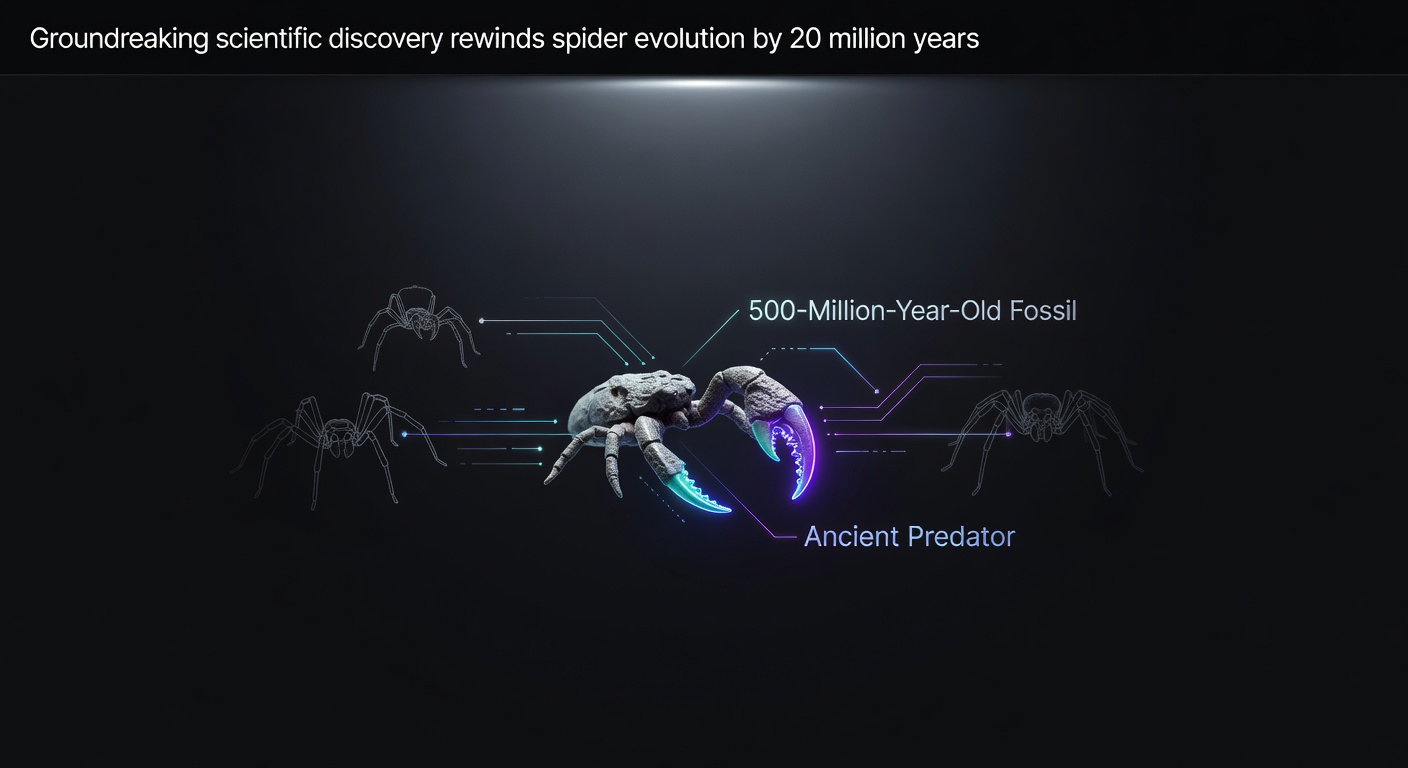
So here's the thing: that claw-like appendage—the chelicera—is basically the defining feature of spiders, scorpions, horseshoe crabs, and their relatives. It's what makes them "chelicerates." While insects have antennae at the front of their heads, chelicerates have these specialized grasping claws instead, often used for grabbing prey and delivering venom.
The problem was, nobody had ever found clear evidence of a chelicera in the Cambrian period—the explosive era of life diversity about 500 million years ago. This fossil, named Megachelicerax cousteaui, fills that massive gap.
A Microscopic Detective Story
To appreciate how big a deal this is, you need to understand the work involved. Lerosey-Aubril spent more than 50 hours hunched over a microscope with a tiny needle, carefully removing rock from around this 8-centimeter-long creature. Every. Single. Speck.
What he uncovered was beautifully preserved. The fossil showed a head shield with six pairs of appendages (used for feeding and sensing), nine body segments, and those plate-like structures underneath that look just like the book gills you'd find in modern horseshoe crabs. This wasn't some primitive blob—it was a sophisticated predator with serious anatomical complexity.
Bridging a 20-Million-Year Gap
Before this discovery, scientists thought the oldest chelicerates came from Morocco and dated to about 480 million years ago. Megachelicerax pushes that timeline back 20 million years, and more importantly, it shows us what a transitional form looks like.
Think of it like finding an actual photograph from your family's history instead of just hearing stories about it. This fossil proves that the basic body plan of spiders and their relatives evolved during the Cambrian Explosion, not after it.
Why This Matters More Than You'd Think
Here's what really fascinates me: having advanced features doesn't automatically mean you'll take over the world. Chelicerates had all the sophisticated tools they needed to dominate the oceans 500 million years ago, but they didn't. For millions of years, they remained relatively rare, overshadowed by trilobites and other arthropods.
Only later—much later—did they expand and eventually conquer the land. The lesson? Evolution isn't just about having the coolest innovations. Timing and luck matter just as much.
From Dusty Collection to Major Discovery
Here's the poetic part: this fossil was collected in Utah's House Range back in the 1980s by a hobby fossil collector named Lloyd Gunther. For decades, it just sat in a museum collection, unremarkable and overlooked. Then Lerosey-Aubril came along and chose to examine it as part of his research into early arthropods.
That's a reminder that scientific breakthroughs sometimes aren't about finding something new—they're about really looking at what's already been found.
A Fitting Tribute
The researchers named the species cousteaui after Jacques Cousteau, the legendary French oceanographer. Since Lerosey-Aubril is also French, it seemed fitting to honor someone who spent his life revealing the mysteries of aquatic life.
The Bottom Line
This tiny claw in a half-billion-year-old fossil is proof that the deep history of life on Earth is still full of surprises. We think we understand how major animal groups evolved, and then a patient scientist with a microscope and a needle shows us we've been missing a crucial chapter.
It's a beautiful reminder that nature's story is way more complex—and way more interesting—than we give it credit for.