
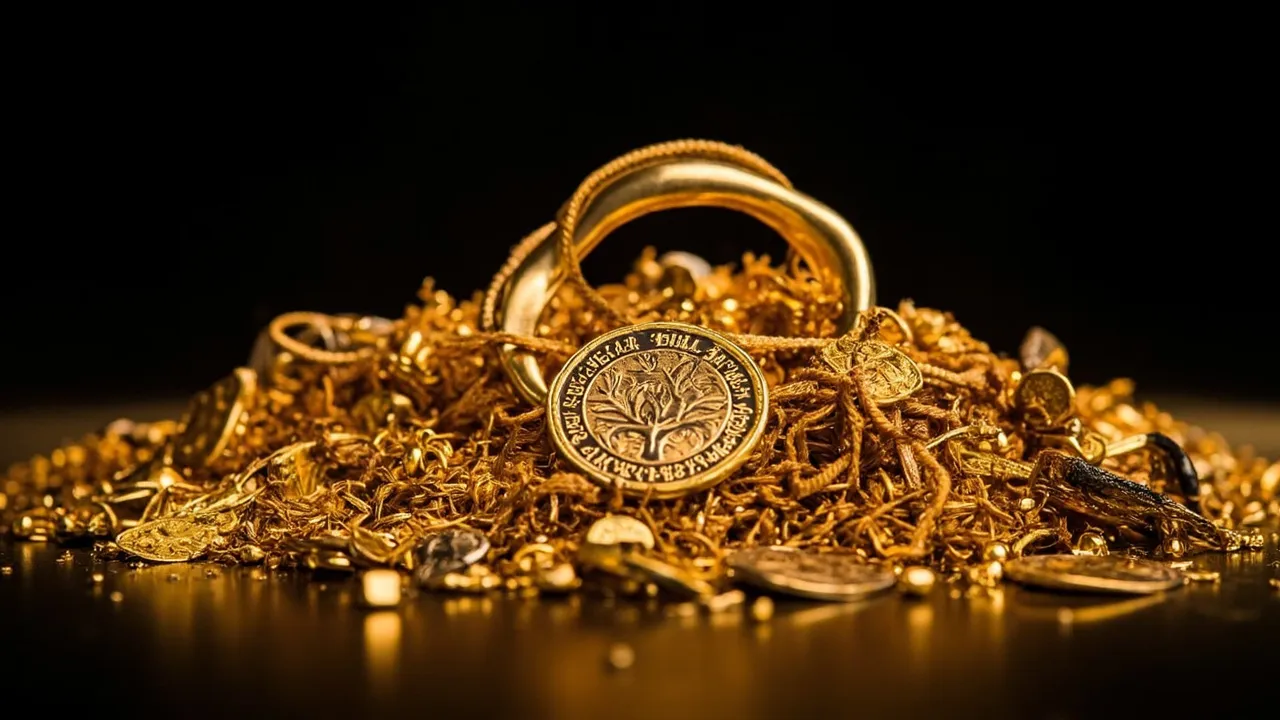
The Hill That Actually Had Gold
Okay, I'll admit it—when someone first mentioned the Bactrian Hoard to me, my first thought was that it sounded like the kind of treasure you'd find in an Indiana Jones film. But here's the thing about real history: sometimes it's stranger than anything a screenwriter could dream up. And this story? It's proof.
Let's set the scene: it's 1978 in northern Afghanistan. A Soviet archaeologist named Viktor Sarianidi is excavating a sun-scorched mound called Tillya Tepe. In the local language, that name means something pretty straightforward—"Hill of Gold." For generations, local people had whispered that something incredible lay buried there. Most researchers would have brushed those stories off as superstition. But Sarianidi? He picked up his trowel and started digging.
And he struck gold. Literally.
What They Pulled Out of the Ground Was Incredible
As the excavation moved forward, golden objects began surfacing from the dust—thousands upon thousands of them. Gold medallions featuring Greek deities like Dionysus. Elaborate jewelry set with gemstones from distant lands. A crown engineered so cleverly it could be taken apart and packed away for travel. We're talking about pieces that would make any modern jeweler absolutely green with envy.
But here's what really got me: this wasn't the treasure of a single civilization. The objects pulled together design elements from Rome, Greece, India, China, and Central Asia all in one spot. The reason? Tillya Tepe sat along the Silk Road—the ancient trade route that connected East and West. Merchants, monks, and soldiers from completely different cultures passed through, each leaving their imprint on the local art and customs. These nomadic communities weren't just swapping physical goods—they were exchanging ideas, beliefs, and aesthetic traditions.
One skeleton found at the site wore a belt with Buddha on one medallion and Dionysus on the other. Think about that for a second. Two entirely different spiritual systems, side by side, in ancient Afghanistan.
Then Everything Went Sideways
Now, you'd assume that unearthing something this spectacular would mean the artifacts would end up safely displayed in a museum where everyone could appreciate them. That seems like the obvious ending, right?
Not quite.
The excavation had barely finished when war came to Afghanistan. The country was about to become one of the most dangerous places on the planet, and Sarianidi faced an agonizing choice: leave the dig incomplete—including that final, unexcavated burial chamber—or put his entire team at risk. He made the call to leave, taking with him everything they'd already recovered.
For years afterward, nobody knew what had happened to the treasure. Civil war tore through Afghanistan. The National Museum in Kabul was shelled and looted. Archaeological sites across the country were picked over by treasure hunters. Most experts assumed the Bactrian gold had been lost forever—either melted down, smuggled abroad, or destroyed entirely.
But it hadn't vanished.
The Hidden Vault
This is where the story gets almost spy-thriller-level crazy: the gold had been locked away in a vault at Afghanistan's Central Bank, known only to a small group of people. They called themselves the "tawadars"—the guardians of the keys. They kept the secret safe even as rumors circulated that the treasure was gone for good.
Can you picture being in their position? Knowing that one of humanity's most precious discoveries was sitting in a basement, unable to share that knowledge, watching your country crumble around you?
It wasn't until 2004—more than two decades after the original discovery—that the vault was finally opened. Sarianidi was present. Historians and archaeologists crowded into a cramped back office of the bank, probably trembling as they unlocked the door to something the world had given up for lost.
And there it was: roughly 20,000 artifacts, intact and waiting.
A World Tour
What happened next felt almost cinematic. Recognizing that they couldn't adequately protect such a collection in their war-ravaged nation, the Afghan government worked out an arrangement with museums around the world. The Bactrian Hoard went traveling, showing up in respected institutions like the Metropolitan Museum of Art in New York and the National Gallery of Art in Washington. For the first time ever, ordinary people could stand in front of these masterpieces with their own eyes.
Some of these objects had spent over two millennia underground. Now they were sparkling under museum spotlights halfway around the globe.
Eventually, pieces started making their way back to Kabul, where they were exhibited at the National Museum. It seemed like the perfect ending to an incredibly long saga.
And Then It Vanished. Again.
Just when you'd think it's safe to believe in happy endings, life throws you a curveball. In late 2020—as political chaos once again engulfed Afghanistan—the treasure disappeared from public view.
The final documented viewing took place at the Presidential Palace, where a small group of officials and preservation advocates met to discuss safeguarding the collection. And then... silence. The gold went back into hiding, this time at a location nobody is willing to disclose.
Given what unfolded in Afghanistan afterward, it's hard to fault that decision. Protecting these irreplaceable objects has to come first. They're not merely Afghan heritage—they belong to all of humanity.
So What Comes Next?
Honestly? I don't have an answer. And I think that's the truthful response.
These artifacts have survived wars, invasions, civil conflicts, and more close calls than I can count. They've been buried, rediscovered, exhibited worldwide, and concealed again. If that gold could speak, it would have some truly unbelievable stories to share.
One thing I keep coming back to is that last burial site Sarianidi never got to explore. The looters who descended on the area after he fled likely found whatever lay inside, and we'll never know what secrets it held. That's a loss that makes my historian's heart ache.
But maybe—just maybe—the rest of the Bactrian Hoard will emerge from hiding again someday. When Afghanistan stabilizes, when peace becomes more than a fragile aspiration, when people can safely marvel at what their ancestors created. These objects are survivors. They've beaten the odds before.
And honestly? After learning this story, I wouldn't bet against them.
Had you heard of the Bactrian Hoard before reading this? Leave a comment below—I'd really love to know if this story surprised you as much as it surprised me!