
The Problem with Traditional AI Pipelines
You know how frustrating it can be when you want to customize something but you're stuck with an all-or-nothing approach? That's exactly what's been happening in the AI image generation world.
Until now, if you wanted to create custom AI image workflows, you basically had two choices: use a pre-built pipeline exactly as-is, or write everything from scratch. It's like being forced to either buy a pre-made sandwich or grow your own wheat — there wasn't much middle ground!
Enter the LEGO Approach to AI
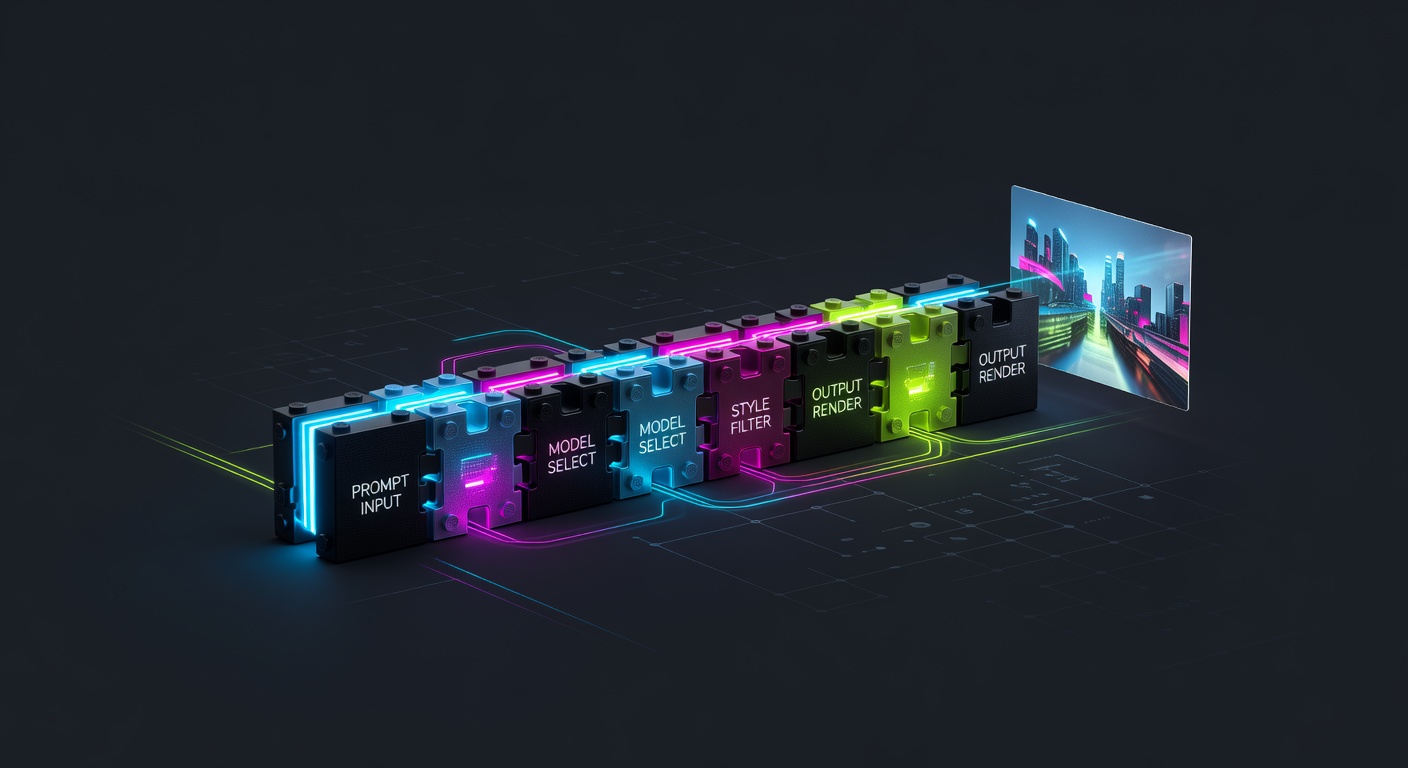
Here's where Modular Diffusers comes in with a brilliant solution that honestly makes me excited about the future of AI development. Instead of treating image generation as one massive, monolithic process, they've broken it down into individual "blocks" that you can snap together like LEGO pieces.
Think about it: every AI image generation process follows roughly the same steps — understanding your text prompt, encoding it, doing the actual image generation magic, and then decoding it into a final picture. What if each of these steps was a separate, reusable block that you could mix and match?
How Simple Can It Get?
The beauty is in the simplicity. Here's what blows my mind — you can still use the familiar, simple API that everyone knows and loves:
# It looks just like the old way...
pipe = ModularPipeline.from_pretrained("black-forest-labs/FLUX.2-klein-4B")
image = pipe(prompt="a serene landscape at sunset")
But under the hood, it's completely different. You're actually running a collection of specialized blocks — text encoding, image encoding, denoising, and decoding — that work together seamlessly.
Why This is a Game-Changer
What gets me really excited about this approach is the flexibility it unlocks. Want to swap out just the text encoder for a better one? Easy! Need to add a custom preprocessing step? Just insert a new block! Want to experiment with different denoising techniques? Mix and match to your heart's content.
This is especially powerful for researchers and developers who need to experiment with different approaches. Instead of rewriting entire pipelines every time they want to test something new, they can just swap out the relevant blocks.
The Visual Workflow Revolution
But wait, it gets even cooler! They've integrated this with something called Mellon — a visual, node-based interface where you can literally drag and drop these blocks to create workflows.
Imagine being able to design your AI image generation pipeline the same way you'd create a flowchart. No more staring at walls of code — just connect the dots (or blocks) visually and see your custom workflow come to life.
What This Means for the Future
This modular approach reminds me of how software development evolved from writing everything from scratch to using libraries and frameworks. It's democratizing AI development by making complex customization accessible to more people.
I can already see the community that's going to grow around this. People will start sharing their custom blocks, creating libraries of specialized components, and building increasingly sophisticated workflows without the traditional barriers to entry.
My Take
As someone who's watched the AI space evolve rapidly over the past few years, this feels like one of those "why didn't we think of this sooner?" moments. The modular approach is so intuitive and practical that I expect it'll become the standard way people build AI workflows.
The fact that you can start simple (using pre-built blocks) and gradually customize as you learn more advanced techniques makes this perfect for both beginners and experts. It's like having training wheels that you can remove one at a time as you get more comfortable.
What excites me most is thinking about all the creative combinations people will come up with when they can easily experiment with different block arrangements. We're about to see an explosion of innovation in AI image generation workflows!
Source: https://huggingface.co/blog/modular-diffusers