
What in the World Is Lighting Up the Ocean Floor?
Okay, I need to tell you about something that's been blowing my mind, and honestly? The fact that it remains unexplained makes it even more fascinating.
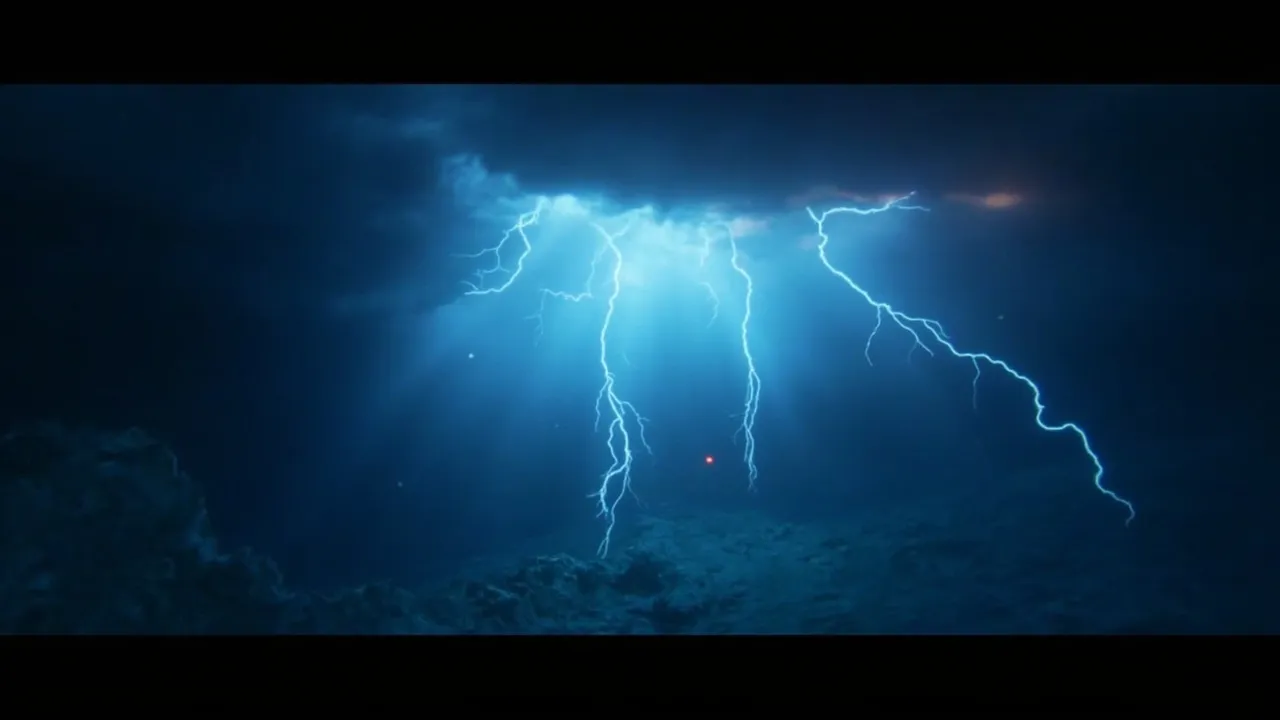
Imagine you're on a boat in the middle of the Pacific Ocean — way out past sight of any land. The night is dark, the stars are brilliant, and suddenly... FLASH. Something lights up beneath the waves. A streak of light shoots through the water like a torch being lit and immediately blown out.
This isn't some rare, one-off thing. For thousands of years, sailors in the Pacific have reported seeing this phenomenon. They call it te lapa, which simply means "the flashing" in their language. And here's what gets me: these ancient navigators didn't just see it — they used it.
The Navigators Who Read the Sea Like a Book
The Polynesian wayfinders were absolutely incredible. I'm talking about people who crossed thousands of miles of open ocean in outrigger canoes using nothing but the stars, the swells, and their deep understanding of the ocean. No GPS. No compasses. Just pure skill passed down through generations.
And according to these navigators, te lapa was like a lighthouse — but underwater. When they saw those flashes, they knew land was nearby.
One of the last great masters of this art was a man named Aliki Koloko Kaveia, who lived on the remote island of Taumako in the Solomon Islands. He was a direct descendant of the legendary voyager Lata, and he spent his life teaching others the ancient navigation methods. Cultural anthropologist Marianne George spent years with Kaveia, learning everything she could.
When George finally witnessed te lapa herself, she described it exactly as the navigators had — not like regular lightning reaching down from storm clouds, but something that shot through the depths, there and gone in an instant.
So What Is This Thing?
Here's where it gets really interesting — and honestly, a little humbling for modern science.
George has made multiple trips to the Pacific, trying to get to the bottom of te lapa. She published a study in 2013, and her conclusion? She couldn't figure it out. (I love that scientists can just say that sometimes.)
So what do we know? Well, we've figured out what it's not:
- It's not reflections from stars or satellites — they can't produce light bright enough
- It's not any known weather phenomenon
- St. Elmo's Fire? That buzzing blue-purple plasma that appears on ships? Researchers realized it can't occur underwater
Here's the really puzzling part: deep-sea submersibles have detected strange voltage spikes around hydrothermal vents and underwater volcanoes. Some scientists now wonder if these areas might actually produce electrical discharges — underwater lightning, if you will.
But wait... isn't that supposed to be impossible? I mean, saltwater is an excellent conductor of electricity. The dissolved salts break apart into ions that should carry current away almost instantly. Any electrical charge should dissipate before it builds up, right?
Apparently not. The researchers found that under the right conditions — certain gas bubbles, rapid temperature changes, mineral-rich plumes from hydrothermal vents — voltage can actually accumulate. And these discharges might travel hundreds of feet before fading.
A Bridge Between Old Knowledge and New Science
What I find most beautiful about this story is how it connects ancient wisdom with modern curiosity.
Kaveia had his own theory: he believed the flashes were related to ocean swells — the way waves rise from distant storms, crash into each other, merge, or collapse. He thought the interference between these swells might somehow focus light, like a massive underwater lens.
It's a fascinating idea, even if we can't quite prove it yet.
George has another hypothesis: what if the constant tectonic activity in the Pacific's "Ring of Fire" — the same geological process that creates all those volcanoes — is triggering electromagnetic emissions from the islands themselves? Phantom lights appearing in the depths?
Honestly? Both ideas might have pieces of the puzzle.
Why I Find This So Captivating
Here's what gets me: we can put rovers on Mars. We've mapped the human genome. We split atoms and peer into the smallest particles in the universe. And yet, somewhere in the depths of the Pacific Ocean, there's a light show that we simply cannot explain.
There's something almost poetic about that.
The Polynesian navigators saw te lapa, trusted it, and used it to cross oceans and find islands in the vastness of the Pacific. They didn't need to understand the science — they just knew it worked.
Maybe there's a lesson there for all of us. The universe is full of mysteries that don't wait for us to be ready to solve them. And sometimes, the most ancient knowledge points us toward questions we're only now sophisticated enough to ask.
I, for one, hope scientists keep chasing this one. Because honestly? I'd love to see it with my own eyes someday.
SOURCE: Popular Mechanics