
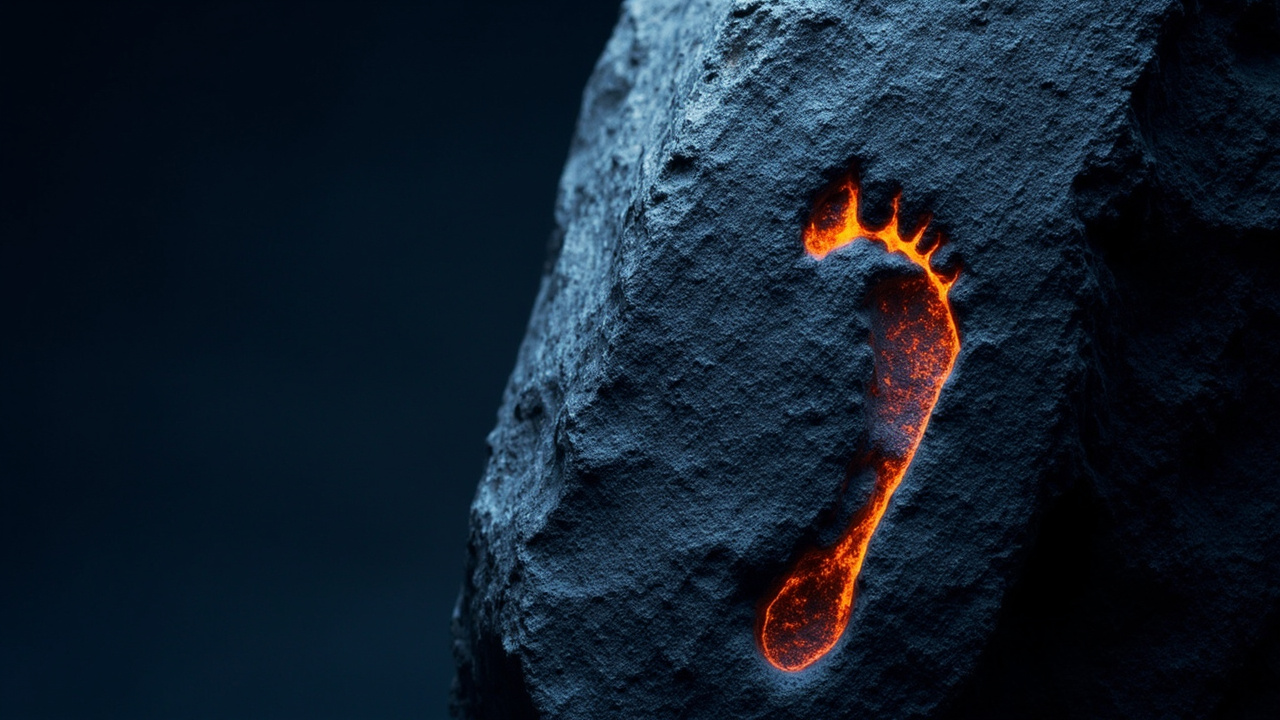
When Footprints Were Forever
Have you ever left a footprint in wet sand at the beach and watched it disappear as the waves washed in? That's temporary. That's fleeting. But what if you wanted to make your mark permanent—to leave evidence that you were here in a way that would survive centuries? Welcome to the world of Bronze Age Scandinavia, where people figured out a pretty profound answer: carve your footprint into bedrock.
I find this genuinely moving when you think about it. These weren't abstract symbols or mythological creatures. They were actual, deliberate impressions of real feet—and they were meant to last.
More Than Just Doodles on Stone
Here's what makes this discovery so fascinating: researchers recently took a deep dive into thousands of these carved footprints scattered across Sweden, Denmark, and Norway, all dating back to somewhere between 1700 and 500 BCE. They're not just randomly scattered either. These footprints—called "podomorphs" in archaeology-speak—were carefully placed on bedrock in very specific locations.
The carvers were meticulous. They added details like cross-straps and other fine lines that mimicked what an actual footprint would look like pressed into sand or snow. Each one looks different from the next, almost like they were created by tracing someone's actual foot or shoe. That level of care tells us this wasn't about making pretty pictures. It was about capturing individuals.
The Water Connection
Here's where it gets even more interesting: these footprints weren't placed randomly on the rock. They were positioned so that water would flow over them—right near mineral veins, natural cracks, or spots where rainwater would gather. The researchers think this water interaction was totally intentional. As water moved across these carvings, it would catch in the carved lines and make them shimmer and gleam, bringing them to life. It's like the ancient carvers understood that stone alone wasn't enough—they needed to activate their art with movement and light.
That's some sophisticated thinking about how to make something last.
A Ritual of Connection
Now here's the really cool part: most of these footprints come in pairs, but not matching pairs. When two prints sit together on the same rock, they're usually different sizes and depths. Some show clear evidence of being added at different times, like someone carved one print, and then years or decades later, another person added theirs right next to it.
What does this mean? The researcher behind this study, Fredrik Fahlander from Stockholm University, has a compelling theory: this was a bonding ritual. Two people—maybe friends, maybe partners entering into an agreement, maybe a couple getting married—would each carve their footprint into the stone, creating a permanent physical record of their relationship. Your footprint says "I was here." Two footprints together say "we were here together."
It's basically the ancient version of carving your initials in a tree, except infinitely more permanent and meaningful.
Why Just Footprints?
What's particularly revealing is that footprints appear only on exposed bedrock near water. You don't find them on bronze objects. You don't find them in burial monuments. You find them only on rock faces where water flows. This tells us something important: these weren't memorials for the dead. They were living statements. They were for the people who made them and for whoever came after them and saw their marks.
There's a philosophical idea in some Siberian and Icelandic traditions that a footprint is an extension of a living person—a piece of them left behind. I wonder if the Bronze Age Scandinavians were thinking along similar lines. By carving their footprints, they weren't leaving behind a picture of themselves. They were leaving behind a part of themselves.
The Permanence Principle
What really gets me about this is the contrast between how temporary our existence feels and how desperately we want to matter. A footprint in sand or snow melts away. A shadow disappears. A reflection fades. But carve it into stone? That lasts. That's 3,000-year-old proof that you existed, that you mattered, that you had a relationship with someone else worth marking forever.
In a world before written language was common, before monuments and gravestones, before social media and permanent digital records, these people found a way to say: I was here. I was real. And I did this together with someone I cared about.
That's not just archaeology. That's profoundly human.