
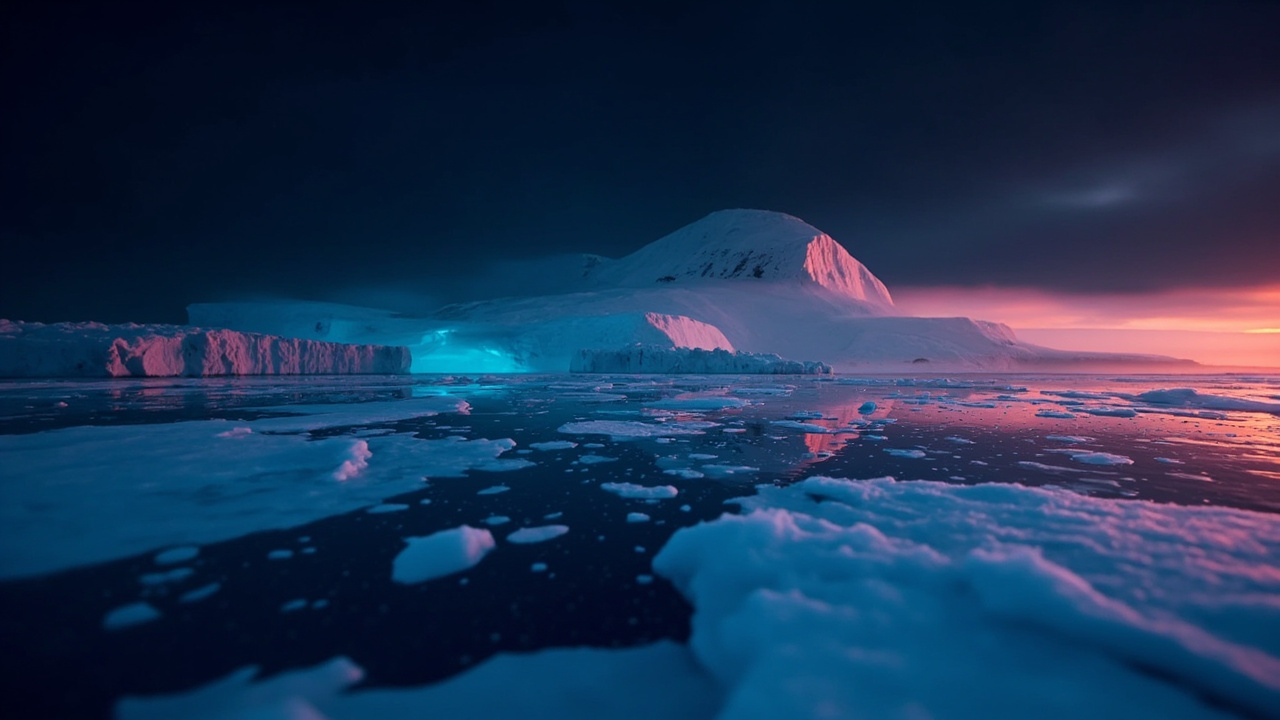
The Ice Shelf Problem Nobody Was Looking For
You know that feeling when you discover your house has a structural issue you never knew about? Welcome to how climate scientists are feeling right now about Antarctica.
For years, researchers have been laser-focused on how global warming melts ice and raises sea levels. It's straightforward enough—more heat, more melting, more water in the ocean. But it turns out the real story happening underneath our planet's ice sheets is way more complicated and way more concerning.
Nature's Sneaky Heat Trap
Imagine you're at the beach, and there's a little current that keeps pulling warm water into a cove. Now multiply that effect across an entire ice shelf the size of a small country, and you're starting to understand what's happening beneath Antarctica.
Recently, researchers from a Norwegian research center made a startling discovery: the undersides of Antarctic ice shelves have these microscopic channels carved into them. Sounds boring? Here's the scary part—these channels act like tiny highways for warm ocean water. Instead of letting warm water flow past and dissipate, these channels actually trap it right against the ice where it does the most damage.
It's like having heating pipes built directly into your ice cream—which, yeah, would melt it really fast.
The Math Gets Worse
What makes this discovery really worrying is the scale factor. Scientists found that even small amounts of warmer water getting stuck in these channels can increase melting rates by orders of magnitude. We're talking about the difference between a slow drip and an open fire hose.
The lead researcher, Tore Hattermann, put it perfectly: the shape of an ice shelf's underside "is not just a passive feature." It's actively working against us, basically. When those channels expand—and they can expand when there's more melting—they start destabilizing the entire ice shelf like a crumbling building losing its support columns.
Why This Matters for Your Beach House
Here's where it gets personal. If these ice shelves become unstable and start failing, they're essentially the bouncers at a nightclub keeping massive amounts of land ice from sliding into the ocean. Once those shelves break down, millions of cubic kilometers of ice start flowing toward the sea.
And here's the thing nobody wants to hear: our current predictions about sea level rise might be drastically underestimating how fast this could happen. We're not accounting for these small-scale melting processes in our models. It's like trying to predict a flood while ignoring the drainage system.
The Research Puzzle
You might be wondering how scientists figured this out. They didn't send divers down—that's basically impossible under miles of ice. Instead, they used detailed maps of the ice shelf underside combined with sophisticated computer models. They essentially ran simulations showing what happens when warm water encounters smooth ice versus channeled ice, in both cooler and warmer ocean conditions.
The results were pretty sobering.
The Real-World Implications
So what happens if we're wrong about how much time we have? For coastal cities around the world, it could mean preparing for much more dramatic flooding, much sooner. We're talking about the difference between having several decades to adapt and needing to rethink infrastructure right now.
The kicker is that scientists are only now starting to understand these mechanisms. We've been publishing sea level rise projections based on incomplete information. It's not that scientists were being careless—it's just that Antarctica is hard to study. Sending robotic submarines under ice sheets to map cavities is frontier-level exploration.
What Comes Next
The good news? Now that we know about this problem, it can be included in future climate models. The bad news? We still don't fully understand how widespread this phenomenon is or how quickly these channels might grow and destabilize shelves.
This is one of those discoveries that feels like opening a door and realizing the room is bigger and darker than you thought. It's not the outcome we wanted, but it's the reality we needed to know.
The race is on to figure out exactly how much our timelines need to change—and whether we can actually do anything about it beyond reducing emissions. Because unlike most engineering problems, you can't exactly hire someone to repair the underneath of an ice shelf.