
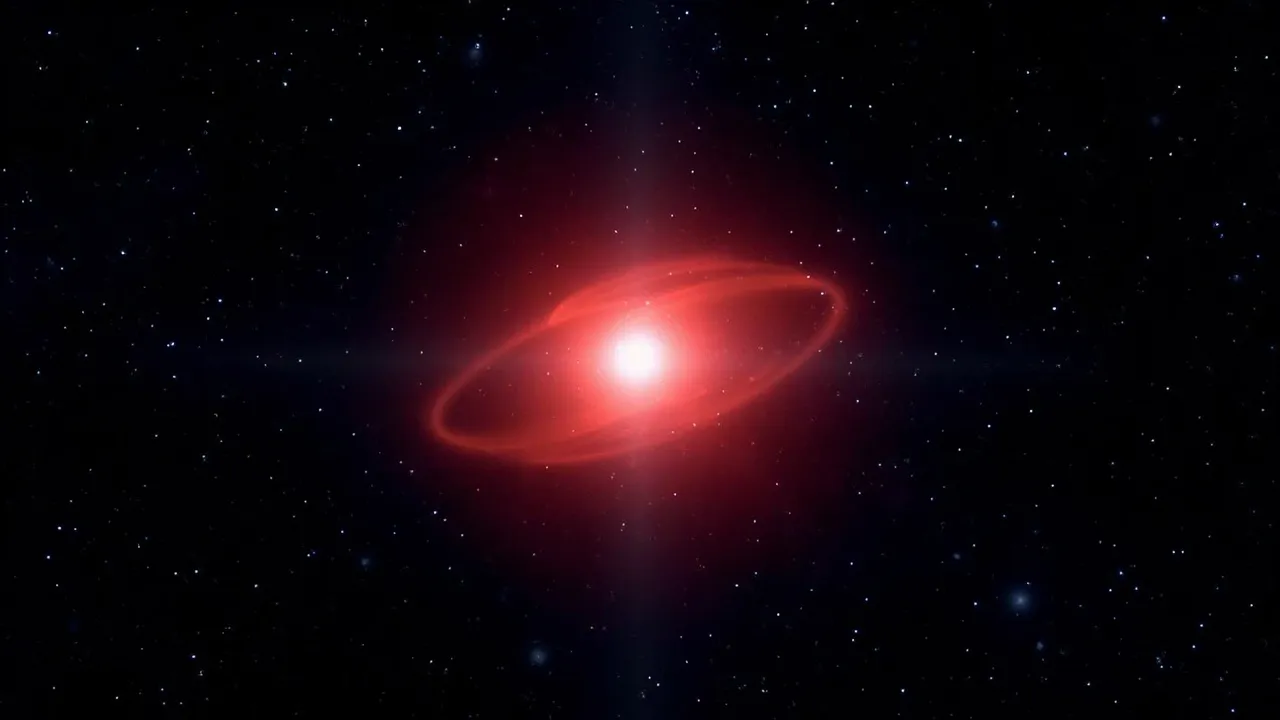
Okay, I need you to picture this with me.
Somewhere in the universe, over six billion years ago, two incredibly dense stellar corpses—each one roughly the mass of our Sun but compressed into a city-sized sphere—spiral toward each other at impossible speeds. They're neutron stars, the leftover cores of massive stars that died in spectacular explosions. When these two cosmic heavyweights finally collide, the energy released would make your head spin. And somewhere, somehow, humans were watching.
That's exactly what happened according to new research published in Science Bulletin, and honestly? This is one of the coolest astronomical discoveries I've read about in a while.
What the Heck Is a Magnetar?
Before we go further, let's talk about magnetars—because these things are absolutely wild. A magnetar is essentially a neutron star on steroids. It spins rapidly (we're talking hundreds of rotations per second) and has a magnetic field so intensely strong that if one existed at the distance of our Moon, it would erase every credit card on Earth. Yeah, you read that right.
Scientists have suspected for years that magnetars might form when two neutron stars merge together. But here's the problem: confirming this has been notoriously tricky. Why? Because the flashes we usually look for—those brief bursts of gamma rays—fade in just a second or two. It's like trying to identify a specific firework by only seeing the initial spark.
The X-Ray Flash That Wouldn't Quit
What makes this new discovery so special is that astronomers didn't just catch a quick gamma-ray burst. They spotted something much longer-lasting: an X-ray flash that glowed for nearly ten minutes. According to the research team, this is the longest-lasting "prompt X-ray flash ever observed from a neutron star merger."
Let that sink in. Ten minutes might not sound dramatic compared to, say, watching a movie. But in the world of cosmic explosions, this is practically an eternity. And it suggests something important survived the collision—specifically, a newly-formed magnetar that kept the explosion going by "damping its magnetic power into the surroundings," as Professor Eleonora Troja puts it.
A Race Against Time (and Starlight)
Here's where the story gets even better. The discovery happened because of incredibly fast teamwork. When the Einstein Probe satellite detected the event on July 4, 2025 (designated EP250704a/GRB 250704B), graduate student Niccolò Passaleva was, get this, traveling home by train.
"I was rushing against time to commandeer one of the largest telescopes in the world from my laptop," he recalled.
From his laptop. On a train. I don't know about you, but I can barely get decent WiFi on trains, let alone redirect a massive telescope in Chile to observe a cosmic explosion.
Using the Very Large Telescope's X-Shooter instrument, Passaleva and his team broke apart the light from this ancient explosion into its individual components. By analyzing the absorption patterns, they calculated the event happened at a redshift of z=0.6610—meaning its light traveled for more than six billion years before hitting our planet.
Six billion years. Our solar system is only about 4.6 billion years old. This explosion happened before Earth even existed.
Why No Supernova Mattered
One crucial detail helped confirm this was indeed a neutron star merger: there was no supernova.
Now, you might be thinking, "Wait, isn't a supernova a big deal? Shouldn't we want one?" In this case, the absence of a supernova actually told scientists something important. If this X-ray flash had come from the collapse of a massive star (another possible explanation), we'd expect to see a bright supernova following the explosion. We didn't. Combined with the measured distance and the burst's specific properties, the evidence strongly points to two neutron stars colliding and forming something new—a magnetar.
What This Means for Astronomy
Here's why I find this so exciting: we've basically caught a glimpse of what happens in the aftermath of some of the universe's most violent events. Until now, we've relied heavily on detecting gravitational waves—ripples in spacetime caused by merging neutron stars. But this discovery suggests X-ray flashes might offer another way to find these mergers, especially when gravitational wave detectors can't pinpoint the location.
As Passaleva put it: "It is an opportunity to have a front-row seat to the most extreme forces of the Universe and discover more of its secrets."
And honestly? That sentiment captures exactly why I love writing about space. We're not just passively observing distant explosions—we're actively piecing together the story of how the universe creates some of its most exotic objects. Every time we catch one of these fleeting events, we learn something new about the physics governing the cosmos.
The universe is vast, violent, and utterly indifferent to our existence. And yet, here we are, on a small planet orbiting an ordinary star, watching the birth of something extraordinary from billions of years ago. If that doesn't blow your mind, I don't know what will.
Source: https://www.sciencedaily.com/releases/2026/09/260930020252.htm