
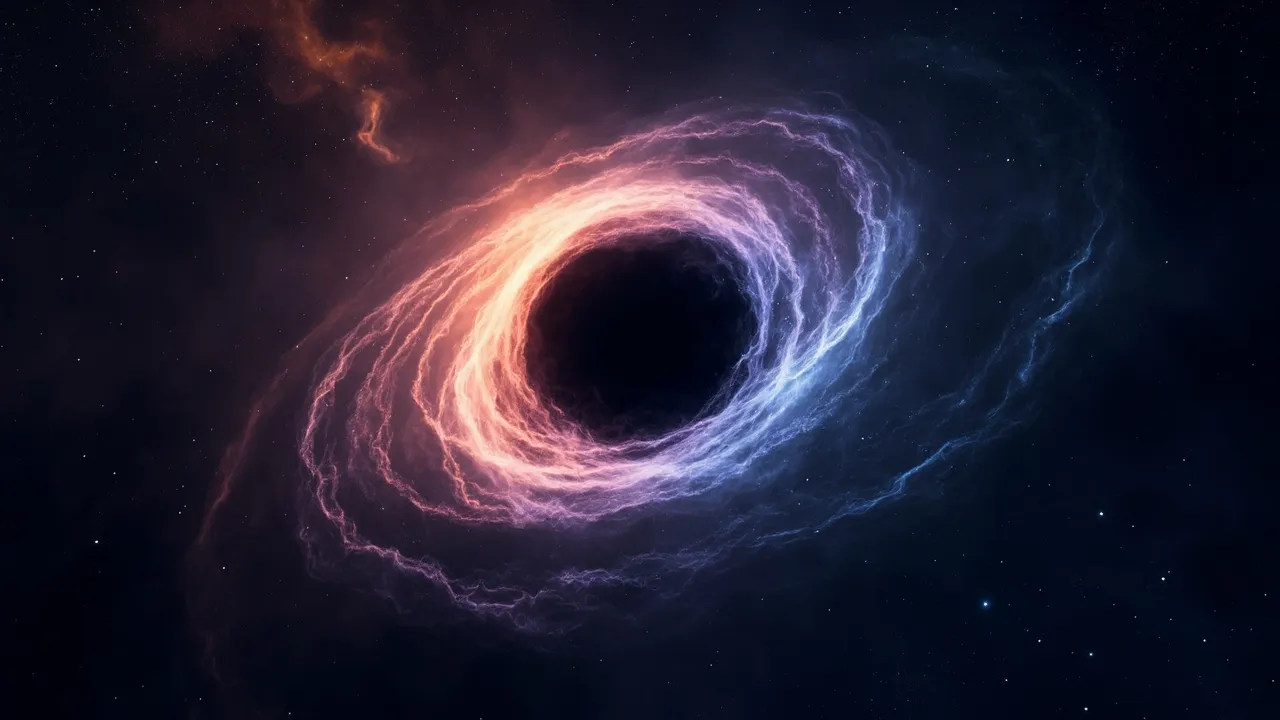
Okay, I need to tell you about something genuinely mind-blowing that space scientists just discovered, because it made me sit back and think about the universe in a completely different way.
Black holes are famous for one thing: swallowing stuff. You probably picture them as cosmic vacuum cleaners, relentlessly devouring everything that gets too close. And yeah, that's true—but here's what nobody talks about enough: they're also absolutely puking stuff back out into space. And apparently, we had no idea just how violent that cosmic vomiting actually is.
A team of researchers just published findings that made my inner space nerd absolutely lose its mind. They discovered that the winds created by supermassive black holes carry about 100 times more energy than scientists previously estimated. One hundred times! That's not a small correction—that's a "we basically had no idea what we were talking about" level of discovery.
Wait, What Exactly Are These "Winds"?
Let me break this down so it makes sense. When a supermassive black hole (the kind at the center of galaxies) is actively feeding on gas and dust, it doesn't just quietly nom on its cosmic snack. It releases enormous amounts of energy in the form of incredibly powerful winds. Think of it like the universe's most extreme version of that scene in every disaster movie where someone lights a match near a gas leak.
These winds are made of superheated gas shooting outward at ridiculous speeds. Scientists have known about them for a while. But here's what they got wrong: they thought these winds were pretty much contained within the galaxy where the black hole lives. Like, sure, they're powerful, but they're an inside-the-house problem.
Except they absolutely are not.
The Discovery That Changed Everything
The research team, led by Assistant Professor Satoshi Yamada from Tohoku University, pointed the X-ray telescope XRISM at a quasar called H1821+643. (Quasars are basically black holes on steroids—actively feeding and releasing insane amounts of energy, making them visible across billions of light-years.)
This particular quasar sits about 3.4 billion light-years away in the constellation Draco. It's in a galaxy cluster, surrounded by hot gas that emits X-rays. The researchers analyzed that X-ray emission to figure out how the gas was moving around.
What they found was absolutely wild: the turbulence and energy in these winds extends about 300,000 light-years from the black hole. To put that in perspective, that's roughly three times the diameter of our entire Milky Way galaxy. These black hole winds aren't contained in the neighborhood—they're reaching out and messing with stuff across distances that make galaxies look like tiny neighborhoods.
And get this: the energy in that turbulence is roughly equivalent to several billion supernova explosions happening simultaneously. You know, the spectacular explosions that happen when massive stars die? This black hole is casually outputting the energy of billions of those. Continuously. Just... out there.
Why Should We Care?
Here's where this gets really interesting. We tend to think about black holes as these isolated, destructive forces—eating everything in their path. But this research suggests they're actually playing a huge role in shaping the cosmos on a massive scale.
Think about it: these black holes are pumping enormous amounts of energy far beyond their own galaxies. That energy affects the gas in the surrounding space, influencing how new stars form (or don't form), how galaxies evolve, and how the large-scale structure of the universe develops. Black holes aren't just destroyers—they're cosmic engineers, reshaping their environments in profound ways.
I don't know about you, but I find that incredibly humbling. We're out here on a small planet orbiting a modest star in an unremarkable galaxy, and at the centers of many galaxies are these unfathomably powerful objects that are actively sculpting the universe around them. And we had no idea they were this influential.
What Comes Next
This is really just the beginning. Scientists plan to use XRISM and other instruments to study more black holes and understand exactly how these powerful winds work. We might find that this is typical behavior for supermassive black holes, or maybe H1821+643 is unusually active. Either way, we're going to learn a lot more about how these cosmic engines operate.
One thing's for sure: we need to update our mental models of black holes. They're not just cosmic vacuum cleaners or isolated destructive forces. They're active, powerful players that shape the universe around them in ways we're only starting to appreciate.
And personally? I think that's way more fascinating than the old picture.
So the next time someone tells you about black holes, remember: yes, they consume, but they also create. They don't just take from the universe—they give back (in the form of shock waves powerful enough to reshape galactic neighborhoods). The cosmos is so much more dynamic and interconnected than we often imagine.
Keep looking up, my friends. There's always something new to discover.