
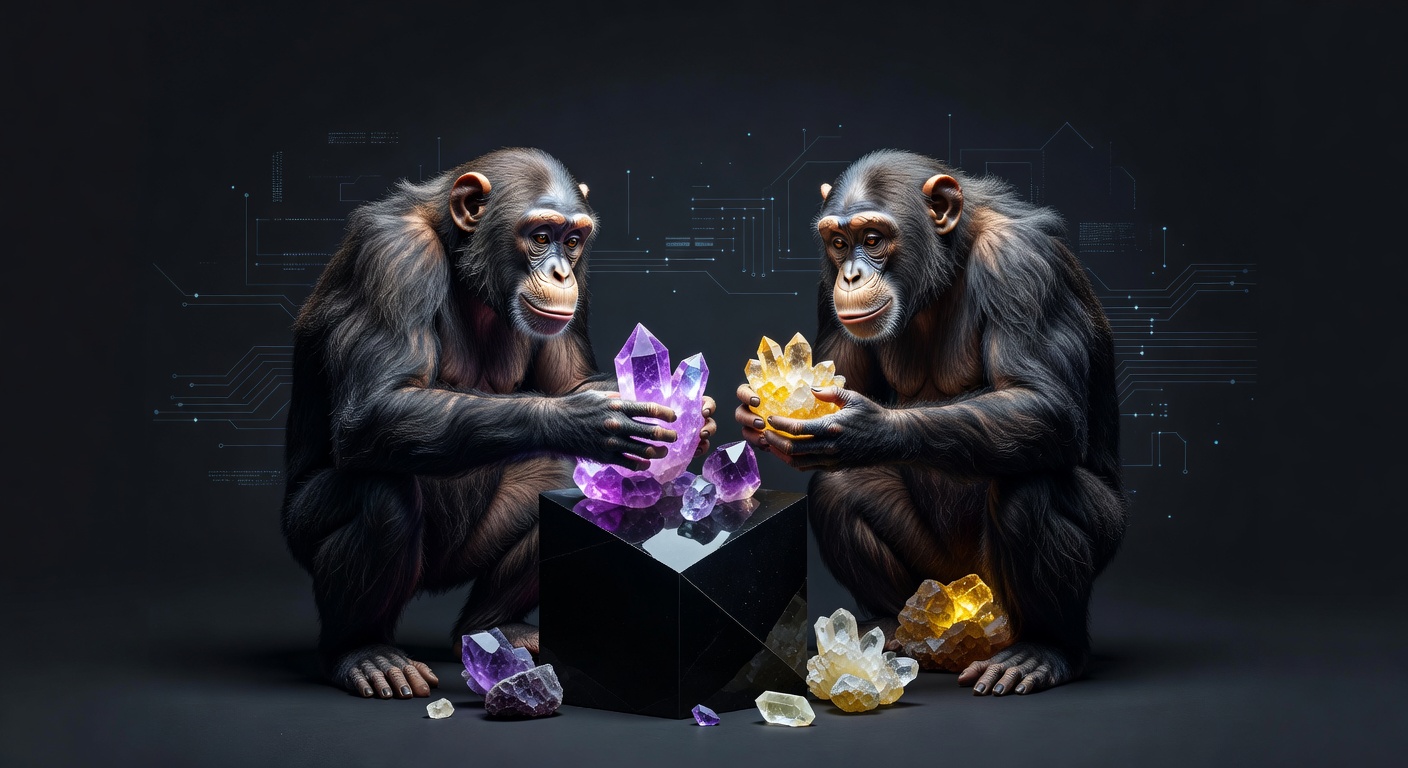
When Science Meets Crystal Obsession
Picture this: You're a researcher studying crystals, and you decide to show some sparkly quartz to a group of chimpanzees. Sounds harmless enough, right? Well, Dr. Juan Manuel García-Ruiz learned the hard way that chimps can be just as crystal-crazy as any human with a collection of healing stones on their windowsill.
In what might be the most adorable scientific heist of all time, the chimps at a Spanish rehabilitation center became so obsessed with the crystals that they essentially stole them and refused to give them back. I'm talking full-on negotiations involving mountains of bananas and yogurt just to retrieve one large crystal. Some of the smaller ones? Still missing in action, probably tucked away in some chimp's secret stash.
The Great Crystal Caper
The setup was beautifully simple. The research team placed a foot-tall quartz crystal on one pedestal and a similar-sized sandstone rock on another. They even named the experiment "The Monolith" after that mysterious object in 2001: A Space Odyssey — which is honestly the kind of nerdy reference that makes me love scientists even more.
What happened next was pure chaos in the best possible way. The chimps went absolutely wild for the crystal while completely ignoring the boring old rock. One alpha female named Manuela literally ripped the crystal off its pedestal and from then on, it rarely left the group's sight.
But here's my favorite part: there's video footage of a 50-year-old male chimp named Yvan casually carrying this crystal around while climbing and eating cabbage, passing it between his hands and feet like some kind of acrobatic crystal collector. If that doesn't make you smile, I don't know what will.
More Than Just Shiny Object Syndrome
Now, you might think this is just typical "ooh, shiny!" behavior, but the researchers noticed something deeper. When they scattered small crystals among piles of regular pebbles, the chimps immediately sorted out the crystals with laser-like precision. They weren't just grabbing random pretty things — they were specifically drawn to these particular objects.
Even more fascinating? The chimps would hold the crystals up to their eyes like old-timey prospectors examining their finds, turning them in the light and studying them intently. One researcher even caught Yvan gripping a crystal as he settled into his hay nest for the night. That's some serious attachment right there.
Why This Matters (Beyond Being Adorable)
Here's where things get really interesting from a scientific perspective. Dr. García-Ruiz has this mind-blowing theory that crystals might have actually helped early humans develop abstract thinking and geometry. His reasoning? Crystals are essentially "the only Euclidean object in nature" — they're perfectly geometric in a world of organic, irregular shapes.
Think about it: if you're an early human encountering these naturally occurring geometric forms, wouldn't that blow your mind? Maybe our ancestors' fascination with crystals wasn't just about their beauty, but about recognizing something fundamentally different about their structure.
Archaeological evidence shows that humans have been collecting crystals for at least 700,000 years, often without turning them into tools or ornaments. They just... kept them. Sound familiar?
The Bigger Picture
Of course, not everyone's ready to jump on the "crystals invented geometry" bandwagon. Other experts point out that we can't draw too many conclusions from a small study with rescued chimps who've lived around humans. Fair point — their behavior might be influenced by their unique backgrounds.
But I find myself fascinated by the possibility that this crystal obsession runs deeper than we think. Whether it's ancient humans, modern crystal enthusiasts, or chimpanzees hoarding quartz like treasure, there's clearly something about these objects that speaks to us on a primal level.
What's Next?
Dr. García-Ruiz wants to try this experiment with wild chimpanzees next, which honestly sounds both thrilling and slightly terrifying. Imagine trying to retrieve crystals from chimps who have zero experience with human negotiations and probably won't accept banana bribes as readily.
But here's what I love most about this research: it reminds us that curiosity and fascination with beauty aren't uniquely human traits. Maybe our love of crystals — whether for their supposed healing properties or just their undeniable beauty — connects us to something much more ancient and fundamental than we realized.
So the next time someone rolls their eyes at your friend's crystal collection, just remember: even our closest animal relatives think they're worth hoarding. Sometimes the most "unscientific" human behaviors turn out to have the deepest evolutionary roots.