
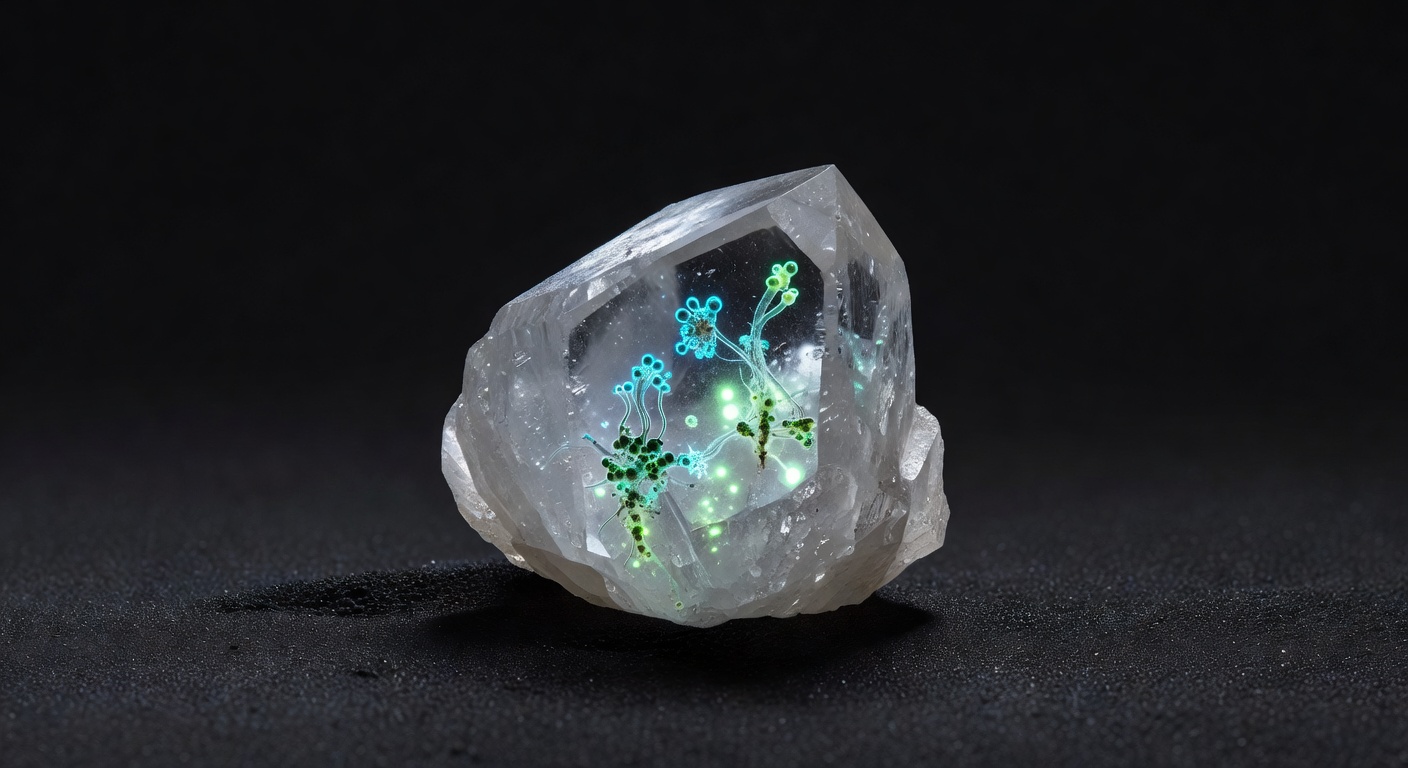
A Time Capsule in the Desert
Picture this: you're standing in Chile's Atacama Desert, one of the most brutal places on Earth. The sun is relentless, the air is bone-dry, and the landscape looks like something straight out of a sci-fi movie. Now imagine finding ancient life perfectly preserved in glittering crystals scattered across this alien terrain. That's exactly what researchers discovered recently, and it's got me absolutely fascinated.
Meet Gypsum: Nature's Perfect Preservative
Here's where things get really cool. The researchers found these amazing biosignatures trapped inside gypsum crystals – those translucent, almost glass-like minerals you might recognize from geology class. But gypsum isn't just pretty to look at; it's like nature's version of amber, except instead of preserving insects, it's been keeping microbes alive and fossilized for millennia.
What makes gypsum so special? It's translucent enough to let just the right amount of light through for photosynthesis, while simultaneously acting like a protective shield against deadly UV radiation and dehydration. Think of it as the ultimate microbial safe house.
Why This Makes Me Excited About Mars
Now here's where my inner space nerd gets really excited. We already know that Mars has gypsum deposits. We've spotted them using spectroscopy from orbit, and where there's gypsum on Earth, there's often preserved life.
The connection is pretty mind-blowing when you think about it. Mars wasn't always the barren wasteland we see today – billions of years ago, it had lakes, rivers, and maybe even oceans. If microbial life existed back then (and that's a pretty big "if," but not unreasonable), some of those ancient Martian microbes might still be sitting there, perfectly preserved in gypsum crystals, just waiting for us to find them.
The Atacama: Mars on Earth
The researchers chose the Salar de Pajonales salt flats for good reason. At over 11,500 feet above sea level, this place is about as close to Mars as you can get without leaving Earth. It's incredibly dry, bombarded by UV radiation, and filled with the same types of sulfate minerals we see on Mars.
What blew my mind is that despite these absolutely brutal conditions, life found a way. The team discovered not just one type of preserved microbe, but a whole community: bacteria, archaea, and even diatoms (those beautiful microscopic organisms that look like living glass sculptures).
What This Means for Future Mars Missions
This discovery is potentially game-changing for how we approach the search for Martian life. Instead of just looking for organic molecules in Martian soil (which can be tricky to distinguish from non-biological processes), we might want to focus on gypsum deposits and stromatolite-like structures.
Stromatolites, by the way, are those layered rock formations created by ancient microbial mats – some of the oldest evidence of life on Earth. Finding similar structures on Mars could be like discovering a fossil record of an entire alien ecosystem.
The Bigger Picture
What I love about this research is how it shows that life is incredibly resourceful. Even in one of the most hostile environments on our planet, microorganisms found ways to not just survive, but thrive and leave behind a record of their existence.
It makes me wonder: if life can persist in the Atacama Desert for thousands of years, perfectly preserved in crystal time capsules, what might we find when we finally get our hands on some Martian gypsum samples?
The universe just got a little less lonely, don't you think?
Source: https://www.popularmechanics.com/space/moon-mars/a70426355/desert-crystal-extraterrestrial-life