
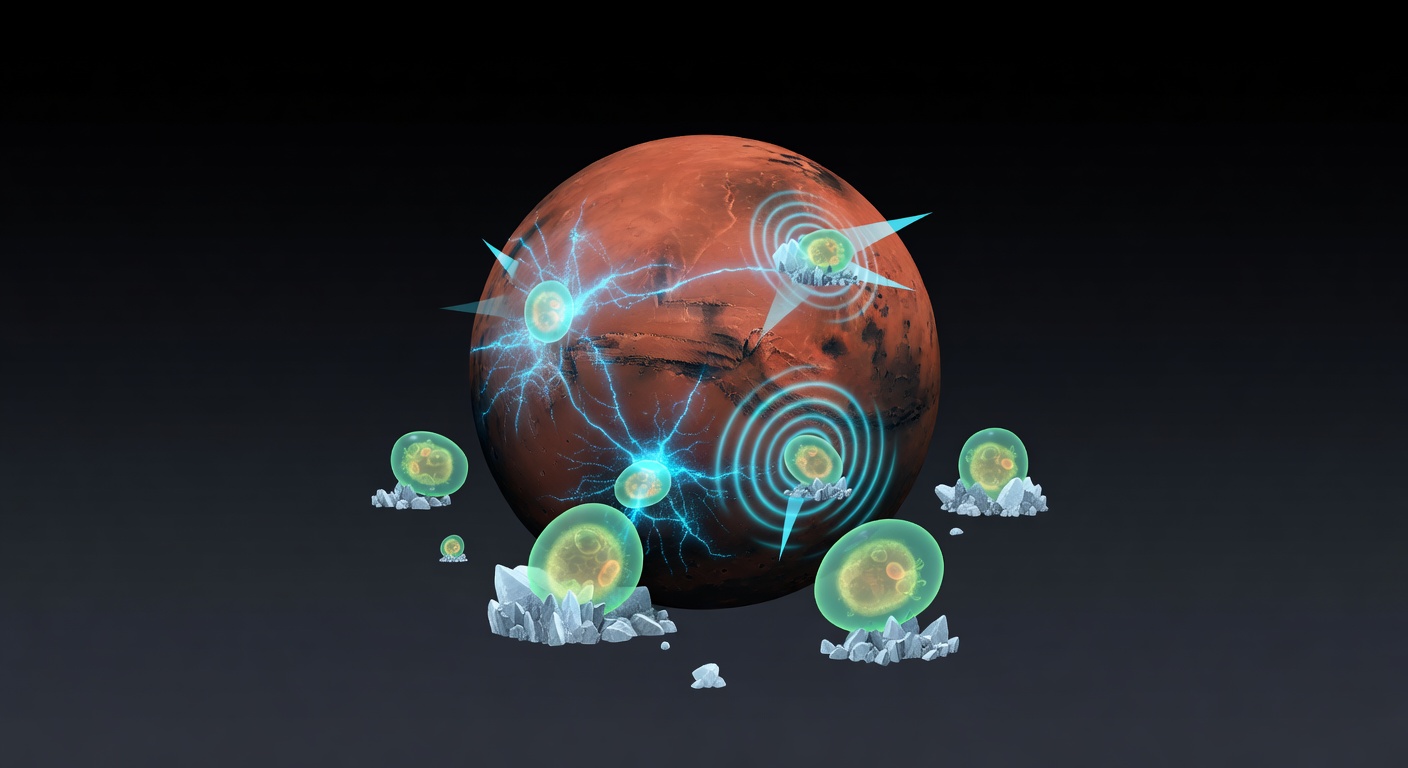
Mars Is Basically Hell, But Maybe Not for Everyone
Let's be honest—Mars is not a vacation destination. The planet is basically a hostile wasteland where everything that could go wrong does go wrong. If any kind of life ever existed there, it would need to be essentially unkillable.
There are two particularly nasty threats on Mars that would make survival nightmarish for Earth organisms:
Shock waves from asteroid and meteorite impacts that pound the surface with incredible force, and perchlorates—weird, aggressive salts in the Martian soil that mess with the fundamental chemistry that keeps cells alive. These salts are like tiny chemical ninjas, attacking the molecular bonds that hold proteins and other essential cellular machinery together.
So here's the big question: Could anything actually survive that?
Why We're Learning Life Lessons from Yeast
To answer this, researchers decided to get weird and use yeast—yes, the same stuff that makes bread rise and beer happen—as a test subject.
Now, I know what you're thinking: "Why yeast? That's not exactly a thrilling organism." But here's the thing—yeast is actually a perfect microscopic guinea pig for this kind of research. It shares fundamental biological systems with much more complex organisms, including humans. Scientists have sent yeast to space before, they know how it behaves under stress, and it's easy to study in a lab.
When cells face extreme conditions, they don't just panic and die. Instead, they have backup plans. One of the coolest backup plans involves something called RNP condensates—basically temporary protective structures made from RNA and proteins that work like cellular emergency shelters. These structures huddle together to protect genetic material and help the cell survive until things calm down.
Think of them as biological panic rooms.
Creating a Martian Nightmare in the Lab
Here's where it gets really cool. Indian researchers at the Physical Research Laboratory in Ahmedabad used a specialized device called the High-Intensity Shock Tube for Astrochemistry (HISTA) to simulate actual Martian conditions. This isn't some pretend experiment—they were generating shock waves at 5.6 times the speed of sound, which is basically what happens when a meteor slams into Mars.
They also exposed the yeast to perchlorates at levels comparable to what scientists have actually measured in Martian soil samples. So they're not just guessing—this is realistic Mars stuff.
The Surprise: These Tiny Cells Are Survivors
Here's the wild part: the yeast actually survived.
Yes, the cells were stressed. Yes, their growth slowed down. But they didn't die. They adapted.
When the shock waves hit, the yeast activated their cellular emergency shelters—forming stress granules and other protective structures. When exposed to the toxic perchlorates, they formed different protective structures. And when hit with both stressors at the same time? They still made it through.
The researchers also tested yeast that had been genetically modified so it couldn't form these protective structures, and those cells basically got destroyed. This proved that these emergency shelters aren't just nice-to-have—they're absolutely essential for surviving extreme conditions.
What's Happening at the Molecular Level
The scientists dug even deeper and examined the yeast's transcriptome—basically the instruction manual of all the genetic messages the cell was creating. They found that the Mars-like conditions were definitely causing genetic chaos, disrupting normal cellular processes.
But here's the important part: because the yeast could form those protective structures, it could stabilize key functions and keep itself alive even while things were falling apart around it. It's like having a really good immune system when you've got the flu.
So... Could Life Actually Exist on Mars?
This research is genuinely mind-blowing because it suggests that simple life forms might be way more resilient than we ever gave them credit for. We tend to think of extreme environments as absolutely deadly, and they are—for most things. But for simple organisms that have evolved survival mechanisms? Mars doesn't look quite so impossible.
We're not saying there's definitely life on Mars right now. But this study shows that if simple organisms did survive there in the past, or could get there somehow in the future, they might actually have a fighting chance. They'd need to be small, simple, and tough, but those are things that exist in nature.
Which is honestly kind of amazing when you think about it.