
When Your Best Telescope Is Actually at the Bottom of the Ocean
Imagine trying to hear a whisper at a rock concert. That's basically what neutrino hunting is like on Earth's surface. There's just too much noise. So what do you do? You go underwater. Deep underwater. Really deep underwater.
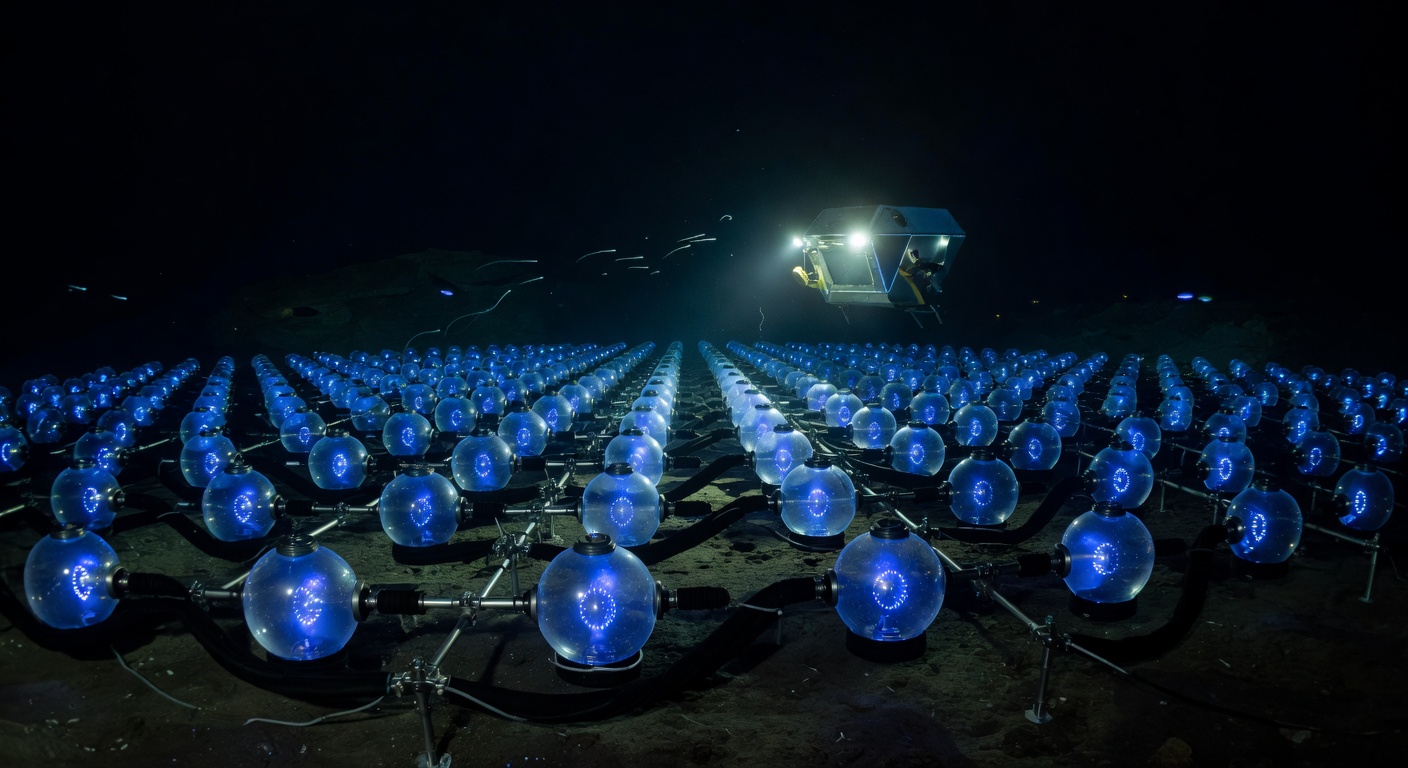
Welcome to ARCA, a wild underwater experiment sitting 3,500 meters (that's about 11,500 feet) below the Mediterranean Sea near Sicily. And I'm genuinely fascinated by how smart this is—sometimes the best way to detect something invisible is to hide from all the interference first.
Why Go Deep for Invisible Particles?
Let's talk about neutrinos for a second. These things are absolutely tiny—I mean, so unbelievably small that billions of them are passing through your body right now as you read this. You can't feel them. They don't interact with you. It's kind of creepy, honestly.
What's even wilder? They don't really care about anything. Neutrinos pass straight through planets, water, and pretty much whatever stands in their way. The Earth is like a cosmic ray shield, but neutrinos basically say "nope, going through anyway."
The problem is detecting them when the surface world is screaming with electromagnetic noise from phones, satellites, and natural radiation. So scientists had a brilliant idea: move the detector down where it's quiet. Under 348 atmospheres of pressure (compared to the one atmosphere we experience topside), the chaos of the surface world is basically muted.
A Russian-Nesting-Doll Approach to Particle Detection
The ARCA setup sounds like something out of a sci-fi movie. Picture this: thousands of spherical sensors arranged on vertical strands that stretch 700 meters tall, dangling in the darkness. These aren't random spheres though—they're nested inside each other like a Russian doll, each layer designed to filter and detect different things.
Here's where it gets clever. The scientists at ARCA realized they could use noise itself as a tool.
The Noise Layering Strategy (Yes, This Is Actually Genius)
Layer One: Radioactive Background Noise
Deep underwater, potassium-40 naturally decays, creating a steady, predictable optical signal. Instead of treating this as annoying interference, the team uses it to calibrate their instruments. It's like having a built-in tuning fork. And here's the bonus: supernovae throw out neutrinos with a unique signature that looks different from these background signals, so this noise actually helps scientists spot them.
Layer Two: Cosmic Ray Aftershocks
Cosmic rays constantly bombard Earth's atmosphere from space. When they slam into air molecules, they create a shower of particles called muons. These decay rapidly and create more optical noise. Again, instead of ignoring it, the team uses this predictable muon decay pattern for calibration and to solve other physics mysteries.
Layer Three: Atmospheric Neutrinos
Now we're getting to the good stuff. Some of those cosmic rays create muons that eventually decay into muon neutrinos. Think of it like the universe's Russian doll of particles: cosmic ray → muon → neutrino. Each layer gives up something until you get to the seed—the neutrino.
The Fourth Layer: The Secret Weapon
But ARCA has one more trick up its sleeve. A fourth detection layer that basically ignores all the expected noise and only lights up for exceptionally energetic neutrinos coming from deep space.
And here's what's incredible: recently, ARCA detected the most energetic neutrino they've ever seen. This wasn't some calm, everyday atmospheric neutrino. Scientists believe this one came from something cataclysmic—maybe a supernova, or some other violent cosmic event happening far, far away.
Why This Actually Matters
When ARCA's sensors suddenly lit up bright during this detection, it was like turning on the lights in a room that's supposed to be pitch black. The team knew they'd found something special. This high-energy neutrino could be the fingerprint of cosmic explosions we've never directly observed before.
Think about it: we're using the ocean floor as a massive detector to essentially "see" the invisible universe. Neutrinos are cosmic messengers, ghostly particles that bring us information from the most dramatic events in the cosmos. And now we can finally catch them reliably.
The Big Picture
What gets me about projects like ARCA is how they flip conventional thinking on its head. You'd think the best place to observe the cosmos would be a pristine mountaintop or space itself. But sometimes, going down into the darkness is exactly what you need.
This detection is just the beginning. Scientists now have proof that they can spot high-energy neutrinos from distant cosmic sources. Future detections could literally help us map the violent events happening across the universe—all thanks to a cleverly designed machine sitting quietly on the seafloor, patiently listening for ghosts.