
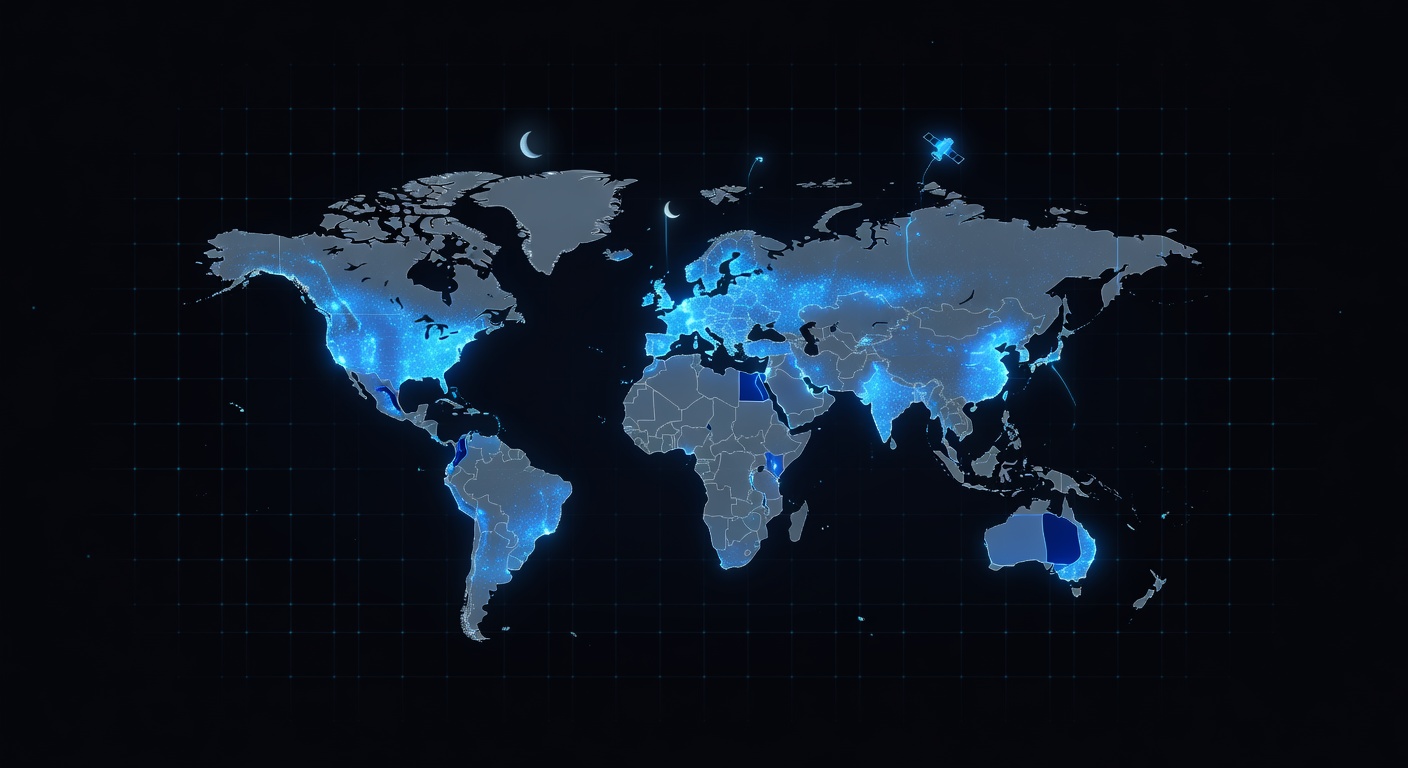
The Paradox of Our Glowing Planet
You'd think that if Earth is getting brighter at night overall, that would mean every corner of the globe is turning up the lights. But here's where it gets interesting: the real picture is way more complicated than that. Researchers using satellite data from 2014 to 2022 discovered something surprising—while the world is getting brighter by about 2% each year, this growth is wildly uneven. Some places are blazing up like never before, while others are deliberately switching things off.
Think of it like this: imagine a party where some guests keep turning up the music while others are quietly asking for it to be turned down. That's essentially what's happening across our planet right now.
The Winners and Losers in the Lighting Game
The biggest changes are happening in countries experiencing rapid urban growth. China and India saw dramatic increases in nighttime brightness during the study period, which makes sense—massive cities are being built, roads are being lit, and more people are moving to urban areas. These regions account for most of the global increase in artificial light.
But here's the twist: industrialized nations like many in Europe are actually going in the opposite direction. Why? Two main reasons. First, LED technology is becoming standard, which uses way less electricity to produce the same amount of light. Second, cities are getting serious about light pollution. Some European cities are turning off streetlights in the middle of the night or switching to dimmer lighting when foot traffic dies down.
When War and Policy Turn Off the Lights
Not all changes happen gradually. Ukraine experienced a shocking drop in nighttime lighting following the Russian invasion—a dramatic and tragic shift captured right there in the satellite data. It's sobering to see conflict literally reflected as missing light from above.
On a less tragic but equally deliberate note, France reduced its nighttime brightness by 33% by implementing policies to turn off city lights after midnight. Cities like this are treating light pollution seriously—protecting both the environment and saving energy at the same time.
Germany's situation is particularly fascinating. While the country's overall light emissions stayed roughly the same, different regions went different directions. Some areas lit up by 8.9%, while others dimmed by 9.2%. It's like a patchwork quilt of lighting choices.
How We're Actually Measuring All This
Here's the technical bit that matters: scientists are getting much better at measuring this stuff. They're using satellites called VIIRS (that's the Visible Infrared Imaging Radiometer Suite, but you can just call it the night-light detector) that take images after midnight. These satellites scan nearly the entire planet every night, and each image shows details about 0.5 square kilometers—that's roughly the size of 70 football fields.
The clever part? Researchers now use full-resolution data instead of just monthly or yearly averages. This lets them spot short-term changes and localized patterns that would've been invisible before. They've also developed better algorithms that account for the angle at which satellites are viewing different areas. A residential neighborhood looks different when seen from an angle versus straight overhead, and the new analysis accounts for this.
The researchers also had to be careful to exclude natural light sources like wildfires and auroras, which the satellites can detect but aren't relevant to measuring human artificial lighting.
Why Should You Care About Nighttime Brightness?
This might seem like a "neat data point" kind of thing, but it actually matters in real ways. Artificial lighting uses huge amounts of electricity—it's one of the major energy consumers after dark. More light means more electricity consumption, which means more carbon emissions (unless that light is coming from renewable sources).
There's also the environmental impact. Excessive artificial light disrupts ecosystems. Birds get confused during migration, insects are drawn to lights and die in massive numbers, and animals' natural behaviors get thrown off. Light pollution is a real problem that scientists have been warning about for years.
The Future: Europe Wants Its Own Night-Watching Satellite
Here's something interesting: the United States and China each have multiple satellites dedicated to watching nighttime light, but Europe doesn't have one designed specifically for this purpose. That's about to change. Christopher Kyba, who led this research, is spearheading efforts to develop a new European satellite through the European Space Agency's "Earth Explorer 13" mission.
The new satellite would detect much fainter light sources and provide higher resolution imagery, which means way less uncertainty about how global lighting is actually changing. It's the kind of specialized tool that could give us much clearer answers about whether our efforts to reduce light pollution are actually working.
The Bottom Line
Our planet is getting brighter at night, but the story is beautifully complex. We're seeing rapid growth in some parts of the world, deliberate reductions in others, and significant regional variations driven by policy, technology, and yes, sometimes tragic circumstances. As we grapple with climate change and environmental protection, understanding our relationship with artificial light is becoming increasingly important.
The satellites watching our nighttime glow are giving us a perspective that's literally impossible to see from the ground—and that perspective is helping us make smarter choices about how we light our world.