
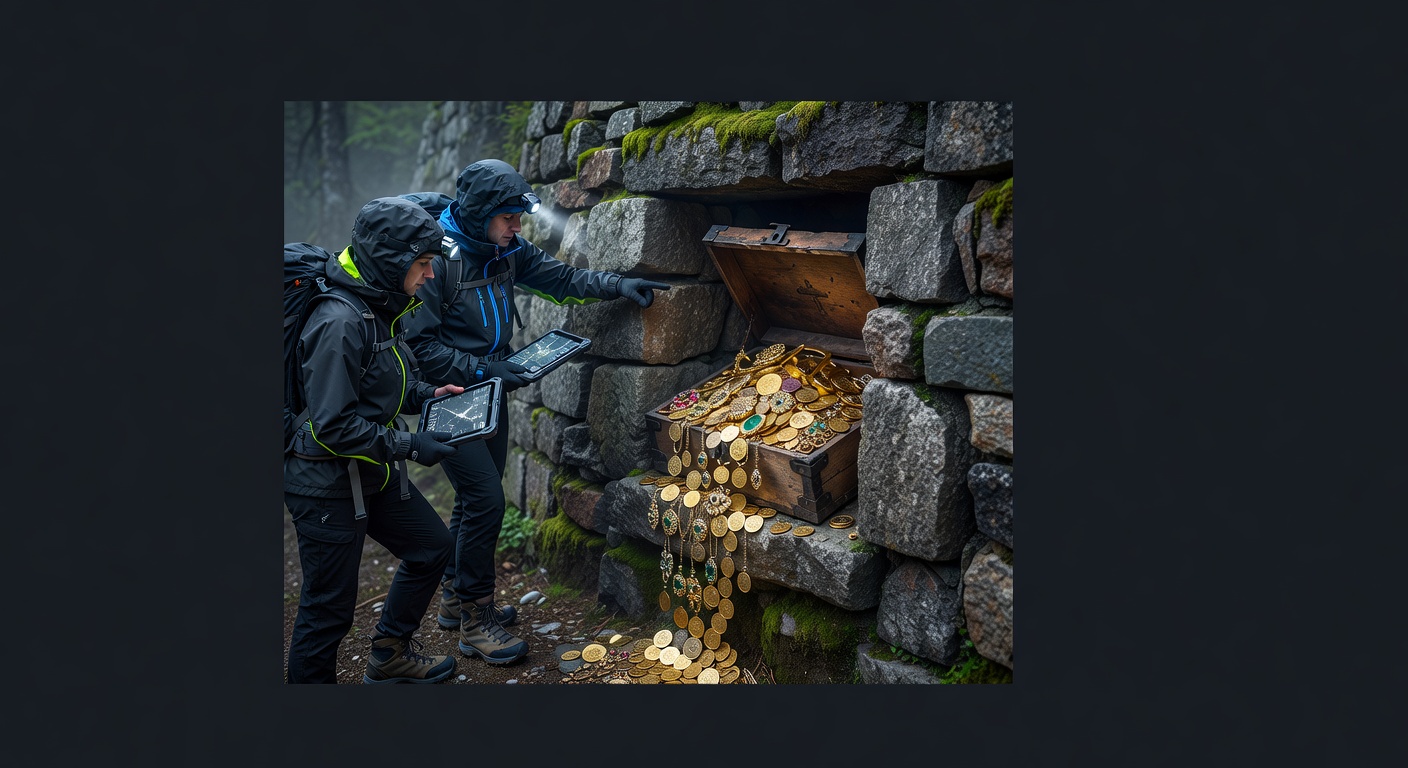
When a Regular Hike Turns Into Archaeology Gold
Imagine you're out for a pleasant hike in the Krkonoše Mountains (also called the Giant Mountains) in the Czech Republic, enjoying some fresh air and nature, when something catches your eye—a small aluminum can sticking out from a stone wall. Most people would walk right past it. These two hikers decided to open it.
What they found inside would change their lives. Hundreds of gold coins. Actual, real gold coins. I'm talking 598 of them, stacked in 11 neat piles wrapped in black fabric. And if that wasn't enough, they discovered an iron box just a few feet away filled with cigarette cases, jewelry, bracelets, and other valuables—all made from precious metals. These hikers essentially won the lottery without buying a ticket.
The Numbers Are Seriously Impressive
Let's talk about what they actually found, because the details are wild. The total haul weighed about 15 pounds and is valued at over $330,000. But here's where it gets even more interesting: the museum experts who analyzed it said the historical value is basically priceless.
The coins? They're from everywhere. France, Turkey, Belgium, Romania, Italy, Russia, Austria-Hungary—we're talking about a genuinely international collection. And they all date back to between 1808 and 1915. Some of the Austria-Hungary coins have a special composition that was only used until the 1930s, which gives us some clues about timing, but honestly, figuring out the full story is like solving a 100-year-old puzzle with half the pieces missing.
So... Who Put This There and Why?
This is where the mystery gets really juicy. Historians and museum experts have some pretty compelling theories, but nothing concrete.
The leading theory? Someone was trying to protect their wealth during World War II. The Czech Republic was annexed by Nazi Germany, and this stone wall hideaway was created right around that turbulent time. Maybe a Czech family buried their life savings. Maybe German citizens, fearful of expulsion after the war, hid their fortune before fleeing. Maybe it was even Jewish gold hidden during some of the darkest days of the Holocaust.
Museum director Petr Grulich actually summed it up perfectly when he said, "It is hard to say whether it was Czech, German, or Jewish gold." The truth is, we might never know for sure. The coins are from so many different countries and time periods that tracking their exact journey to that stone wall is nearly impossible.
A Discovery That Makes You Think
What fascinates me most about this story isn't just the monetary value—it's the human story behind it. Someone took the time to carefully wrap those coins in black fabric, stack them neatly, and hide them away with the hope of coming back for them someday. They probably never returned. Maybe they couldn't. Maybe something happened to them during the war. Maybe they thought they were being smart, but life had other plans.
Miroslav Novak, head of the archaeological department at the Museum of Eastern Bohemia, explained that hiding valuables this way has been common practice since prehistoric times. In uncertain moments, people have always buried their treasures. But what makes this find unique is the sheer weight of precious metal and the mystery surrounding it.
What Happens Now?
The hikers who found this treasure definitely earned some good karma. They're getting a finder's fee of 10 percent, which is a nice chunk of change for doing the right thing and turning it over to the museum instead of, well, not doing that.
The museum plans to display the collection to the public, and honestly, I'd love to see it. There's something magical about standing in front of an object and knowing it survived a century hidden in a wall, waiting for someone to stumble upon it. It's a tangible piece of history—a window into someone's fears, hopes, and desperation from nearly 100 years ago.
When Novak first saw the contents of that aluminum can, he said his jaw literally dropped. I get it. Some discoveries remind us that real life can be just as dramatic as any adventure movie—you just have to know where to look (or in this case, stumble upon it while hiking).
The forest kept its secret for almost 100 years. Pretty amazing that two random hikers got to be the ones to finally reveal it.