
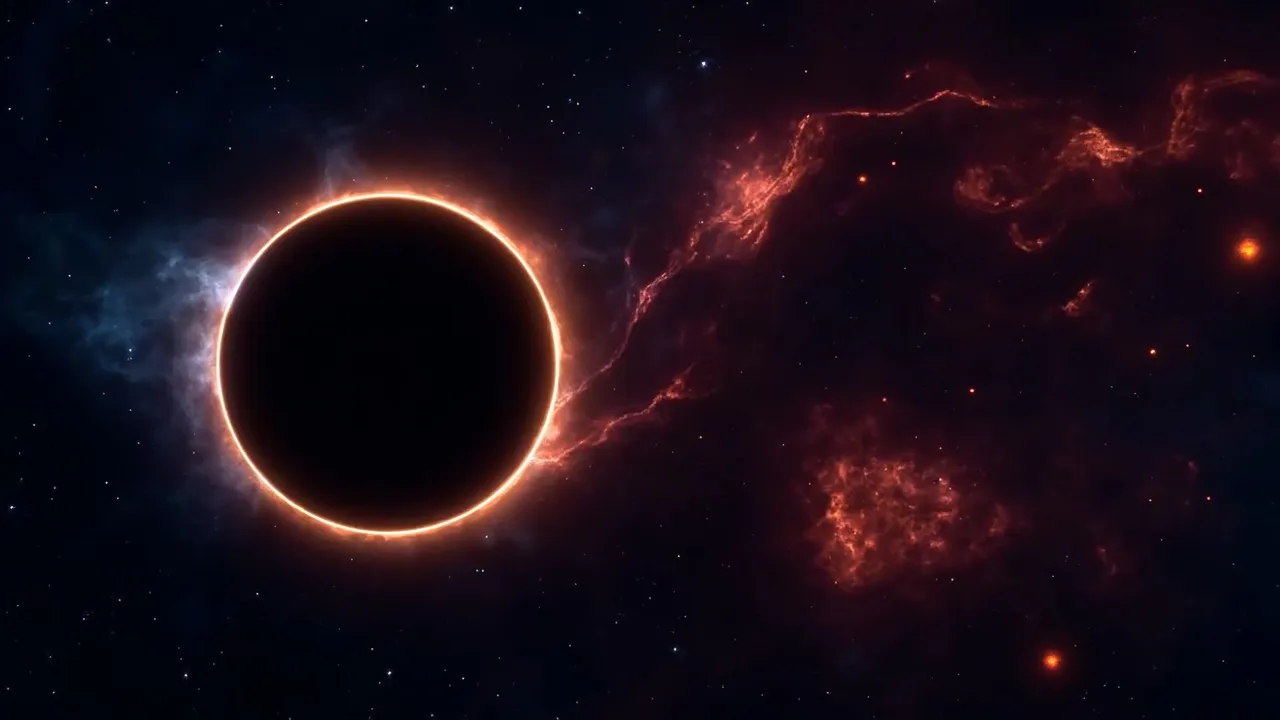
The Case of the Missing Black Hole
Okay, picture this: You're an astronomer, and you're convinced that supermassive black holes are like responsible adults — they stay put at the center of their galaxies, doing... black hole stuff. And then someone says, "Actually, some of them just wander off."
That's basically what happened recently, and honestly? I find it delightful.
A team from the University of Maryland just announced they've discovered a dormant supermassive black hole hanging out about 30,000 light-years from its galaxy's center. For context, that's roughly the distance from Earth to the center of the Milky Way. Except this isn't our black hole misbehaving — it's one that seems to have wandered away from home and is now just... floating in the cosmic suburbs.
How Do You Find Something That's Basically Invisible?
Here's the thing about dormant black holes: they're not doing much. They're not actively gobbling up matter, they're not shooting out jets of energy, they're just... there. Sitting quietly. Which makes them incredibly hard to spot.
So how did these researchers find this one?
The short answer: AI saved the day.
The team used the Zwicky Transient Facility, which basically stares at the entire northern sky every two days and picks up on anything that changes. We're talking hundreds of thousands of events every single night. No human could possibly look at all of that.
So they trained an AI to look for a very specific pattern — the signature of a tidal disruption event. That's what happens when a black hole gets hungry and tears a passing star apart. It creates a brilliant flare of light that's briefly visible across the universe.
They started running the program in August 2025. Three months later — boom — they found one. Way out in the galactic outskirts, far from any galaxy's center.
"I remember the moment we discovered it very clearly," said researcher Robert David Stein. "We dropped everything and started triggering all kinds of other instruments. We weren't really sure we would be successful so quickly, so it's amazing that we found one so fast."
Same, honestly. I'd be texting everyone too.
The Plot Thickens: Where's Its Galaxy?
But here's what's really wild. When scientists looked at the region around this black hole, they couldn't find a visible galaxy. It seems to be floating out there, all alone, with its mass comparable to the black hole at the center of our own Milky Way.
"There's should be a Milky Way-like object around it — and that's definitely not the case," said Professor Sylvain Veilleux.
Which raises the question: what happened to its home?
The leading theory involves galactic mergers and chaos. Remember, galaxies collide all the time. When they do, things get messy. One possibility is that this black hole once belonged to a smaller galaxy that got absorbed by a larger one. Over time, the bigger galaxy stripped away most of the smaller one's stars, leaving just the dense core and its black hole behind.
Another idea is even more chaotic: maybe three black holes got involved in some kind of gravitational dance, and the smallest one got kicked out entirely.
Either way, this is the kind of story that makes you appreciate how dynamic and sometimes violent the universe actually is.
Why Should You Care?
Here's the bigger picture: most black holes in the universe are probably dormant, just like this one. We've mostly found the active ones because, well, active things are easier to see. But if wandering black holes are common, it means there's a whole population of these objects we've been completely missing.
This discovery opens up an entirely new way of looking at how galaxies and their black holes evolve together. It suggests the history of our universe is even more complex and eventful than we imagined — full of cosmic mergers, ejections, and objects that just... went their own way.
And honestly? I love that an AI helped us find it. We built these tools to help us process the overwhelming amount of data our telescopes collect, and they're already changing what we can discover.
So the next time you hear about a supermassive black hole, don't assume it's sitting peacefully at the center of everything. Some of them, it turns out, are wanderers.
And now we know to look for them.
Source: ScienceDaily — "A star's violent death exposed a hidden supermassive black hole" https://www.sciencedaily.com/releases/2026/08/260805082457.htm