
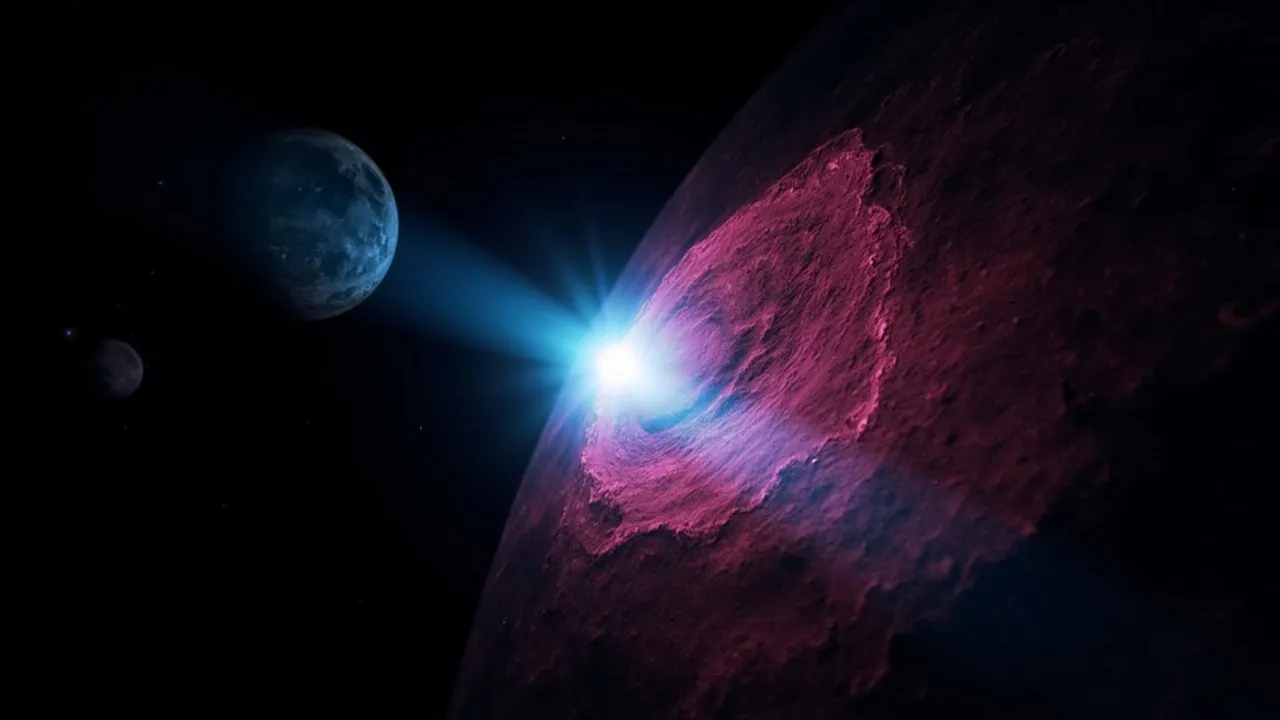
So here's a fun thought for your next dinner party conversation starter: somewhere on the Moon, there's a brand-new hole. And it's a big one.
NASA's Lunar Reconnaissance Orbiter (LRO) recently discovered the largest fresh impact crater ever found forming anywhere in our solar system. The crater — now officially named McGetchin, after a pioneering lunar scientist — stretches a whopping 728 feet across. That's roughly the length of two football fields lined up end to end. And at 141 feet deep? You could drop three yellow school buses in there, stacked vertically, and still have room to spare.
Talk about a cosmic pothole.
The Accidental Discovery
What makes this story even cooler is how scientists found it. Robert Wagner, an image-processing specialist who works with the LRO camera system, was just doing his job — scrolling through routine lunar maps when something caught his eye. A bright patch surrounded by a dark halo. That pattern, it turns out, is a telltale sign that something has recently disturbed the surface.
"I just stopped, dropped everything, and started looking into what that spot was," Wagner said.
Can you imagine the moment? Just casually checking data, then suddenly realizing you've spotted something nobody has ever seen before. That's the kind of stuff scientists' dreams are made of.
The culprit? An asteroid or comet roughly the size of a three- to six-story building that decided the Moon would make a lovely target sometime between April 11 and May 22, 2024. The impact carved out this enormous crater in what was probably a split second of absolute violence.
The Moon Gets Pummeled — A Lot
Now, before you start worrying, this kind of thing is way more common than you might think. The Moon has been getting hammered by space rocks for billions of years, and it's not slowing down.
Here's what's wild: since the LRO started orbiting the Moon over 17 years ago, scientists have identified more than 1,000 new impact craters. Over 100,000 other surface changes have been recorded too — things like debris scattered from impacts or the aftermath of those collisions.
Unlike Earth, the Moon doesn't have a protective atmosphere to burn up incoming objects. Everything just comes straight down. Most of these impacts are tiny — the smallest craters scientists can spot are about 30 feet across, roughly the length of a three-story building lying on its side. And impacts of that size happen about 140 times every single year.
So the Moon is basically collecting battle scars all the time. We just usually can't see them unless we're looking really, really carefully.
Wait, There's a Cold Spot?
Here's where things get even more interesting. When researchers followed up on McGetchin crater, they used another instrument on the LRO called Diviner to examine the area around it. What they found was unexpected.
The region surrounding the crater — roughly 4 miles wide — is about 16 degrees Fahrenheit colder at night than the surrounding terrain.
Four miles! That's not just the crater itself. The impact actually changed the thermal properties of the ground far beyond the hole it created.
Scientists think this happens because the impact churned up and loosened the lunar soil, known as regolith. Loose, less-dense material doesn't hold heat as well after the Sun goes down. So even months later, this area is still radiating less warmth than it should.
This is actually pretty important for future Moon missions. If you're planning to send rovers or set up bases, understanding these kinds of surface changes matters. The texture and density of the soil affects how vehicles drive, how equipment sits, and potentially how structures behave. A single impact can change the game for a surprisingly large area.
Why This Matters
Here's the thing that gets me excited about this story: this discovery shows exactly why long-term lunar observation is so valuable.
The LRO has been circling the Moon continuously since 2009. Its cameras photograph the surface from about 60 miles up, building up incredibly detailed maps over thousands of orbits. By comparing these maps over time, scientists can spot changes that would be invisible if we were just taking occasional snapshots.
And as humanity pushes toward a sustained presence on the Moon — with Artemis missions and eventually permanent bases — this kind of detective work becomes more than just scientific curiosity. Understanding how the lunar surface changes helps us plan where to land, where to build, and how to stay safe.
Craters like McGetchin are rare (scientists estimate impacts this large happen only about once per century), but they're also a reminder that the Moon isn't a static museum exhibit. It's a dynamic world that's still very much alive geologically.
So next time you look up at that familiar silver sphere in the night sky, remember: it's hiding a fresh new scar that didn't exist a year ago. And thanks to some dedicated scientists with very good eyes, we actually got to see it happen.
Pretty cool, right?