
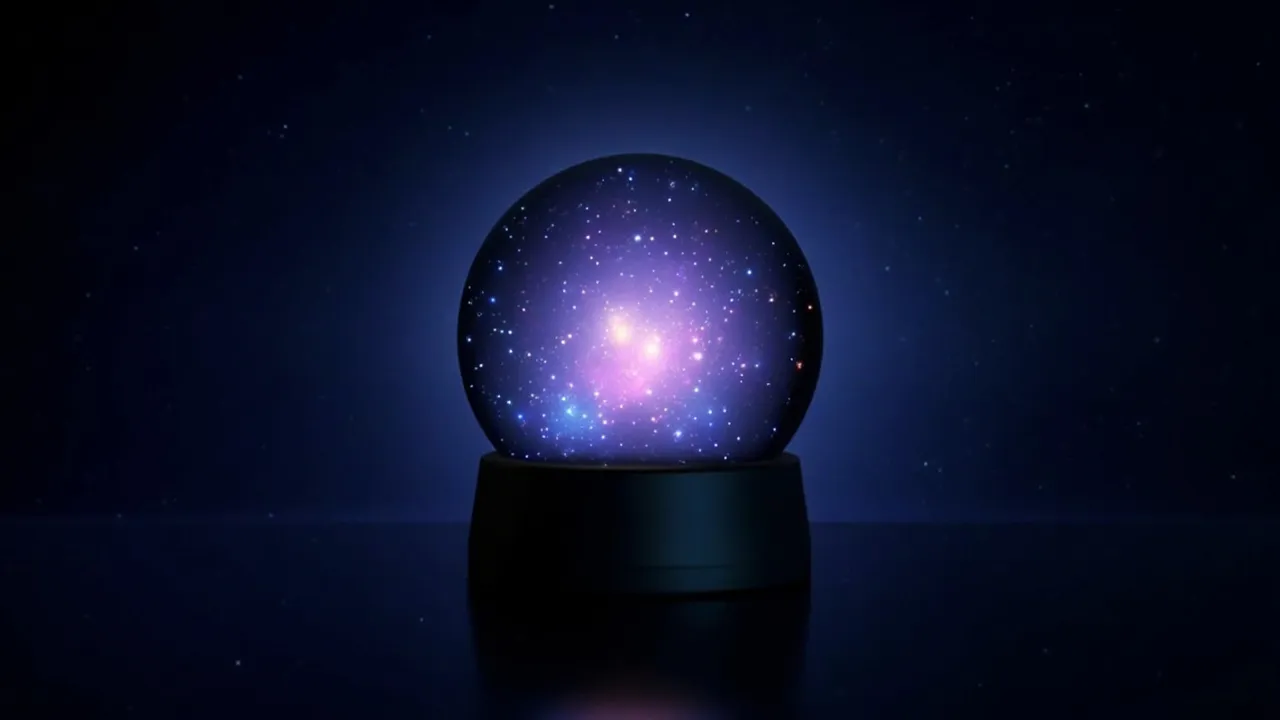
Have you ever looked up at the night sky and felt that little flutter of wonder? That feeling where you realize you're just a tiny speck floating on a rock in the middle of infinite space?
Yeah, this image does that for me.
A Star Snow Globe Floating in Space
NASA's Hubble Space Telescope recently captured Messier 3 — or M3 for short — and the photo is absolutely mesmerizing. Imagine over 500,000 stars all clustered together, glowing in shades of red, white, and blue like some kind of cosmic fireworks display frozen in time.
The image was released to celebrate America's 250th anniversary, but honestly? This beauty belongs to all of us.
What makes M3 special isn't just its size (though at one of the largest globular clusters in our Milky Way, it's no small fry). It's what this cluster represents: a snapshot of the universe's childhood.
Nature's Perfect Time Capsules
Here's what blows my mind about globular clusters like M3. All those stars — all 500,000+ of them — formed from the same cloud of gas roughly the same time. We're talking billions of years ago. These aren't young, evolving stars like the ones in the neighborhoods where our Sun lives. These are ancient celestial objects that have been hanging out together since basically forever.
Astronomers have found about 150 of these clusters orbiting the outer edges of our galaxy. They're like archaeological dig sites, preserving a record of what our Milky Way was like when it was young.
Stars That Pulse Like Cosmic Heartbeats
M3 has another trick up its sleeve — it's absolutely loaded with something called RR Lyrae variable stars. Scientists have found over 240 of them in this single cluster, which is more than any other globular cluster in our galaxy.
So what are these things? Think of them as the universe's metronomes. These stars brighten and dim in a perfectly predictable pattern, kind of like a lighthouse flashing at regular intervals.
Here's why that's incredibly useful: astronomers know exactly how bright these stars should be based on their pulse cycle. So when they look at one in the sky and compare that "true" brightness to how bright it appears from Earth, they can calculate its distance with remarkable accuracy.
It's like seeing a car's headlights at night. If you know the headlights are rated at a certain wattage, you can guess how far away the car is based on how dim they look. Same principle, just with stars.
The Rebellious Blue Stragglers
Now here's where things get really interesting. M3 also contains around 70 blue straggler stars, and honestly, the name is perfect.
These stars are blue. Like, suspiciously blue. And bright. In a cluster full of ancient, reddish stars (which, by the way, are red because they're cooler), these blue newcomers really stand out. They look like rowdy teenagers at a retirement home.
But here's the twist: they're not actually younger. They're the same age as their neighbors. So what gives?
Scientists think these troublemakers stole gas from nearby companion stars through gravitational interactions. That extra mass gave them a second wind, making them hotter, brighter, and bluer than they should naturally be. It's like they found the cosmic fountain of youth by raiding their neighbors' supplies.
M3 was actually the first place astronomers ever spotted these blue stragglers, which makes it extra special in the astronomy world.
A Possible Galactic Merger in the Past
There's even more detective work happening around M3. The cluster contains two distinct populations of stars with slightly different compositions, which has scientists wondering if this cluster might actually be the product of two globular clusters that merged billions of years ago.
The theory goes like this: those original clusters might have belonged to a dwarf galaxy that got absorbed by the Milky Way. When that smaller galaxy was swallowed up, the two clusters merged into what we now see as M3 — a potential relic of an ancient galactic encounter.
How cool is that? We're literally looking at evidence of cosmic collisions that happened billions of years before Earth even existed.
The Color Code of Starlight
One thing I love about this image is that the colors aren't just for show. In Hubble's photos, blue represents shorter wavelengths of visible light, while red corresponds to longer wavelengths. Scientists assign these colors during image processing, but here's the beautiful part: a star's color actually tells us about its temperature.
Hot stars burn blue. Cool stars burn red. So when you're looking at this image, you're essentially looking at a temperature map of a 500,000-star community, with the hot-heads glowing blue and the mellow ones glowing red.
Why This Matters
This image is part of a larger Hubble project surveying roughly half of the Milky Way's known globular clusters. The goal isn't just to collect pretty pictures (though I'm certainly not complaining). By studying these ancient stellar systems, astronomers hope to piece together how our entire galaxy formed and evolved over billions of years.
After more than 30 years of service, Hubble is still going strong and working alongside newer telescopes like the James Webb Space Telescope. Together, these observatories keep revealing new details about our universe and helping us understand our place in it.
The Takeaway
Every time I see images like this, I'm reminded of something important. We're not just observers of this universe — we're part of it. Those 500,000 stars in M3 have been shining for billions of years, and now their light is landing on our telescopes, on our screens, in our hearts.
It's a reminder that space isn't just "out there." It's everywhere. It's ancient. And it's absolutely magnificent.
So next time you're feeling small or insignificant, remember: there's a cosmic snow globe floating out there with half a million stars in it, and you get to see what it looks like. That's pretty remarkable if you ask me.