
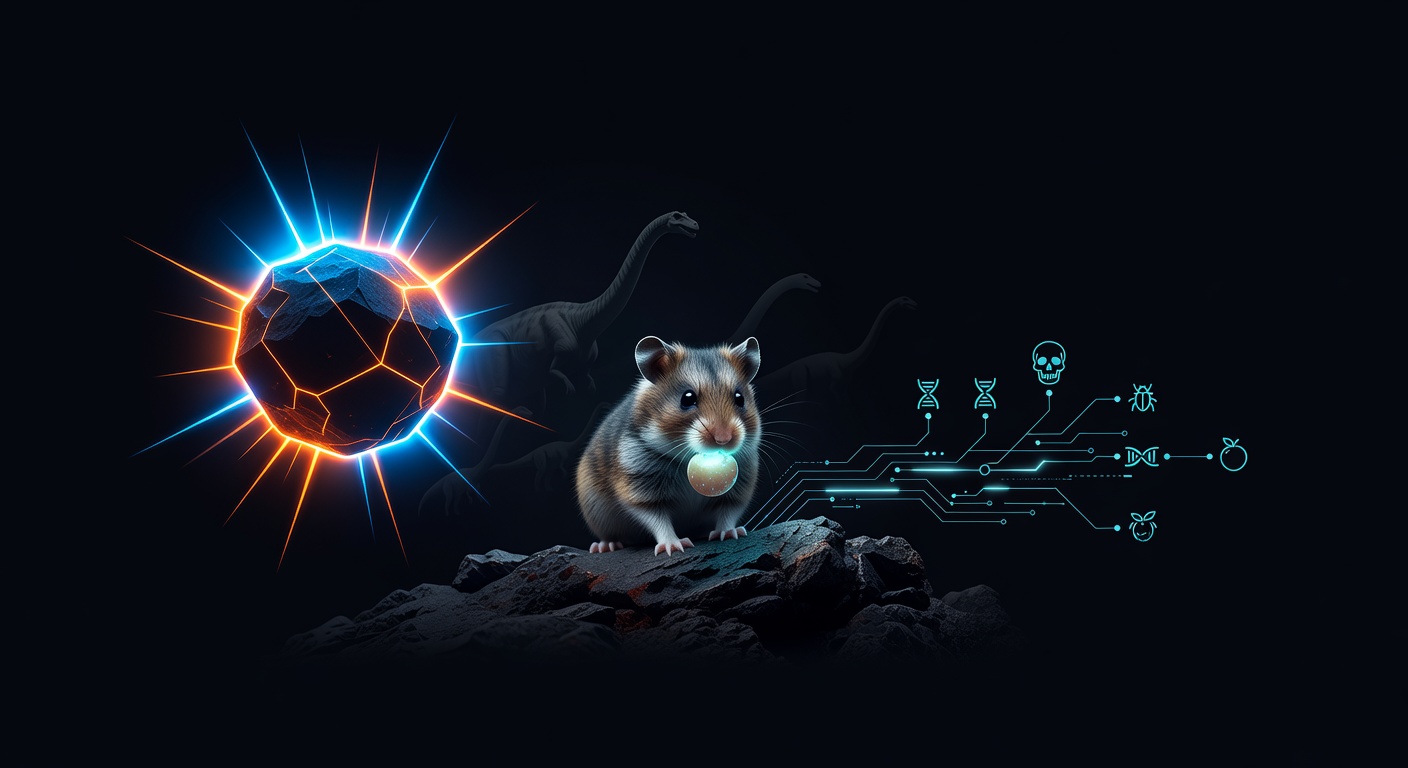
The Underdog That Changed Everything
Picture this: it's the Late Cretaceous period, dinosaurs are absolutely dominating the planet, and somewhere in what's now Mexico, a creature about the size of your hand is just... existing. No one's paying attention to it. It's not scary, it's not impressive by dinosaur standards. It's basically the wallflower at the ultimate apocalypse party.
But here's where it gets wild: when that massive asteroid slammed into Earth 66 million years ago and took out most of the dinosaurs, this little guy and its relatives made it through. They survived. And over millions of years, their descendants evolved into pretty much every mammal we see today—including us.
Meet Cimolodon Desosai: Nature's Underdog
Researchers at the University of Washington just identified a new species of this ancient survivor, and they're calling it Cimolodon desosai. The specimen is about 75 million years old and roughly the size of a golden hamster (so basically adorable, even as a fossil).
From what scientists can tell, this little guy was kind of the definition of flexible. It scampered around on the ground, climbed trees, and had what we'd call "omnivore mode" activated—munching on fruits and insects depending on what was available. That flexibility? That's exactly the kind of trait that helps you survive when the world goes to hell.
A Lucky Find Changes Everything
Here's something cool: most fossils from this era are pretty disappointing. You find a tooth. Maybe another tooth. That's it. You're basically working with dental records from millions of years ago.
But when researchers discovered Cimolodon desosai in 2009, they hit the paleontology jackpot. A field assistant named Michael de Sosa spotted just a tiny tooth sticking out of a rock crack in Baja California. What could've been a routine "yep, that's a tooth" discovery turned into something special. When they carefully extracted the specimen, they found teeth, a complete skull, jaws, and even some skeletal pieces like a femur and ulna.
This is huge because it meant scientists could actually figure out how big the animal was, how it probably moved, and what kind of environment it lived in. You can't do any of that with just a molar.
Technology Helps Us See the Past
To properly analyze the fossil, the team used some seriously high-tech imaging—specifically something called micro-CT scanning, which is basically a super-detailed 3D X-ray machine. They then compared the teeth with other Cimolodon species to confirm this was genuinely a new species.
It's fascinating how much detective work goes into this. Scientists are essentially playing paleontology detective, using fossils like puzzle pieces to understand an entire world we'll never see.
A Beautiful Way to Remember
Here's the touching part: the species was named Cimolodon desosai to honor Michael de Sosa, the field assistant who spotted it. De Sosa tragically passed away while the research team was still studying the fossil, but his legacy is now literally part of science. His name is permanently attached to this discovery—a little creature that survived the end of the world.
Why This Actually Matters
So why should you care about a hamster-sized extinct mammal? Because understanding how these creatures survived teaches us something fundamental about life's resilience. The dinosaurs—massive, powerful, seemingly invincible—couldn't adapt. But these tiny, omnivorous, adaptable mammals? They rolled with the punches.
Their survival strategy wasn't about being the biggest or the strongest. It was about being flexible enough to eat whatever was available, small enough to hide and survive on less food, and intelligent enough to exploit different environments. Those same traits that saved them 66 million years ago? They're still valuable survival skills today.
Plus, every mammal you see—from blue whales to chimpanzees to your pet dog—owes its existence to tiny creatures like Cimolodon desosai that refused to give up when everything fell apart.
Not bad for a hamster-sized nobody, right?