
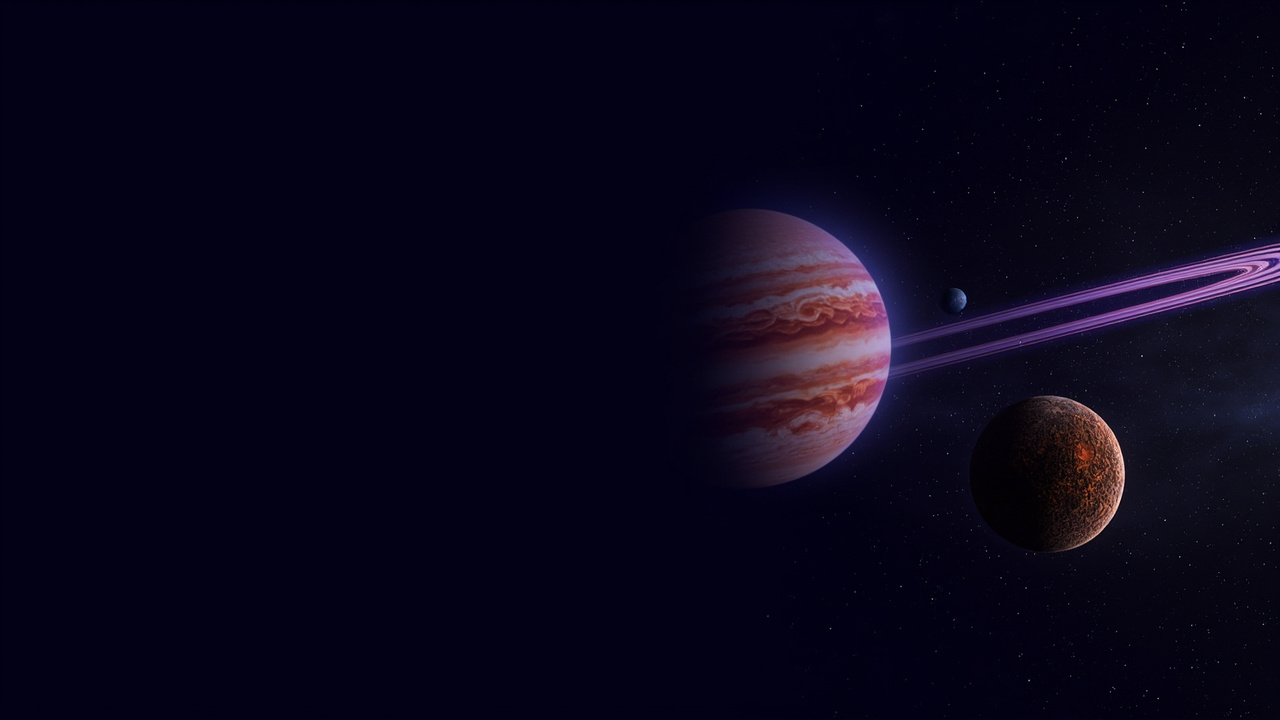
The Solar System's Hidden Assembly Line
Imagine looking back 4.6 billion years and seeing our solar system as a cosmic construction site. Picture a massive, swirling disk of gas and dust surrounding a young Sun. Tiny specks of material are constantly bumping into each other, sticking together, and gradually building up into bigger and bigger chunks. Eventually, these chunks become planets, asteroids, and all the rocky bodies we see today.
Sounds simple, right? Well, here's where it gets interesting: it wasn't simple at all.
The Mystery Nobody Could Quite Solve
For years, scientists knew that planets formed from this "protoplanetary disk," but the details were fuzzy. Different regions of the early solar system had completely different environments. Some areas were hot, some were cold, some had more material than others. So how did all these different types of rocky bodies form in the first place?
That's the question a team from Germany's Max Planck Institute decided to tackle. And their answer is genuinely mind-blowing: there was basically a "planet factory" operating just beyond Jupiter's orbit, and it was incredibly productive for millions of years.
Jupiter's Accidental Dust Trap
Here's where Jupiter comes in, and this is the clever part. As Jupiter was gathering up material around its own orbit, it essentially created a cosmic vacuum. The gas and dust nearby got swept up or pushed around, leaving a gap. But here's the thing — right at the edge of that gap, where the planet's gravity influence was strongest, something interesting happened.
The pressure of the remaining gas actually increased just beyond Jupiter's orbit. Think of it like water backing up behind a dam. This high-pressure region acted like a cosmic trap, collecting dust and pebbles like a magnet. All this material piling up in one place? Perfect conditions for building planetesimals (the rocky building blocks of planets).
Scientists had theorized about these "dust traps" before, but nobody knew if they could actually keep producing different types of space rocks over long periods. This is where the simulations come in.
Computers Solving Ancient Mysteries
The research team built incredibly detailed computer models that tracked how particles behaved in the early solar system. And I mean detailed — they tracked everything from microscopic dust grain collisions all the way up to the movement of massive clumps of material across the entire disk. Some particles were fragile and dusty, while others were sturdy chunks that had formed in hotter regions closer to the Sun.
What the simulations revealed was stunning: over roughly two million years, this region just beyond Jupiter produced multiple generations of planetesimals, and each generation was different from the last.
During the first 500,000 years or so, the fragile, dusty material got used up pretty quickly. But then it built back up again. Meanwhile, Jupiter's gravity acted as a stronger barrier to the bigger, sturdier particles compared to the smaller dust grains. This created a constantly shifting balance in what kinds of material were available.
The result? Two completely different populations of planetesimals eventually formed — one made mostly of delicate material and another dominated by stronger stuff.
The Meteorite Connection: Proof in the Rocks
Here's where this gets really cool. The researchers didn't just make up a nice story and call it a day. They had actual evidence to test their ideas against: meteorites.
Meteorites are fragments of ancient space rocks that survived crashing through Earth's atmosphere and landed on our planet. Many of them are essentially time capsules from the early solar system, barely changed since they formed billions of years ago. Scientists have studied these meteorites in laboratories for decades, figuring out their ages and compositions.
One particular type called "carbonaceous chondrites" caught the team's attention. Laboratory analysis shows these meteorites formed beyond Jupiter around the same time period their simulations covered. But here's the kicker: these meteorites come in different varieties. Some are fragile and fine-grained, while others are sturdier with visible chunks of material embedded inside them.
Guess what the simulations produced? The exact same two types of compositions, in the exact same proportions, for the exact same reasons.
"For the first time, we have succeeded in accurately reproducing the results of laboratory studies of meteorites using computer simulations of the early Solar System," said Thorsten Kleine, the director of the Max Planck Institute. That's not just a small thing — that's validation that their model actually explains how the real solar system worked.
What This Means for Understanding Our Cosmic Origins
So why does any of this matter? Because understanding where planets come from helps us understand our own planet's origins. It shows us that the early solar system wasn't a random mess but rather a system with actual mechanisms that produced diversity in a predictable way.
It also helps us understand exoplanetary systems around other stars. When we look at other star systems with planets in weird configurations, we can use what we've learned about Jupiter's role in our own backyard to figure out what might have happened there.
Plus, there's something genuinely awe-inspiring about realizing that billions of years ago, your solar system had a literal "factory" churning out the building blocks of worlds, all operating from a single ring-shaped region next to the biggest planet in the neighborhood.
The early solar system was chaotic, sure, but it wasn't random. It was more like a finely-tuned (if somewhat chaotic) machine.
Source: https://www.sciencedirect.com/science/article/pii/S0019103526000455