
🌟 The Universe's Most Beautiful Baby Factory
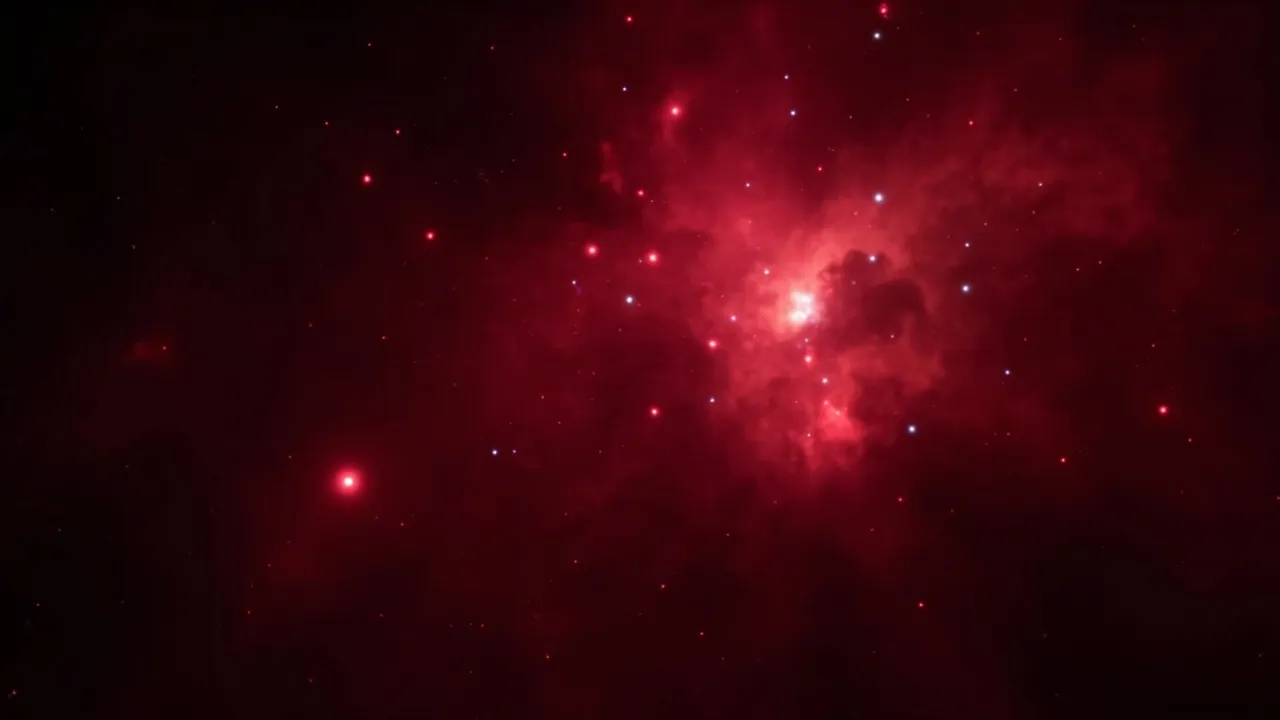
Okay, I have to be honest with you — when I first saw this image from Hubble, I just sat there staring at my screen for a while. It genuinely looks like the universe put on a show just for us. Thousands of brilliant blue and white stars are scattered across glowing crimson clouds of hydrogen gas, and those aren't just pretty colors — they're clues about what's actually happening in this cosmic neighborhood.
This is LH 95, a massive star-forming region hanging out in the Large Magellanic Cloud, which is basically a dwarf galaxy that orbits our own Milky Way. Think of it as a neighboring apartment complex where stars are being born around the clock.
The Heavy Hitters of the Neighborhood
Here's what really caught my attention: those brightest blue stars in the image? They're the biggest troublemakers in LH 95. Each one packs at least three times the mass of our Sun, and they're not exactly quiet neighbors. These massive stars are blasting out intense ultraviolet radiation and powerful stellar winds that heat up the surrounding gas and slowly sculpt the nebula into those wild, dramatic shapes we see.
It's kind of like how some people just naturally command attention when they walk into a room — except these stars are reshaping their entire environment through sheer energy output.
You might notice those dark, wispy filaments cutting through the red clouds. Those are lanes of dust so thick that even all that radiation and those powerful winds can't wear them away. They're like cosmic speed bumps in this energetic neighborhood.
Why the Colors Tell a Story
Now, here's something that blew my mind when I learned about it: those gorgeous colors in the Hubble image aren't exactly what your eyes would see if you were floating around in there with a front-row seat. Scientists assigned colors to represent different wavelengths of light — blue for shorter wavelengths, red for longer ones. The brilliant crimson glow comes from something called hydrogen alpha emissions, which is basically a neon sign that says "new stars are actively forming here."
It's like the universe is leaving us breadcrumbs, and we're getting better and better at following the trail.
Thousands of Stars Still Growing Up
Here's where it gets really exciting. Hubble's observations revealed approximately 2,500 stars in LH 95 that are still in their teenage years — not quite adults, but definitely not babies anymore either. These are what scientists call "pre-main-sequence stars," and they're basically in that awkward growing phase where they're still pulling in material from the disks of gas and dust that formed them.
They're like cosmic teenagers, still figuring out their final form. Eventually, their cores will get hot and dense enough to start hydrogen fusion, and boom — they'll officially be grown-up stars.
A Growth Process That Takes Millions of Years
One of the most interesting discoveries from studying this region is that stars grow more slowly than scientists once thought. The observations showed that as a young star ages, its rate of accretion naturally slows down, and this growth process can continue for several million years. That's a lot longer than some earlier models suggested.
It makes sense if you think about it — even cosmic teenagers need time to figure things out. These stars aren't in any rush, and honestly, neither is the universe. We're just lucky to be watching in on the process.
A Family with Generations of Stars
Here's something that really made me smile: LH 95 isn't hosting a single star-birth event. It's been creating stars over an extended period, which means multiple generations are living side by side. It's like a neighborhood where grandparents, parents, and children all coexist.
The most interesting resident? There's one superstar (literally) that's somewhere between 60 to 70 times the mass of our Sun, yet it's about one million years younger than most of its neighbors. It's like the new kid on the block who's somehow already the biggest person around. Stars this massive burn through their fuel incredibly quickly, which means they'll eventually end their lives in spectacular supernova explosions — the universe's ultimate fireworks display.
When that happens, they'll scatter heavy elements into space that will eventually become part of future generations of stars and planets. We're literally made of stuff from ancient stellar explosions, which I think is one of the most beautiful facts in all of astronomy.
Why This Place Is a Gift for Scientists
What makes LH 95 so valuable to astronomers is that it's relatively close to us AND less hidden by dust than similar star-forming regions in our own galaxy. It's like getting to watch a play from the front row with perfect visibility instead of trying to peek through a foggy window.
This clearer view means scientists can observe thousands of developing stars at different stages of evolution all within the same cosmic neighborhood. They're basically watching a time-lapse of stellar development without having to travel millions of light-years to do it.
Hubble has been doing this kind of groundbreaking work for over 30 years now, and it's not slowing down. These observations are now being complemented by the James Webb Space Telescope, which can see in infrared, giving scientists an even more complete picture. And looking ahead, the Nancy Grace Roman Space Telescope, set to launch later this year, will expand our cosmic exploration capabilities even further.
I don't know about you, but every time I see images like this, I can't help but feel a little sense of wonder. We're sitting on a small planet, looking out into the universe, and watching stars being born in clouds of glowing red gas billions of miles away. That might just be the most human thing we do.
Source: https://www.sciencedaily.com/releases/2026/07/260704232639.htm