
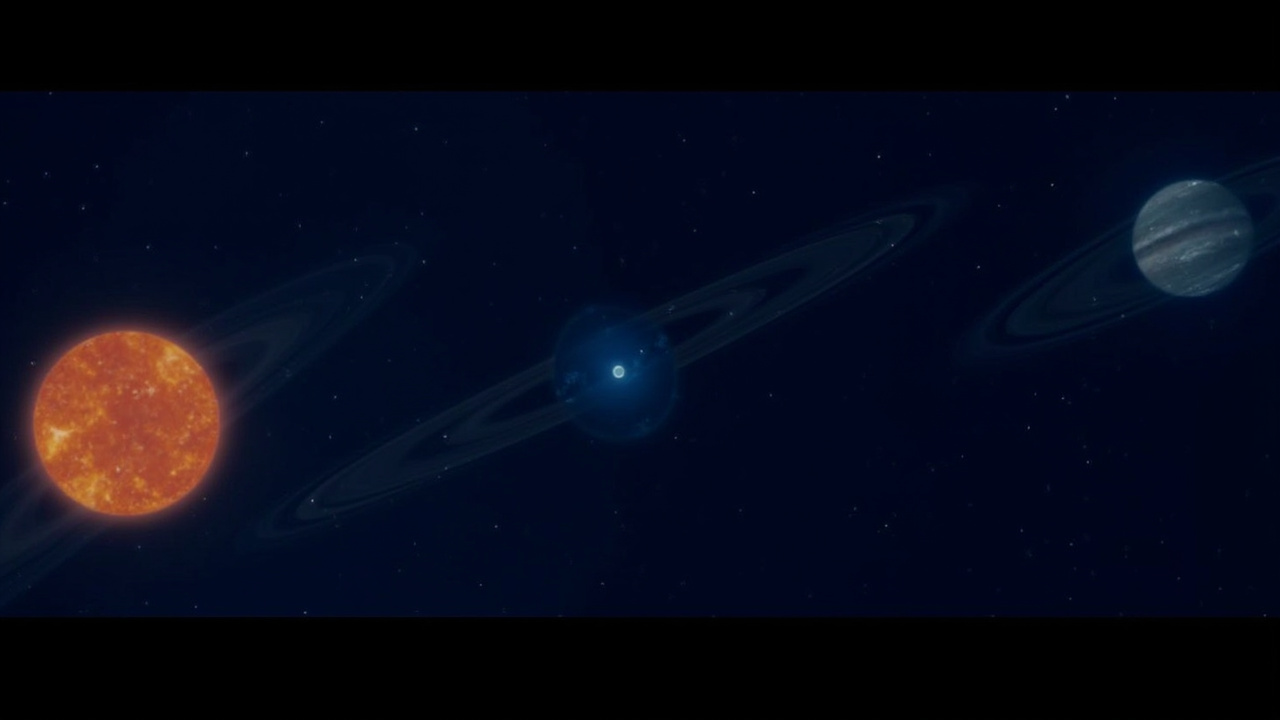
So here's something that'll blow your mind: there might be a massive planet lurking at the edge of our Solar System that nobody has ever actually seen. I know, right? It sounds like the plot of a sci-fi movie, but this is real science, and the story just got a lot more interesting.
The OG "Planet X" Hunt
Believe it or not, the idea of a hidden planet out there isn't new. Astronomers were theorizing about it before Pluto was even discovered in the 1930s. Back then, scientists noticed something weird: Uranus wasn't orbiting the Sun quite where physics said it should be. The obvious explanation? Something massive must be tugging on it from further out.
Turns out, that mystery was eventually solved in the 1990s when someone realized they'd just gotten Neptune's weight wrong. Case closed, right? Well... not quite.
Enter Planet Nine (Or Does It?)
Fast forward to 2016, and two astronomers from Caltech — Konstantin Batygin and Mike Brown — floated a new hypothesis. They weren't looking at Uranus this time. Instead, they were studying the Kuiper Belt, that giant cosmic junkyard beyond Neptune where Pluto lives, along with countless dwarf planets, asteroids, and other objects.
Here's the thing: several of these distant objects (called trans-Neptunian objects, or TNOs for short) have weird orbits. They're not moving in the nice, predictable paths you'd expect if the Sun was the only major gravitational influence out there. Brown's take from 2024? "I think it is very unlikely that P9 does not exist. There are currently no other explanations for the effects that we see."
Makes sense, right? If the Moon can orbit Earth while also orbiting the Sun, maybe something similar is happening with these Kuiper Belt objects — just on a much bigger scale.
But Then Things Got Complicated
This is where the plot thickens. In 2018, astronomers spotted 2017 OF201, a dwarf planet candidate about 700 kilometers across (Earth's about 18 times bigger). It's got a highly elliptical orbit, which could mean Planet Nine is influencing it.
But here's the twist: newer discoveries are making scientists scratch their heads. The latest is 2023 KQ14, spotted by the Subaru telescope in Hawaii. This little guy is what's called a "sednoid" — an object that spends most of its time far, far away from the Sun.
And here's the kicker: 2023 KQ14's orbit is actually pretty stable. That's a problem for the Planet Nine theory because if a massive planet was messing with sednoids, you'd expect their orbits to be more chaotic, not stable.
This is now the fourth sednoid discovered with a stable orbit. If Planet Nine exists, it might have to be lurking even farther away than we thought — maybe beyond 500 astronomical units. (For reference, Neptune is only about 30 AU from the Sun.)
So Why Haven't We Found It?
Here's the frustrating part: the outer Solar System is big. Like, incomprehensibly big. And we just haven't been watching it long enough to catch a glimpse.
Consider this: 2017 OF201 takes about 24,000 years to complete one orbit around the Sun. To really understand how gravity is affecting it, astronomers probably need to observe it for four or five orbits. Good luck with that when one orbit takes longer than human civilization has existed.
Plus, let's be real — we've only sent one spacecraft (New Horizons) out that far, and it took over a decade to get there. At the speed New Horizons travels, it would take 118 years to get far enough to potentially spot Planet Nine. We literally can't send a probe out there to look for it with current technology.
My Take on This Cosmic Whodunit
Look, I'm rooting for Planet Nine. The idea of a hidden giant planet circling the Sun from the shadows is just cool. Plus, Batygin and Brown have made a compelling case, and the gravitational weirdness of those Kuiper Belt objects isn't easy to explain away.
But science is about following the evidence, even when it disappoints you. These new sednoid discoveries don't necessarily disprove Planet Nine — they just make it harder to fit into our models. Maybe it's there, but even farther away. Maybe it's smaller than expected. Or maybe — and this is the fun option — it's not a planet at all, but something even more exotic, like a tiny black hole lurking in the darkness.
Whatever the truth is, one thing's for sure: the outer Solar System still holds plenty of secrets. And honestly? I can't wait to see what we discover next.
Source: ScienceDaily — "Planet nine mystery deepens as new discovery challenges hidden planet theory"
https://www.sciencedaily.com/releases/2026/06/260608040009.htm