
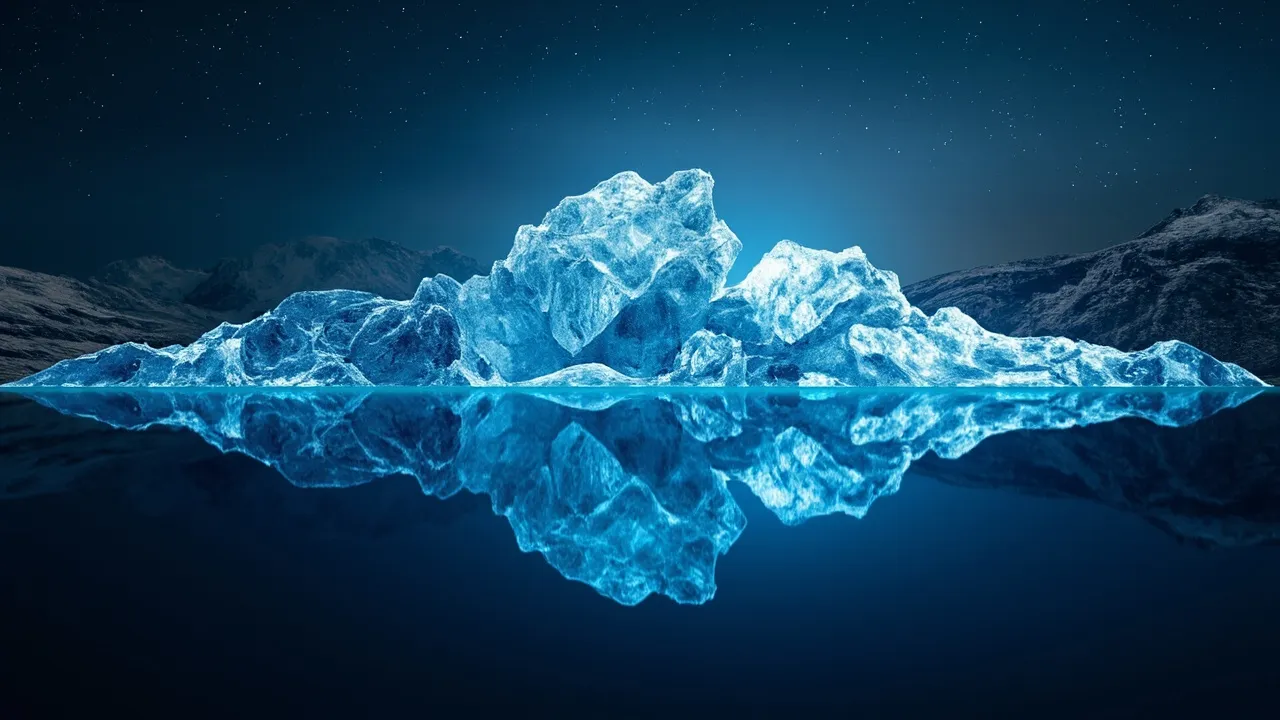
What's Hiding Under Those Rocks?
I have to share something that genuinely stopped me in my tracks. You know those stretches of loose stones and debris scattered across mountain hillsides? The kind you can walk across without a second thought?
Turns out, some of them are keeping a pretty incredible secret.
Buried deep beneath these rocky surfaces, there's often solid ice. And I'm not talking about a thin layer—I'm talking about massive quantities.
Researchers from the University of Utah recently investigated a hidden ice deposit beneath Mount Timpanogos outside Salt Lake City. What they discovered was striking.
The Numbers Are Almost Unreal
The Timpanogos Rock Glacier—I love that name, it sounds like something Gandalf would mention—stores approximately 1.5 million cubic meters of frozen water. Let me put that into perspective:
- That's equivalent to 600 Olympic swimming pools of ice
- Roughly the same volume as the Great Pyramid of Giza
- Here's the kicker: the glacier is 83% ice, with only 17% rock mixed in
"You could be walking across loose rubble and not realize there are 120 feet of ice hidden beneath your feet," noted Leif Anderson, a glaciology professor involved in the research.
One hundred twenty feet. Imagine stacking a twelve-story building vertically in ice, completely invisible unless you knew it was there.
How Did They Actually See Through the Rock?
This is the clever part. The team used a device called a gravimeter—a super-sensitive scale that picks up tiny differences in density. Rock is heavy. Ice is light. So dragging this tool across a rock glacier lets researchers map where the lighter ice sits underneath the denser rock layer.
Over six separate field visits, researcher Bronson Cvijanovich collected gravity readings at 232 locations across the glacier, building what amounts to a gravity map. After months of computer analysis and some sophisticated statistics—specifically Bayesian methods, for those keeping score—they reconstructed a 3D picture of the hidden ice.
Think of it as giving the mountain a medical scan.
These Glaciers Are Younger Than You'd Expect
Here's what really surprised me: these rock glaciers aren't remnants of the Ice Age. They actually formed after the main glaciers retreated, building up over thousands of years.
The mechanism is pretty elegant. In the Wasatch Range, the mountains are gradually eroding. Rock and debris tumble down slopes and accumulate on top of persistent snow patches. That debris layer acts as insulation, preventing the snow underneath from melting during summer months. Year after year, layer after layer, a hidden ice core develops beneath the rubble.
"In the Wasatch, the mountains are essentially burying the snow themselves, and that's what creates these rock glaciers," Anderson explained.
So the mountains are essentially manufacturing their own ice reserves. That's remarkable.
Why This Actually Matters
Here's where it gets significant. The team studied a single rock glacier, but Utah contains hundreds more. Extrapolating from the Timpanogos data, they estimated that Utah's roughly 836 rock glaciers could hold substantial amounts of frozen water.
Globally? Researchers have identified approximately 50,000 rock glaciers worldwide. Combined, they might store around 48 gigatons of water—equivalent to filling 400,000 Olympic swimming pools.
That's an enormous amount of concealed ice.
As climate change makes traditional snowpacks less dependable, these underground ice reserves could grow in importance. They represent a natural water storage system that's been there all along, quietly waiting beneath piles of ordinary-looking rocks.
The Takeaway
Next time you find yourself hiking through rocky mountain terrain, maybe take a moment to pause. That stony surface you're standing on might conceal something ancient and valuable—dozens of feet of ice that took centuries to accumulate.
It's a useful reminder that nature still holds mysteries, even in places we've walked for generations. Sometimes the most significant things are the ones we can't see right away.