
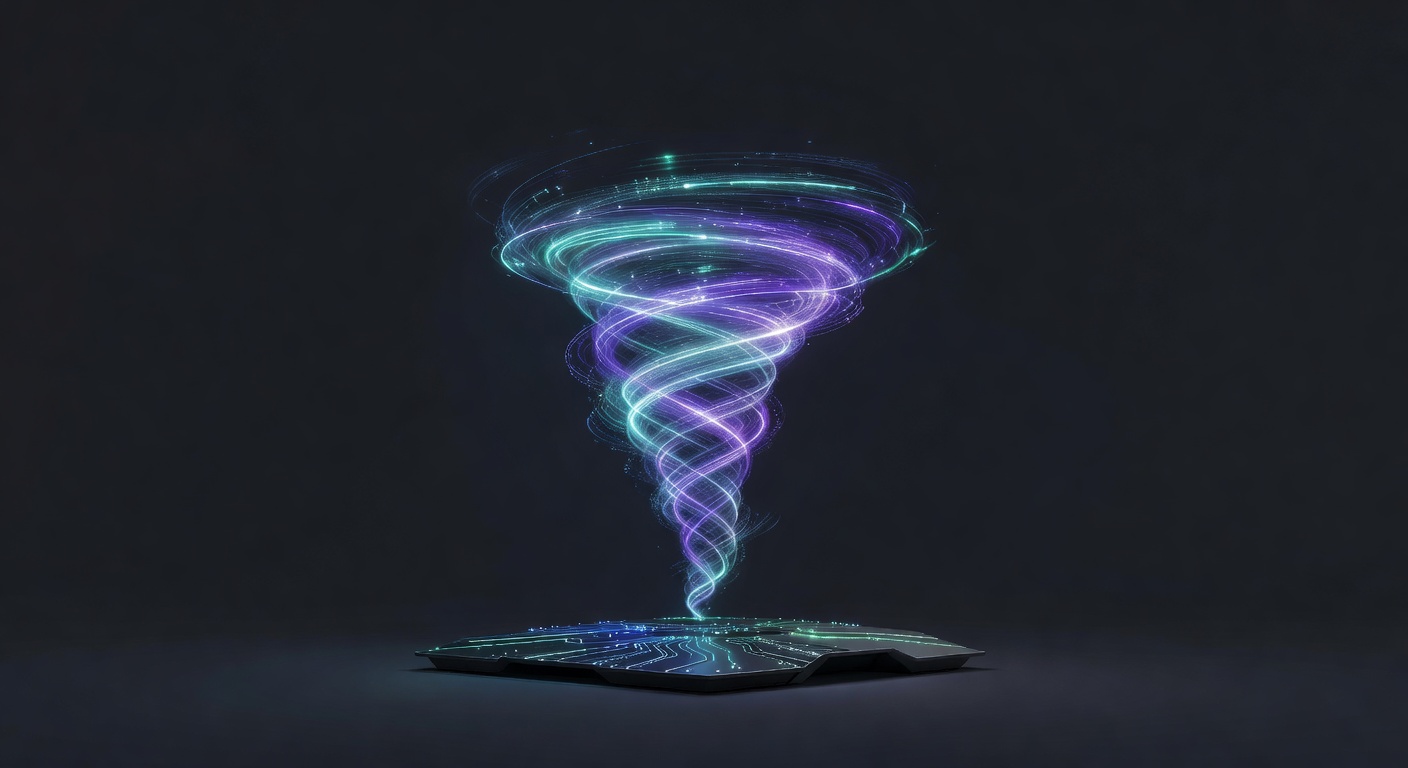
When Light Gets Dizzy: The Optical Tornado That Could Transform Technology
Okay, let me ask you something: have you ever watched a tornado on a nature documentary and thought, "I wonder if light can do that?" Well, some clever researchers apparently asked the same question—and the answer is yes.
Scientists from universities in Poland, France, and New York have literally created spinning light inside microscopic structures. Not in some massive lab with huge mirrors and lasers everywhere, but in something surprisingly elegant and small. And honestly? This could be a big deal for the future of quantum communication.
So What Exactly Is This "Optical Tornado"?
Imagine a light wave that doesn't just move forward like normal light does. Instead, it twirls around its own axis while traveling, kind of like a drill bit boring through space. The researchers call this an "optical vortex," and it's actually pretty wild.
The spinning gets even more interesting because the light's polarization—which is basically the direction it's wiggling—also rotates along with it. So you end up with light that's literally doing multiple types of twists at once. It's like the light is dancing while it moves.
Now, here's the thing: scientists already knew this was possible. The problem was that creating these vortices usually required either ridiculously complicated nanostructures or enormous lab setups that cost a fortune. That's where this breakthrough gets exciting.
The Surprisingly Simple Solution: Liquid Crystals
Instead of building something super complicated, the research team thought, "What if we use something way simpler?" And they landed on liquid crystals—the same stuff that's in some old electronic displays.
Liquid crystals are kind of magical materials. They can flow like liquids, but their molecules naturally arrange themselves in an ordered way, like they're following invisible rules. It's the best of both worlds.
Within these liquid crystals, the researchers found tiny defects called "torons." Picture a DNA helix twisted super tight, but then imagine that spiral gets bent into a ring shape—like a donut. These toroidal defects act like microscopic traps for light, catching and confining it.
The genius part? These traps were sitting there all along. The scientists just had to figure out how to use them.
Creating a Synthetic Magnetic Field for Photons
Here's where it gets a bit more technical, but stick with me—it's actually cool.
Light doesn't respond to magnetic fields the way electrons do. But the researchers found a workaround: they created what they call a "synthetic magnetic field" for light. This happens because of something called "spatially variable birefringence"—basically, different types of light polarization travel at different speeds through the liquid crystal depending on where they are.
Mathematically, this behaves exactly like a real magnetic field, even though no actual magnetic field exists. As a result, the light bends and curves in its own little orbit, just like an electron would in a real magnetic field.
To make this effect even stronger, they placed their toron inside a tiny optical cavity—basically a small mirror box that bounces light back and forth. This keeps the light trapped longer and makes the effect more dramatic. And here's the kicker: they can control all of this with an external electric voltage. Want a different size trap? Just adjust the voltage.
The Game-Changing Discovery
But the most exciting part came when the researchers tested their system. In every other known system that creates these spinning light vortices, you need a lot of energy to achieve it. The vortex only appears in "excited states"—basically, high-energy conditions.
These researchers pulled off something nobody had done before: they got the vortex to appear in the "ground state"—the lowest-energy state of the system. And this matters more than you might think.
The ground state is like the default setting. It's the state where energy naturally wants to stay because there's less energy loss. It's stable. It's comfortable.
This means light naturally "chooses" to spin like a tornado in this system because it's the easiest, most efficient way for it to exist. When the team added laser dye to test it, the spinning light didn't just twist—it lased. It became coherent light with a defined energy and direction, just like proper laser light.
Why Should You Care?
All of this might sound pretty abstract, but the implications are genuinely exciting. Structured light with orbital angular momentum is super useful for quantum communication and for manipulating tiny objects. The problem has always been that creating it required either incredibly complex setups or huge, expensive equipment.
Now we have a simple, elegant solution that works with relatively straightforward materials and can be controlled with voltage. This could make quantum communication devices smaller, cheaper, and easier to manufacture. It could make photonic devices—the technology that moves information around using light instead of electricity—way more practical.
The researchers describe their breakthrough as pulling inspiration from advanced physics theories, even mentioning that they've gotten photons to behave like quarks (subatomic particles). While I won't pretend to fully understand all the theoretical implications, the bottom line is clear: we've found a new, simpler way to manipulate light in ways that could power tomorrow's technology.
And it all started with asking whether light could spin like a tornado.
Source: https://www.sciencedaily.com/releases/2026/04/260424233215.htm