
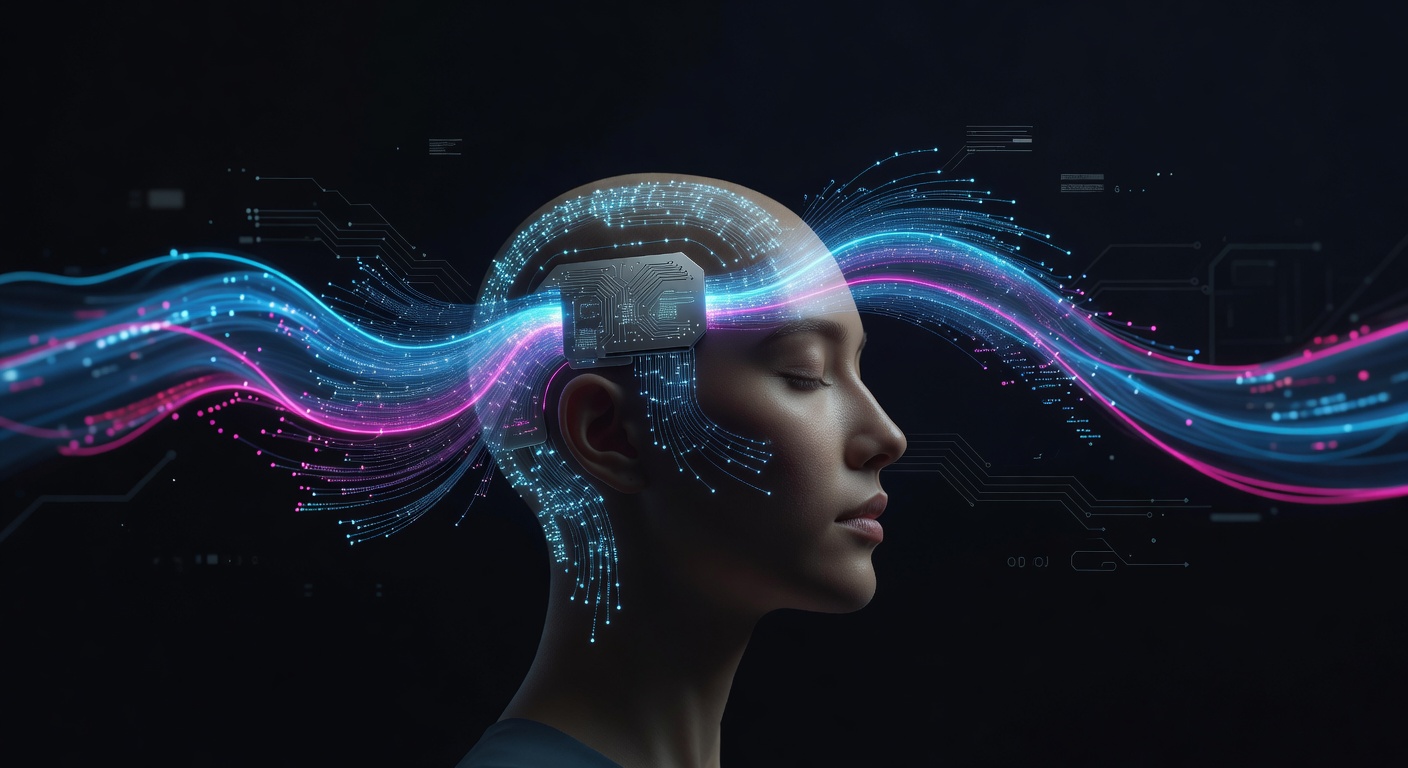
The Future is Already Here (And It's in Someone's Head)
Friends, we need to talk about something absolutely mind-blowing that's happening right now. While we're all arguing about whether AI will take our jobs, there are people walking around with computers literally plugged into their brains — and they've been doing it for years.
I'm talking about brain-computer interfaces (BCIs), and specifically the remarkable story of someone who's been living with a Synchron brain implant for half a decade. This isn't science fiction anymore. This is someone's daily reality.
What Does "Brain Implant" Actually Mean?
Let me break this down in simple terms because, honestly, when I first heard about this stuff, my brain (pun intended) went straight to cyborg territory.
A brain-computer interface is essentially a tiny device that can read the electrical signals your brain produces when you think about moving. Think of it like a really, really sophisticated translator — it takes your thoughts about movement and turns them into digital commands that can control external devices.
The Synchron system is particularly clever because it doesn't require opening up your skull. Instead, it's inserted through blood vessels (kind of like how doctors insert stents for heart procedures). The device, called a Stentrode, sits in a blood vessel near the motor cortex — the part of your brain that controls movement.
Five Years Later: The Real Talk
Here's what fascinates me about this five-year milestone: we're getting past the "wow, it works!" phase and into the "okay, what's it actually like to live with this?" territory.
From what we know about long-term BCI users, the experience is both more mundane and more profound than you might expect. On one hand, using your thoughts to control a computer eventually becomes as routine as using your hands to type. Your brain adapts, the technology becomes part of your normal workflow.
But on the other hand, imagine the psychological shift of suddenly being able to communicate or control your environment again after losing that ability. That's not something you get used to — that's life-changing every single day.
The Bigger Picture (And Why This Matters to All of Us)
What really gets me excited about these long-term success stories is what they mean for the future of treating neurological conditions. We're talking about ALS, paralysis from spinal cord injuries, stroke recovery — conditions that affect millions of people worldwide.
But here's something I think about a lot: this technology also raises fascinating questions about human enhancement. Right now, BCIs are medical devices for people who've lost normal function. But what happens when they work so well that they actually give you capabilities beyond normal human ability?
The Challenges We Don't Talk About Enough
Let's be real for a second. Living with any medical device for five years comes with challenges that don't make it into the flashy headlines.
There are practical considerations: device maintenance, software updates (yes, your brain implant might need to install updates), battery life, and the simple reality that you're dependent on technology that's still relatively new.
There are also deeper questions about privacy and security. When your thoughts can directly control digital devices, what does that mean for mental privacy? These are conversations we need to start having now, not later.
What This Means for Tomorrow
The fact that someone has successfully lived with a brain implant for five years is a huge validation of this technology's potential. It's proof that BCIs can be not just functional, but genuinely life-improving over the long term.
This paves the way for more advanced systems, better surgical techniques, and eventually (I hope) much wider access to these life-changing devices.
My Take: We're Living in the Future
I'll be honest — stories like this make me incredibly optimistic about human ingenuity and our ability to solve seemingly impossible problems. When I think about someone who couldn't move or speak being able to control computers with their thoughts... that's the kind of technology that gives me chills in the best possible way.
We're witnessing the early days of a technology that will fundamentally change how we think about disability, human capability, and the relationship between our minds and machines.
And the most amazing part? This is just the beginning.
Source: https://www.wired.com/story/synchron-brain-computer-interface-five-years-als